

Featured

Charlotte Walshe
Strategic and Impact Director, British Safety Council

Richard Blunt
Volunteer Ambassador, Mesothelioma UK
Asbestos was banned in the UK in 1999, but exposure remains a serious workplace health risk.
In this episode of Health and Safety Uncut, guest host Charlotte Walshe, British Safety Council's Strategic and Impact Director, speaks to Richard Blunt, volunteer ambassador for Mesothelioma UK.
Richard shares his family's experience of mesothelioma, explores the gaps in asbestos awareness and explains why campaigners are calling for a national asbestos strategy, including a digital register of asbestos in buildings.
Key takeaways
- Asbestos remains a serious risk. Although asbestos was banned in the UK in 1999, it is still present in many buildings. A 2024 survey found that 36% of the British public believed asbestos was a problem of the past.
- Mesothelioma affects people beyond traditional industrial roles. Richard shares how his mother, an NHS doctor, developed mesothelioma following asbestos exposure, and how Mesothelioma UK supported his family.
- Greater public awareness can drive change. Richard encourages people to contact MPs and councillors, ask questions about asbestos in public buildings and support organisations helping affected families.
- Campaigners are calling for a national asbestos strategy. Priorities discussed include a phased removal programme, better information about where asbestos is present and a national digital register.
- Employers should be proactive. Richard's closing message is to review existing controls and identify where exposure risks can be reduced or eliminated, rather than waiting for something to go wrong.
Asbestos is next on our Hidden Hazards list
Some of the biggest risks to workers' health are the ones we overlook. Find out what our Hidden Hazards campaign is calling for, and sign up for updates.
In this episode
00:00 Introduction
00:58 Richard's story
03:04 What Mesothelioma UK does
05:58 The gap in asbestos awareness
09:17 What listeners can do
10:55 Hidden Hazards and asbestos: what needs to change
14:53 Why there's still no plan to remove asbestos
16:46 A national digital register of asbestos
17:21 Lessons from RAAC
18:27 One key takeaway: be proactive
Transcript
This transcript has been lightly edited for readability.
Introduction
Charlotte Walshe: Welcome to Health and Safety Uncut, a British Safety Council podcast, with me, Charlotte Walshe, sitting in for Shaun Davis as host. Today I'm delighted to welcome Richard Blunt, who is a volunteer ambassador for Mesothelioma UK, the only national charity dedicated solely to supporting people with mesothelioma.
Despite the UK having the highest incidence of mesothelioma in the world, many patients still lack access to consistent specialist care. With over 2,700 people diagnosed annually, the disease remains a significant public health issue, affecting not only those in industrial roles, but also teachers, nurses and other public servants unknowingly exposed to asbestos.
So thank you for joining us today, Richard. Firstly, can you tell us a bit more about your work as an ambassador for Mesothelioma UK and how that came about?
Richard's story
Richard Blunt: Thank you, Charlotte. It's a real pleasure to be here today and to speak to you.
The reason I became an ambassador for Mesothelioma UK really starts with the story of my mother, who was a GP all of her life. She was sadly exposed to asbestos while working in the NHS as a junior doctor back in the mid-1980s, and then was diagnosed with mesothelioma in 2013.
When she became unwell, the Mesothelioma UK team provided such amazing care for her, as they do for thousands of patients up and down the country, every day of every year, dealing with the legacy of asbestos across the country. The care they provided made a huge difference to her wellbeing and quality of life. I'm originally from the West Midlands, and at the time there wasn't a nurse based in the West Midlands, so their team were travelling over from the East Midlands to look after her and make sure she got the care she needed. They really did an amazing job.
When my mother sadly passed away in January 2014, our entire family were really keen to give back to the charity, which has done so much for our family and for the families of so many people across the UK. I've been an ambassador now for about five years. It's a real privilege and honour to be an ambassador for the charity, and to speak to organisations like yourselves about the work they do, but also about the pressing need for more to be done on asbestos eradication across the UK.
What Mesothelioma UK does
Charlotte: Thank you, Richard, and thank you for sharing that story with us. That's a really personal reason to be involved with such a fantastic charity.
Picking up on what you said about the need for more to happen around asbestos: you'll be aware that British Safety Council has recently launched a two-year campaign called Hidden Hazards, which aims to expose those overlooked workplace health hazards. We're aiming to raise awareness with employers, employees and, crucially, with decision-makers, so that we can take action before harm occurs. We'd love to know: what work does Mesothelioma UK do in that area?
Richard: The charity does so many different things across the UK. It's such an impressive charity and group of professionals working in this space. The primary work of the charity is caring for patients and making sure they receive the care they need across the UK. As you say, they're the only national charity that does this, and that is the number one priority for the charity. There's always much more to be done to care for the number of patients who are still diagnosed with mesothelioma, and with the other asbestos-related cancers which are sadly still present across the UK.
Beyond that work, they also do an enormous amount on campaigning, raising awareness and building support for more to be done to keep people safe. That extends to working with governments directly, and to joining the National Asbestos Taskforce, which was created earlier this year. They regularly attend industry conferences to speak about the ongoing issues of asbestos across the UK, bringing patients, nurses and professionals to tell the stories of how this issue continues to affect so many people across the country.
They're also doing international work, with organisations in Australia and South Africa, to raise international awareness of these issues. For a very small charity, they do an enormous amount of work on this issue. And along with organisations like yourselves at British Safety Council and others, there's so much we can be doing together to push these issues forward nationally, to make sure future generations don't suffer the consequences of asbestos exposure, as people sadly are today.
The gap in asbestos awareness
Charlotte: Thank you for summarising that. You've done a brilliant job of setting out why charities like Mesothelioma UK are so important in converting that frontline delivery and support into what decision-makers need to be hearing, and into what needs to be different in the world.
Some of that sounds very similar to what we want to do with Hidden Hazards. The first pillar of the campaign, which is going to have four broad themes, is on silicosis. We carried out a survey which showed that almost two-thirds of respondents, just over 60%, said they were concerned or very concerned about silica dust. Yet around one in six have little or no knowledge of the harms connected to silica. Do you find there's a similar gap in knowledge around asbestos too?
Richard: Yes, absolutely. There's an enormous amount of work that can still be done to raise awareness about the ongoing issues of asbestos across the UK. There's an extraordinary amount of work being done at present, through organisations like yourselves at British Safety Council with this excellent new campaign, and through the work of Mesothelioma UK. Recently, one of our other ambassadors, Carolyn Quinn, did a BBC Radio 4 Appeal, which was excellent for raising awareness. There are a lot of news organisations continuing to talk about this issue: the Daily Mail, segments on Channel 5, on the BBC. There's a huge amount of work being done to raise awareness, but more certainly needs to be done.
I'd reference a survey carried out in 2024 by an organisation called High Speed Training, 25 years after asbestos was fully banned in the UK. They still found that 36% of the British public believe asbestos is a problem of the past. So more than one in three people still think this issue has essentially gone away.
There's a lot of work to be done to correct that. Asbestos is still present in an estimated 1.5 million buildings, 80% of schools and 90% of hospitals. There's a huge amount of work for government to do nationally to help fix this issue, and the more the public is aware of this problem, and the more support can be gathered to make sure government looks at this issue properly, the better.
Charlotte: Wow, those are some really awful statistics. That 80% of schools and 90% of hospitals is something that really sits with you.
I remember, Richard, when we were talking in a previous call before this conversation, you were sharing the story of your mum, who was a GP, and I shared a similar story from my family. We lost a very close family friend to COPD as a result of being a long-distance lorry driver, amongst other things. What you've said there about awareness is really key: it's not one type of person this is affecting. It's really far-reaching, and that must shape how we go about raising awareness.
What listeners can do
Charlotte: So what I'd really love to ask you is: what can our listeners do to support your work, and the work of others on asbestos, in making those changes?
Richard: Again, there's a huge amount that can be done. First and foremost, get out and speak to your local representatives about this issue in your local community. Write to your local MP, write to your local councillors. Try to find out about the state of asbestos in local public buildings, which would be available through Freedom of Information requests, to really raise awareness that this issue needs to be addressed at a national level.
Alongside that, there's also a lot that can be done to help fundraise for Mesothelioma UK and for other charities working in the sector. It's not just Mesothelioma UK working in this area. There are patient support groups operating up and down the country, and these organisations do so much for patients and families who've been affected by this issue. So do come out and support these organisations as best you can, because they really do have a transformational impact on families such as my own, and on many others across the country.
Charlotte: Thank you. I think that's a really strong point as well: there may be people experiencing this, or who know someone experiencing something similar, who don't even realise there's support like this available. So even just raising awareness of that support is really important.
Hidden Hazards and asbestos: what needs to change
Charlotte: As I mentioned earlier, I'm delighted that one of the future pillars of our campaign is going to focus on asbestos, and that phase is going to move forward in 2027. Similar to what you've been saying, we're looking to move the dial on discussions around, for example: how do we identify risk early? How do we do those verification checks? Can we tighten thresholds on how work is done, and introduce mandatory air monitoring in places where we know asbestos is present? Basically, trying to ensure that workers and workplaces are safe.
Does that resonate with the work of Mesothelioma UK and others? Are there things you think we need to be focusing on beyond that?
Richard: I think there's a huge, broad policy package that needs to be addressed, and those are absolutely some of the issues, in terms of making sure we're reducing exposure risks to the lowest levels possible.
Just talking about legal exposure limits, for example: the government recently pushed back against reducing the legal asbestos exposure limits to the levels now found in the European Union. The European Union tightened their guidance on this issue by, I believe, a factor of 10. The UK has the option to follow suit with the European legislation in this area, but has chosen not to, for various reasons.
There's a broad package of policies that needs to be looked at, to make sure that exposure risks are reduced to the lowest level, and that there is a clear policy and programme in place for the full eradication of asbestos from UK buildings in the future, and from wherever asbestos is found across UK society.
Alongside that, we need a broader package of policies to make sure that patients are getting the care they need at a national level, in an equal way. Because Mesothelioma UK, however fantastic the charity is, fundamentally cannot replace the NHS in looking at this issue at that scale. I've always been an ardent believer that this is not an issue the third sector should be picking up. It should be addressed by the public services and the public sector, which, in the case of patient care, means the NHS.
There are also more policies to look at in making sure that patients get access to compensation services, and all those various other pieces which are also much needed. So there's a huge number of different policies that need to be looked at. The building safety issues you've mentioned are absolutely key, and I have long supported the government putting together a proper national strategy that looks at all these issues in a comprehensive way and moves them forward.
Charlotte: I think that's a really fair final comment: this isn't one area of government's job, and this isn't one policy that's going to fix it. It's about looking at everything holistically and figuring out how all the different pieces fit together.
I also really liked that you touched on where the risk is. Your earlier comments about the majority of schools and hospitals having asbestos in them really stuck with me. There's something there about creating policy around where the risk is, not just where people are working or what they're doing, and recognising all the different ways people can be affected by this. I really appreciate that response.
Why there's still no plan to remove asbestos
Charlotte: So, Richard, everyone's heard of asbestos, and many people may think the ban coming in means the problem got sorted. But of course we know that's not the case, and a lot of the commitments to remove asbestos haven't been honoured. Can you talk to us a bit about that?
Richard: Yes. There are many measures campaigners want to see implemented across the UK. That starts with some of the recommendations made by the Work and Pensions Select Committee when it released its report in 2022. That called for a timeline for the phased removal of asbestos from all public buildings across the country, and for the creation of a national digital register of asbestos, so we know where the issues currently are. Because, as you say, the public isn't fully aware of the scale of the issue, but neither is central government.
Under the Control of Asbestos Regulations 2012, every owner of a building needs to have an asbestos register for any asbestos present in that building. But those registers aren't digitised, and they're in different states of condition. That certainly means central government doesn't have an understanding of where these issues are. So some of the primary objectives for a lot of asbestos campaigners are the implementation of the policies recommended by the Work and Pensions Select Committee.
[Editor's note: under the Control of Asbestos Regulations 2012, the duty to manage asbestos applies to non-domestic premises and to the common parts of multi-occupancy domestic buildings, such as shared hallways in blocks of flats. The dutyholder is usually the owner, but can be a landlord, tenant or whoever is responsible for maintenance and repair. Read HSE's guidance on who has the duty to manage asbestos.]
A national digital register of asbestos
Richard: Talking about the national digital register in a bit more detail: compare it to energy performance certificates. If you go on GOV.UK now, you can put in the postcode of any building across the country, a personal home or a business, and see its energy performance certificate. That's a policy that could easily be brought over to asbestos.
Charlotte: You're absolutely right, because that's something that's so searchable by anyone, and this feels infinitely more important.
Lessons from RAAC
Richard: Exactly. And there are other areas where government has made this a priority and is taking proactive steps to eradicate issues for the future. Look at RAAC, for example. RAAC was a very hot topic in the news several years ago, and to be fair still is today, around making sure there's no RAAC left in schools, hospitals and other public buildings across the UK. The government has set timelines for removing RAAC from these buildings, and it has ring-fenced funding for that removal.
But they haven't been willing to make the same commitment for asbestos, despite the fact that asbestos sadly causes the deaths of thousands of people across this country every year, from mesothelioma and other asbestos-related diseases.
Charlotte: So there are these timelines, these plans, these commitments, these ring-fenced funds for other things, but just not for asbestos.
Richard: Exactly, yes.
Charlotte: Wow, that's really powerful. Thank you.
One key takeaway: be proactive
Charlotte: We always like to round off each episode by asking guests for the one takeaway they want listeners to have from this conversation. So what's your one takeaway?
Richard: For me, it's really about proactivity. I know people lead very busy lives. You move from email to email, from job to job, and the days fly by at a faster rate every day, it seems at the moment. There's been so much going on in the news and elsewhere, so it's very easy to just respond to the things coming into your inbox in your day-to-day life. But the more proactive we can become on issues like asbestos, the better.
There's a range of policy initiatives already in place across UK government, things like the energy performance certificate, the golden thread for UK buildings, and so many other policies and areas where we can become more proactive.
I go back to the point I made about a national asbestos strategy. If you look at what the Australian government did, they proactively set up a government agency, the Asbestos Safety and Eradication Agency, now the Asbestos and Silica Safety and Eradication Agency, to look at this issue in a comprehensive way, write strategy documents and start implementing them. They're on phase three of their plan to address this issue across Australia. The UK government could decide tomorrow: we're going to get on the front foot on this issue, we're going to put together a strategy, and we're going to look at these issues in a whole-of-society way.
That can also be extended down to employers and ordinary people across the country. Are we doing everything we possibly can to make sure that exposure risks from asbestos, and from all the hidden hazards people face, are reduced or eliminated as far as possible? Can we do more? Really interrogate the policies you've got in place and see if they can be made better. If they're absolutely excellent and perfect, then great: you've checked and made sure that they are. And if you've found one little issue you can fix, then brilliant. You've made the situation better for employees and for the wider public. That's always what I would encourage, especially on this issue.
Charlotte: Brilliant. Thank you, Richard. I think that's a really powerful takeaway about being proactive rather than reactive. I'd probably push that a bit further and go back to some of the early things we talked about around raising public awareness. People need to be aware of the things they should be pushing for, and that's probably the first step. But then, you're right, that's what powers proactive action, which I think we'd all like to see.
Thank you so much, Richard. That's been really insightful.
Episode links
Explore more
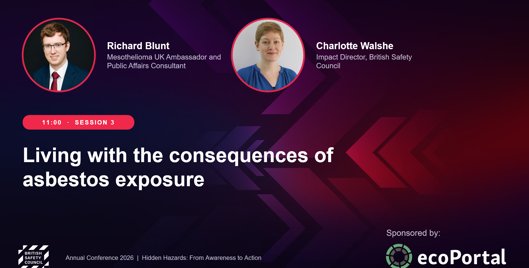
Living with the consequences of asbestos exposure
Watch Richard Blunt in conversation with Charlotte Walshe at our 2026 Annual Conference, on his family's story and what needs to change.
 Watch the session

Asbestos management: time to improve the skills base
Colette and Alan Willoughby of Asbestos Compliance Limited discuss how asbestos is managed in buildings today, and why the industry's skills need to improve.
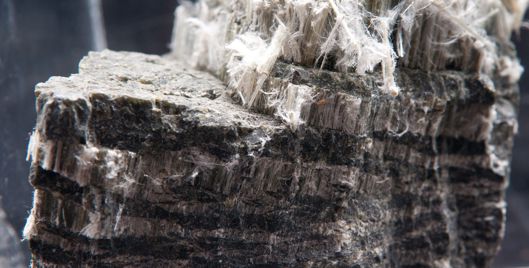
Asbestos Awareness Training
Learn where asbestos may be found, the health risks of exposure and how to reduce them, in this short online course. Free with British Safety Council membership.


Explore every episode
Expert conversations on the health, safety and wellbeing issues that matter at work. Listen to the full Health and Safety Uncut archive, with transcripts for every episode.