

Musculoskeletal disorders are one of the most common work-related health issues in Great Britain. According to the Health and Safety Executive, 511,000 workers were suffering from a work-related musculoskeletal disorder in 2024/25, with 7.1 million working days lost due to MSDs.
MSDs are often associated with manual handling, but lifting and carrying are only part of the picture. They can also be linked to repetitive work, awkward postures, poor workstation setup, vibration, unsuitable equipment, work pace and lack of recovery time.
The back remains the most commonly affected area, accounting for 43 per cent of work-related MSD cases. Rates are also higher than average in sectors including construction, transport and storage, and administrative and support service activities.
For employers, this makes MSD prevention a work-design issue, not simply a training issue. Employers should assess and reduce the risks through practical changes to tasks, equipment, workstations and working patterns. This guide explains what musculoskeletal disorders are, what causes them at work, and the practical steps employers can take.
What are musculoskeletal disorders?
Musculoskeletal disorders, often shortened to MSDs, are injuries or conditions that affect the body’s muscles, joints, tendons, ligaments, nerves and other soft tissues.
They can affect different parts of the body, including the:
- Back
- Neck
- Shoulders
- Arms
- Wrists and hands
- Hips
- Knees
- Legs and feet.
Common examples include back pain, neck and shoulder pain, upper limb disorders and repetitive strain-type conditions.
Work can cause MSDs, but it can also make existing conditions worse. That is why employers need to consider both prevention and early intervention. Not every MSD can be prevented, but many risks can be reduced when tasks, equipment, workstations and working patterns are properly assessed.
Early reporting is also important. If workers feel able to raise discomfort before it becomes serious, employers have a better chance of making practical changes before the problem leads to absence, long-term pain or reduced ability to work.
What causes MSDs at work?
MSDs can develop when the working environment places repeated or excessive strain on the body. The causes vary by sector and task, but they often involve a combination of physical demands, poor design and insufficient recovery.
Although MSDs are often associated with physical demands, psychosocial factors can also contribute to their development. High workloads, low job control, time pressure, fatigue and poor organisational support can increase muscle tension, delay recovery and influence how pain is experienced. Employers should therefore consider both physical and psychosocial risks when assessing work-related MSDs.
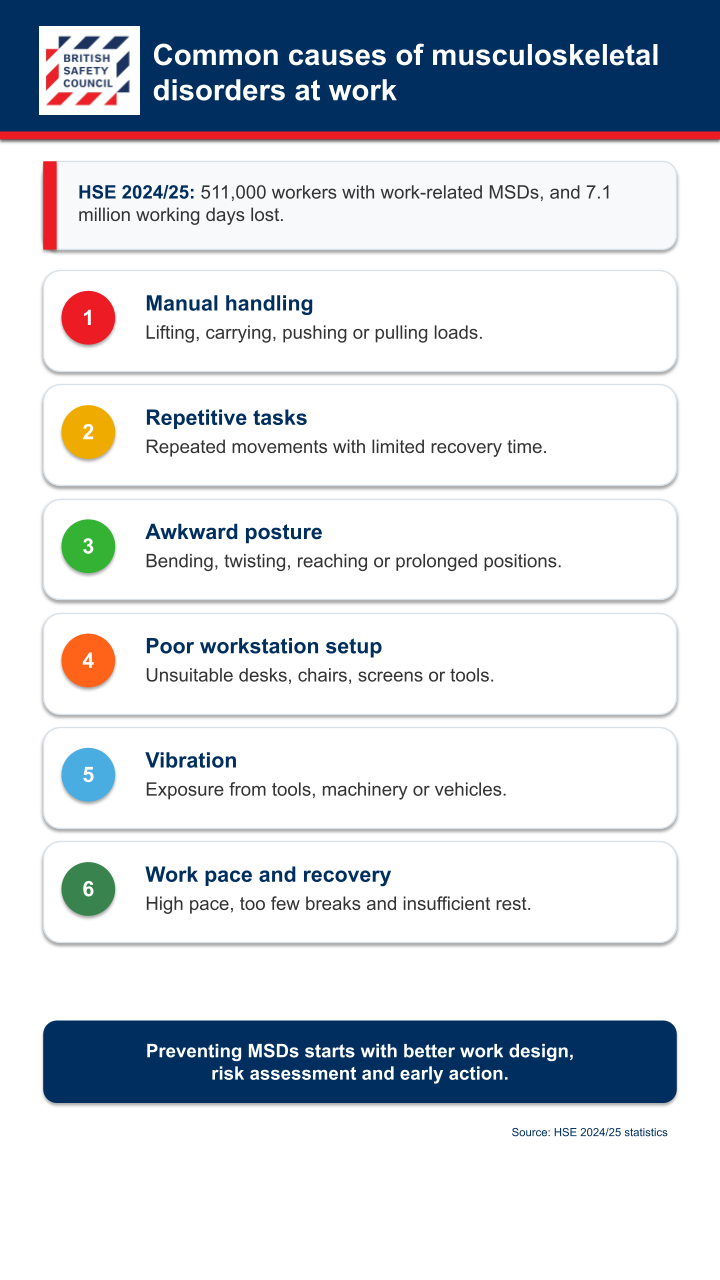
Manual handling and forceful work
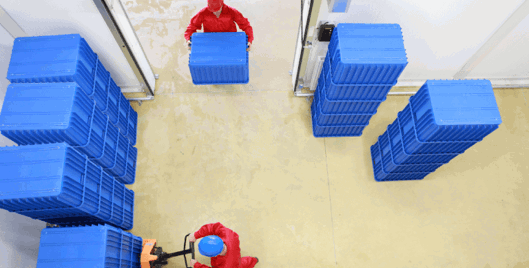
Manual handling includes lifting, lowering, carrying, pushing and pulling. It is one of the best-known causes of MSD risk, especially where workers handle heavy, awkward, unstable or hard-to-grip loads.
The risk can increase when workers need to:
- Lift from floor level or above shoulder height
- Twist while carrying
- Reach away from the body
- Handle loads repeatedly
- Work in restricted spaces
- Push or pull heavy equipment
- Move loads over uneven floors
- Work under time pressure.
Manual handling training can help workers understand the risks, but training alone is not enough. Employers should first consider whether the handling task can be avoided, redesigned or supported with suitable equipment.
Repetition, posture and work pace
MSDs are not limited to heavy work. They can also develop from repeated movements, static postures and tasks that require the same muscles to be used for long periods.
Examples include:
- Repetitive assembly or packing work
- Scanning items at a checkout
- Prolonged keyboard or mouse use
- Working with arms raised
- Bending or twisting for long periods
- Standing or sitting without enough movement
- Working at a pace that limits recovery time.
A task does not need to feel physically demanding to create risk. Small repeated movements, poor posture or limited recovery can build up over time.
Poor ergonomics: workstations, equipment and environment
Poor ergonomics can contribute to MSDs when workstations, tools, equipment or environments do not support safe and comfortable working. For desk-based workers, display screen equipment setup is an important factor. Screen height, chair adjustment, keyboard and mouse position, lighting, and the amount of space available can all affect posture and comfort.
Hybrid, remote and hot desk working can make this more difficult. A worker may have a suitable workstation in the office but spend several days a week working from a kitchen table, sofa or shared space at home, or move between different desks without adjusting the chair, screen, keyboard or mouse. Our recent article on why sit-stand desk investments fail without an active working strategy makes an important point: ergonomic furniture only works when it is supported by guidance, behaviour change and a culture of movement. Regular posture changes, short walking breaks, walking meetings and reducing long, uninterrupted periods in one posture can all help make workstation improvements more effective.
In operational environments, risks can also come from poorly maintained tools, vibration, unsuitable handles, restricted space, cold conditions, poor lighting or uneven flooring. Our article on vibration-related health risks shows how exposure to vibration can raise questions about both immediate symptoms and longer-term health effects.
Good ergonomics is about fitting the task to the worker as far as reasonably practicable. It should not rely on workers adapting to poor design.
What does the law require?
Employers have legal duties to protect workers from health and safety risks, including risks that may cause or worsen musculoskeletal disorders. Under the Health and Safety at Work etc. Act 1974, employers must protect the health, safety and welfare of employees, so far as is reasonably practicable.
The Management of Health and Safety at Work Regulations 1999 require employers to assess workplace risks and put suitable controls in place. More specific duties may also apply. The Manual Handling Operations Regulations 1992 require employers to avoid hazardous manual handling where reasonably practicable, assess unavoidable manual handling risks, and reduce the risk of injury. The Health and Safety (Display Screen Equipment) Regulations 1992 require employers to assess DSE workstations and reduce risks for DSE users.
In practice, this means employers should not wait for workers to become injured before taking action. MSD risks should be identified, assessed, controlled and reviewed as part of routine health and safety management.
How employers can assess MSD risks
A suitable assessment starts with understanding the work as it is really done, not just how it appears in a procedure. For a wider overview of the risk assessment process, see our guide to risk assessments.
Employers should look at:
- The task being carried out
- The loads, tools or equipment used
- The working posture required
- How often the task is repeated
- How long workers spend doing it
- The pace of work
- The work environment
- Individual factors that may affect risk, such as pregnancy, existing conditions, disability, new workers or an ageing workforce
- Reports of discomfort, pain, absence or near misses.
Worker involvement is essential. Employees often know which tasks are uncomfortable, awkward or difficult long before that information appears in absence data. Speaking to workers, observing tasks and encouraging early reporting can help identify risks that might otherwise be missed.
Different tasks may need different assessment methods. A warehouse picking task, a workstation setup and a repetitive production task should not all be assessed in the same way.
The HSE provides several tools to help employers assess MSD risks, including:
- MAC, the Manual Handling Assessment Charts, for lifting, carrying and team handling tasks
- RAPP, the Risk Assessment of Pushing and Pulling tool
- ART, the Assessment of Repetitive Tasks tool
- Body mapping tools to help workers report discomfort and identify patterns
- DSE assessments for screen-based workers.
These tools can help employers move beyond a generic risk assessment and consider the specific demands of the task.
How to prevent musculoskeletal disorders at work
The most effective controls usually come from improving how work is designed, organised and managed. Training has an important role, but it should support wider risk control, not compensate for poorly designed tasks.
Design out the risk where possible
The first question should be whether the risky part of the task can be avoided or reduced.
For manual handling, this might mean:
- Using mechanical aids
- Changing delivery or storage arrangements
- Reducing load size or weight
- Storing heavier items between knee and shoulder height
- Improving access routes
- Reducing the distance loads need to be carried
- Changing the workflow so fewer lifts are needed.
For repetitive or awkward tasks, it might mean redesigning the work area, adjusting task height, changing the sequence of work or introducing more variation.
The aim is to reduce the physical demand of the task before relying on workers to “be careful”.
Improve tools, equipment and workstation setup
Equipment should support safe and comfortable working. This applies in offices, warehouses, factories, construction sites, healthcare settings, retail and many other workplaces.
Practical improvements might include:
- Adjustable chairs, desks or work surfaces
- Suitable lifting aids or trolleys
- Tools that are the right size and weight for the task
- Handles that reduce grip strain
- Anti-vibration tools or better-maintained equipment
- Screens positioned at a suitable height
- Keyboards and mice positioned to reduce strain
- Enough space to work without twisting or overreaching.
For screen-based workers, DSE assessments can help identify whether the workstation is suitable and whether changes are needed. This is especially important when people work across multiple locations.
Reduce repetition and support recovery
Where repetitive work cannot be avoided, employers should consider how to reduce exposure and allow recovery.
This may include:
- Varying tasks during the day
- Rotating roles where appropriate
- Introducing short breaks or microbreaks
- Reviewing work pace and targets
- Ensuring staffing levels allow tasks to be carried out safely
- Avoiding long periods of static posture.
Job rotation can help, but only if the alternative tasks use different movements and muscle groups. Rotating between two tasks with similar physical demands may not reduce the risk.
Train workers and assessors
Training helps workers understand MSD risks and the practical steps they can take to reduce them. It can also support a consistent approach across teams.
For workers involved in lifting, carrying, pushing or pulling, manual handling training can help build awareness of common hazards and safer ways of working.
For those responsible for assessing tasks, more specific training may be needed. Our Certificate in Manual Handling Risk Assessment is designed for people who carry out manual handling risk assessments in the workplace.
For office, hybrid and screen-based workers, Display Screen Equipment training can help users understand how to set up their workstations. Those responsible for assessments may also benefit from the Certificate in DSE Risk Assessment.
Training should be refreshed when tasks, equipment, processes or work locations change.
Encourage early reporting
Workers should feel able to report discomfort, pain or concerns before they become serious.
Organisations with a positive reporting culture are more likely to identify emerging MSD risks before they become injuries. A good reporting culture helps employers identify patterns, such as:
- Repeated discomfort in one team
- Pain linked to a particular task
- Issues with a piece of equipment
- Problems following a change in process
- Workstation issues among hybrid workers.
Early action can prevent minor discomfort from becoming a long-term problem. It also shows workers that health concerns are taken seriously.
Can AI and wearable technology help prevent MSDs?
Technology is creating new ways to understand MSD risk. Wearable sensors, computer vision and machine learning can help collect information about posture, movement, repetition and force. This may make it easier to identify patterns that are hard to see through observation alone.
For example, technology may help organisations understand where workers are regularly bending, twisting, reaching or repeating the same movement. It may also support earlier intervention by highlighting risk trends before injuries occur.
However, technology should not replace good risk assessment, worker involvement or better work design. Data is only useful if it leads to practical improvements.
As discussed in our article on human-centred technology for better work design, technology should be used to support better decisions, not to shift responsibility onto workers or monitor them without meaningful action.
The most effective approach is still human-centred: understand the task, involve workers, assess the risks and improve the design of work.
MSD prevention checklist for employers
Use this checklist as a starting point:
- Identify tasks involving lifting, carrying, pushing, pulling, repetition, vibration or awkward posture
- Speak to workers about discomfort, difficult tasks and near misses
- Observe how tasks are carried out in practice
- Use the right assessment method for the task
- Review workstation setup for office, hybrid and remote workers
- Prioritise task and equipment design before relying on behaviour change
- Provide suitable training for workers and assessors
- Encourage early reporting of discomfort or pain
- Monitor absence, reports and recurring complaints
- Review controls when tasks, equipment, staffing or work locations change.
Why leadership matters for MSD prevention
Preventing MSDs is not solely the responsibility of health and safety teams. Managers, supervisors and leaders all influence work design, workload, staffing levels and organisational culture, making leadership essential to successful prevention.
Preventing MSDs also brings wider business benefits. It can improve productivity, reduce sickness absence, support retention and help organisations maintain operational performance.
How British Safety Council can help
British Safety Council offers training and support to help organisations manage workplace health and safety risks, including those linked to musculoskeletal disorders.
"Musculoskeletal disorders are not an inevitable consequence of work. They are usually a consequence of how work is designed. The organisations making the greatest progress are those that move beyond training alone and focus on creating healthier work through better design, leadership and early intervention. Preventing MSDs isn't just about reducing injuries; it's about enabling people to work safely, comfortably and sustainably throughout their careers."
Relevant courses include:
- Manual Handling
- Certificate in Manual Handling Risk Assessment
- Display Screen Equipment
- Certificate in DSE Risk Assessment
For organisations looking at wider risk management, British Safety Council also provides risk assessment training, audit and consultancy support.
Frequently asked questions
What are musculoskeletal disorders at work?
Musculoskeletal disorders are injuries or conditions that affect the muscles, joints, tendons, ligaments, nerves and other soft tissues. At work, they can affect areas such as the back, neck, shoulders, arms, wrists, hands, hips, knees and legs.
Are MSDs only caused by manual handling?
No. Manual handling is an important cause of MSD risk, but it is not the only one. MSDs can also be linked to repetitive work, awkward postures, poor workstation setup, vibration, unsuitable equipment, work pace and lack of recovery time.
How can employers prevent musculoskeletal disorders?
Employers can help prevent MSDs by identifying high-risk tasks, involving workers, using suitable assessment tools, improving task and equipment design, reducing repetition, providing appropriate training and encouraging early reporting of discomfort.
What is the difference between MSD prevention and manual handling training?
Manual handling training is one part of MSD prevention. A wider MSD prevention approach also considers workstations, repetitive tasks, posture, vibration, equipment, work organisation and recovery time.
Can wearable technology help prevent MSDs?
Wearable technology can help organisations collect data about movement, posture and repetition. This can support better risk assessment and earlier intervention, but it should not replace worker consultation, competent assessment or improvements to work design.
Further reading
Explore related Safety Management articles for more detail on MSD prevention, work design and healthier working practices:
Manage manual handling risks

Manual Handling
Help workers understand common manual handling risks and practical ways to reduce injury when lifting, carrying, pushing or pulling.
 Start manual handling training
Certificate in Manual Handling Risk Assessment
Build the skills to identify manual handling hazards, assess risk and recommend suitable controls in the workplace.
Improve workstation and DSE safety

Display Screen Equipment
Support office, hybrid and remote workers with practical guidance on setting up workstations safely and comfortably.

Certificate in DSE Risk Assessment
Learn how to assess DSE workstations, identify risks and help reduce discomfort linked to screen-based work.