

In elite motorsport, performance is often measured in milliseconds, but the physical cost to drivers can be far more lasting. Recent issues with steering wheel vibration in Aston Martin cars have highlighted a serious and often overlooked topic: the health and safety impacts of prolonged vibration exposure.
By combining insights from occupational health research and real-world Formula One experiences, a clearer picture emerges of how vibration can affect the human body, sometimes with alarming consequences.
Vibration: more than just discomfort
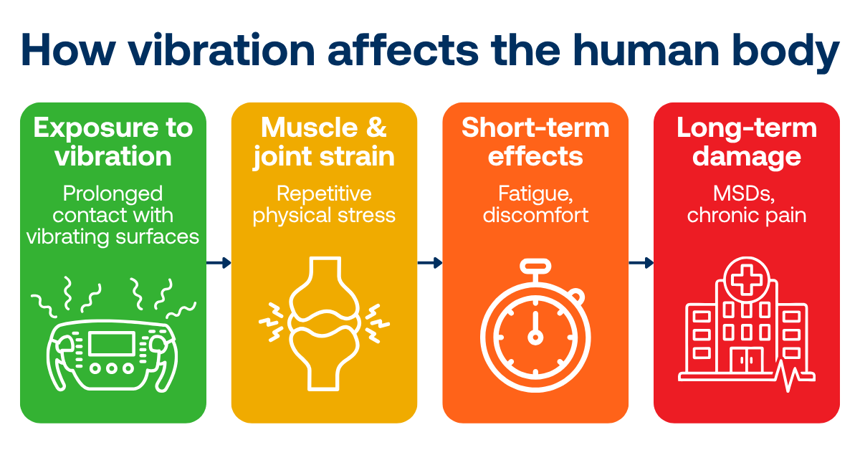
In many industries, vibration is already recognised as a significant occupational hazard. Workers exposed to prolonged vibration, such as those operating heavy machinery, are at increased risk of developing musculoskeletal disorders (MSDs). These conditions arise from repeated strain on muscles, joints, and the spine.
The key factors that increase risk include long exposure durations, high vibration intensity, and repetitive physical stress. Over time, vibration absorbed by the body can lead to both short-term discomfort and long-term damage, including chronic pain and reduced mobility.
While Formula One drivers are far removed from warehouse environments, the underlying principle remains the same: the human body is not designed to endure sustained vibration without consequence.
The Aston Martin case: extreme conditions, immediate risks
The situation faced by drivers like Fernando Alonso and Lance Stroll brings this issue into sharp focus.
According to team principal Adrian Newey, severe vibrations originating from the engine and amplified through the chassis were transmitted directly into the steering wheel, eventually reaching the drivers’ hands and fingers.
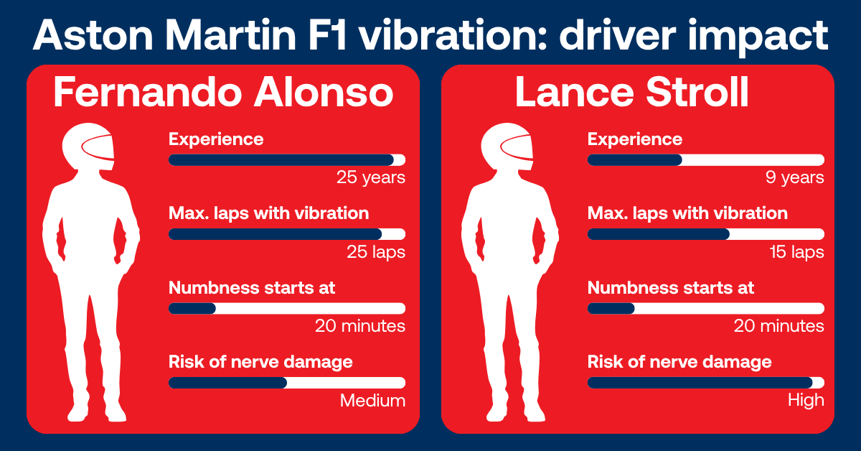
The consequences were immediate and significant. Drivers reported numbness after just 20 to 25 minutes of running, alongside concerns about potential permanent nerve damage. As a result, both drivers indicated they could not safely complete a full race distance without risking injury, with Alonso limiting himself to around 25 laps and Stroll even fewer due to prior wrist issues.
This represents an unusually acute form of vibration exposure, where serious health risks can develop within a single race rather than over extended periods.
From whole-body to localised vibration
Traditional studies focus on whole-body vibration, where forces travel through the entire body, for example, through a vehicle seat into the spine. In the Aston Martin scenario, the issue is more localised but equally dangerous, with high-frequency vibration concentrated in the steering wheel.
This type of exposure can lead to:
- Nerve compression or damage
- Reduced sensation, including numbness
- Loss of fine motor control
The fact that drivers were visibly shaking their hands mid-race to relieve symptoms underscores how quickly the effects set in.
Compounding effects: duration, intensity, and feedback
Just as uneven surfaces can amplify vibration in industrial settings, the F1 car’s structure intensified engine vibrations through the chassis. This not only affected driver health but also caused reliability issues, including components such as mirrors and lights loosening or failing, and reduced overall vehicle reliability.
For drivers, the danger lies in the combination of:
- Intensity, meaning high-frequency vibration
- Duration, meaning continuous laps
- Lack of recovery time
Even short exposure, when intense enough, can rival the long-term risks seen in industrial environments.
Fernando Alonso shared his concerns and said, "It [the vibration] shouldn’t be there and we don’t know the consequences either if you keep driving like that for months. So a solution has to be implemented."
The importance of ergonomic design
Modern machinery design increasingly prioritises ergonomics to reduce vibration exposure, and the same principle is now proving essential in Formula One. Aston Martin has experimented with components designed to dampen vibration before it reaches the driver, reflecting wider industry approaches focused on isolating vibration sources and improving operator comfort.
Although early tests suggested significant improvement of around 80%, these solutions have not yet been fully implemented due to reliability concerns. This highlights the ongoing challenge of balancing performance, safety, and engineering risk.
Broader implications for motorsport safety
The Aston Martin case demonstrates that vibration is not merely an engineering inconvenience but a genuine health hazard. Even highly trained athletes are susceptible to vibration-related injuries, particularly when exposure is intense and localised.
It also raises important questions about long-term effects. While immediate symptoms such as numbness are evident, the potential cumulative impact of repeated exposure over a season remains uncertain.
Conclusion
Steering wheel vibration in Aston Martin’s F1 cars has exposed a critical intersection between engineering and human physiology. What might seem like a technical issue has immediate and potentially permanent health implications.
The lesson extends beyond motorsport. Whenever vibration is transmitted to the human body, whether through a forklift seat or a Formula One steering wheel, its effects must be taken seriously.
Until fully resolved, this issue serves as a powerful reminder that in the pursuit of speed, driver safety cannot be an afterthought.
Related items

Vibration Awareness
Suitable for safety professionals who use vibrating tools and equipment in the workplace.
 Find out more

Driving and Riding Safely for Work
This short online course is for anyone who drives at work, whether using a company vehicle or their own.