

Fire and heat are often treated as the same workplace hazard. Both can cause serious injuries, damage property and disrupt operations. However, while similar and closely linked, they create different risks and require different safety controls.
Fire hazards involve ignition, combustion and the potential for fire to spread. Heat risks involve exposure to high temperatures, hot surfaces or hot environments, which can affect workers’ health, concentration and safety. Some activities, such as welding, can involve both and should be assessed separately.
Understanding the difference matters to anyone responsible for workplace safety. It can help organisations assess risks more effectively and choose the most appropriate controls.
Treating fire and heat as the same hazard can lead to gaps in risk assessments.
In this blog, we’ll cover:
- The definition of fire hazards in the workplace
- The definition of heat risks in the workplace
- The difference between working with fire and working with heat
- The main risks associated with each
- Common workplace activities that create fire and heat risks
- Why fire and heat hazards require different safety controls
- Practical ways to reduce risk
What are fire hazards in the workplace?
A fire hazard in the workplace is any condition, material, activity, or source of ignition that has the potential to start, fuel or spread a fire, putting people, property, or business operations at risk.
What are heat risks in the workplace?
Heat risks in the workplace are the potential dangers and health effects that arise when workers are exposed to excessive heat, hot environments, hot surfaces, or high-temperature processes.
These risks can affect a worker's health, wellbeing, concentration, and ability to work safely.
What's the difference between working with fire and working with heat?
The easiest way to think about it is that fire involves combustion, while heat involves exposure to high temperatures with or without fire.
Working with fire includes activities involving a naked flame, ignition source or the potential for combustion. Common examples include:
- Welding
- Cutting
- Soldering
- Roofing work involving blowtorches
Workers may be exposed to heat (but not necessarily with fire) from:
- Hot surfaces
- Machinery
- Steam systems
- Ovens
- Furnaces
- Any high-temperature environments
Some workplace scenarios involve heat and fire risks combined, whereas others deal with one. For example:
- A welder using a blowtorch may face both fire and heat hazards.
- A baker working near industrial ovens may face heat-related risks, despite not working directly with open flames.
While both hazards can cause burns, the wider risks and control measures are often distinct.
What are the main risks associated with fire and heat in the workplace?
Fire hazards can result in burns, smoke inhalation, property damage and business interruption. If a fire spreads, it can put multiple workers, contractors and visitors at risk.
Heat hazards can also cause burns, but are more commonly associated with heat exhaustion, dehydration, fatigue and reduced concentration. These effects increase the likelihood of mistakes and accidents.
The Health and Safety Executive (HSE) emphasises the importance of managing excessive workplace heat, particularly during warmer months or in environments where workers are exposed to heat as part of their role. HSE guidance recommends taking practical steps to improve thermal comfort, particularly for employees working in hot temperatures. This may include increasing ventilation, providing access to drinking water, allowing suitable rest breaks and adjusting work patterns where needed. For BSC's position on workplace temperature exposure, see our temperature exposure policy.
A common misconception is that there is a legal maximum workplace temperature in the UK. However, this isn’t the case. Instead, employers are expected to provide a reasonable level of thermal comfort by assessing the risks where excessive heat could affect workers’ health or safety.
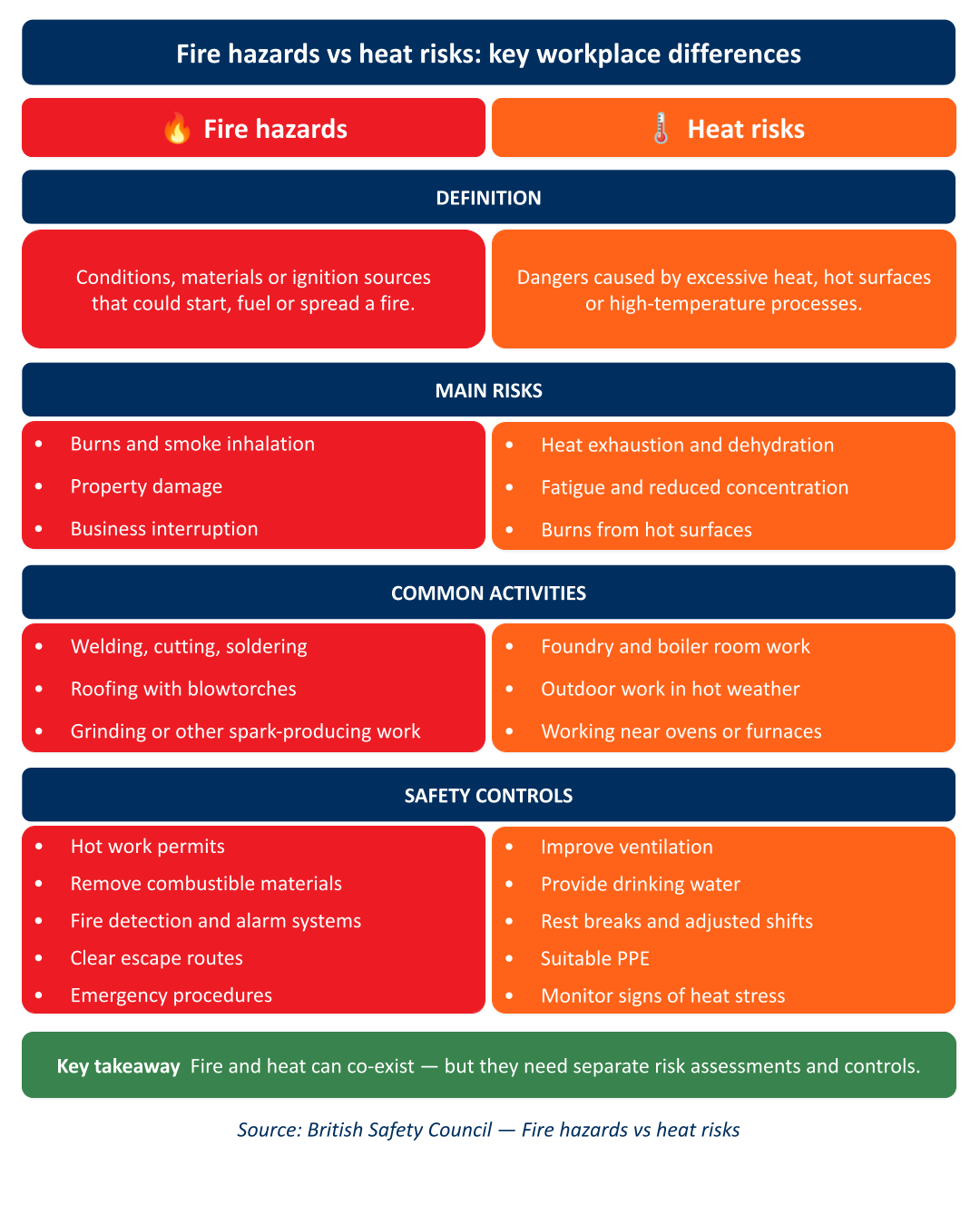
The infographic below summarises the key differences between fire hazards and heat risks in the workplace, including common activities, main risks and typical safety controls.
Which workplace activities create the greatest fire and heat risks?
Hot work activities often create fire hazards. According to HSE guidance, tasks such as welding, cutting and grinding can generate sparks or heat capable of igniting nearby materials.
These risks are commonly found in construction, engineering, manufacturing and maintenance environments. Effective hot work safety procedures are essential for controlling ignition sources in these environments.
Heat hazards can arise in a wide variety of workplaces. Workers may be exposed to high temperatures in foundries, manufacturing facilities, boiler rooms and outdoor environments during periods of hot weather.
Many organisations will encounter both fire and heat hazards within the same working environment. Employers should identify which risks are present and assess each one appropriately.
Why fire and heat hazards require different safety controls
Although fire and heat are often discussed together, the measures used to manage them can be very different.
Fire risk assessments focus on preventing ignition and reducing fire risks in the workplace. They also help ensure people can respond safely if a fire occurs. Controls might include removing combustible materials, using hot work permits, maintaining equipment and putting emergency procedures in place.
Heat-related risk assessments focus on protecting workers from heat-related illness and injury by identifying where excessive heat could affect people’s health, wellbeing or ability to work safely. Employers can reduce heat exposure by improving ventilation, providing drinking water, adjusting working patterns, introducing rest breaks and supplying suitable personal protective equipment (PPE).
Welding on a construction site is a good example. Sparks can ignite nearby combustible materials, creating a fire risk. The task can also involve contact with hot metal surfaces and exposure to heat. Although the activity is the same, employers should assess the fire and heat risks separately.
"Fire and heat are often grouped together, but they present separate challenges and require specific controls. Fire risk focuses on ignition, spread and emergency response, while heat risk often centres on exposure, burns, fatigue, dehydration and safe working conditions. Taking a tailored approach to each hazard helps organisations manage risk more effectively."
|
Fire hazards |
Heat risks |
|
Focus on ignition and fire spread |
Focus on exposure to high temperatures |
|
Fire detection and emergency response |
Heat management and worker wellbeing |
|
Hot work permits and housekeeping |
Ventilation, hydration and rest breaks |
|
Combustible materials are a key concern |
Heat stress and fatigue are key concerns |
|
Can affect multiple people quickly |
Often affects individuals or specific teams |


How employers can reduce fire and heat-related risks
The first step is identifying which hazards are present in the workplace.
Employers should:
- Carry out suitable risk assessments
- Identify sources of fire and heat
- Put appropriate safety measures in place
- Train workers on safe procedures
- Review control measures regularly
- Monitor changes in activities, equipment and working conditions
The Health and Safety at Work Act 1974 places a duty on employers to protect the health, safety and welfare of their employees. Assessing fire and heat hazards separately helps organisations meet those responsibilities.
Where organisations regularly carry out hot work or manage significant fire hazards, fire safety training can help workers understand risks and apply suitable controls. Where employees are regularly exposed to hot or cold environments, workplace temperature training can also help organisations understand thermal risks and how to manage them effectively.
Frequently asked questions about fire vs. heat
1. Is there a legal maximum workplace temperature in the UK?
There is no legal maximum workplace temperature in the UK. However, employers still have a duty to manage risks to workers’ health, safety and welfare. If excessive heat could affect workers’ health, concentration or ability to work safely, employers should assess the risk and put suitable controls in place.
2. Is welding a fire hazard or a heat risk?
Welding can create both fire hazards and heat risks. Sparks, hot work and ignition sources can start or spread a fire, especially if combustible materials are nearby. At the same time, workers may be exposed to hot surfaces, radiant heat, burns, fatigue or dehydration. For this reason, fire and heat risks should be assessed separately.
3. What is the difference between hot work and heat exposure?
Hot work usually refers to tasks that can produce heat, sparks or flames, such as welding, cutting, grinding or soldering. These activities can create fire hazards. Heat exposure is broader and refers to working in hot environments, near hot surfaces, around high-temperature equipment or during hot weather. Heat exposure may occur even when there is no flame or ignition source.
4. What controls help reduce heat stress at work?
Employers can help reduce heat stress by improving ventilation, providing access to drinking water, allowing suitable rest breaks, adjusting work patterns, monitoring workers for signs of heat-related illness and providing appropriate PPE where needed. The right controls will depend on the work activity, environment and level of exposure.
Conclusion
Fire and heat are closely linked, but they are not the same workplace hazard.
Workplace fire risks centre on ignition, combustion and emergency response. Heat risks focus on exposure to high temperatures and their impact on workers. Recognising these distinct risks enables organisations to carry out more effective risk assessments, choose appropriate controls and create safer workplaces.
Learn more and train
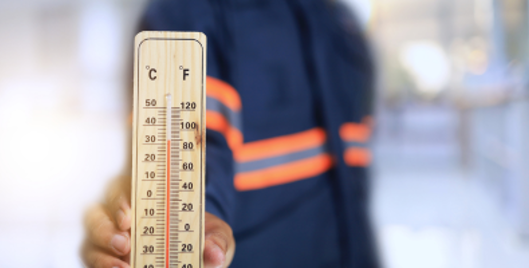
Workplace Temperature Course
This course raises the individual's awareness of the risks of working in hot or cold environments, whether indoors or outdoors.
 Explore workplace temperature training
Fire Safety Courses
Our fire safety training courses offer comprehensive, accredited training to individuals, managers and organisations.
Further reading

Workplace Temperature Exposure: Risks, Law and Action
Understand the risks of heat and cold at work, UK employer duties and British Safety Council’s position on stronger protections for workers.
Fire risk assessments: why they matter and how to get them right
Find out all you need to know about why fire risk assessments matter, what a good assessment involves and how to carry one out effectively.