

Brian Grant was an immense NBA player, a 6’9”, 254lb powerhouse forward whose agility and energy made him a formidable presence on the court. Basketball fans watched in awe as he moved with remarkable lightness, hustling every player around him.
However, in 2004, Grant noticed a change. He could no longer jump off his left leg and began developing tremors in his hands. In May 2006, he played his final game for the Phoenix Suns before retiring. Two years later, at just 36 years old, he was diagnosed with young-onset Parkinson's Disease.
Grant publicly shared his diagnosis in 2009 and has since become an advocate and inspiration, speaking openly about living with Parkinson’s.
It is believed that Grant’s condition may be linked to exposure to Trichloroethylene (TCE) during his childhood at Marine Corps Base Camp Lejeune. His father was stationed at the base, where TCE contamination levels in the water supply were high. As a child, Grant would have unknowingly drunk, bathed in, and swum in contaminated water.
Tragically, Grant’s father died in 2020 at the age of 65 from oesophageal cancer, which has also been linked to TCE exposure.
Stories like this highlight the often-complex relationship between chemicals and long-term health outcomes. The latent effects of exposure can make it difficult to draw direct lines between cause and effect. In many cases, the everyday reality of environmental contamination becomes part of the “toxic soup” present in the air we breathe and the water we consume.
TCE is a solvent with a wide range of industrial and commercial uses, including in adhesives, cleaning products, degreasers, inks, pesticides, refrigerants, wood finishes, dry cleaning products, perfumes, plastics, disinfectants, and soaps. This list is far from exhaustive.
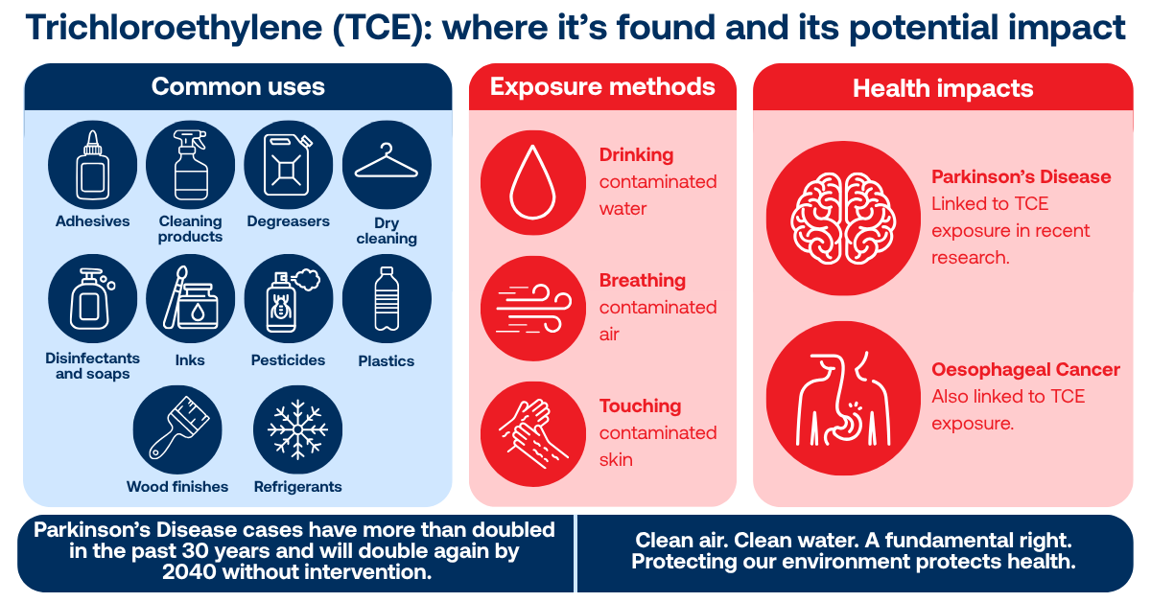
While the toxicity of TCE has long been recognised, an international team of researchers published a paper on 14 March 2023 examining its link to Parkinson’s disease.
The number of people living with Parkinson’s disease has more than doubled over the past 30 years. Without meaningful action, that figure is expected to double again by 2040.
Unlike many health risks where individuals can make personal lifestyle choices to reduce harm, environmental exposure to contaminated air and water is a shared challenge. Protecting public health requires collective action and a commitment to improving the environments we live in.
Breathing clean air and drinking clean, uncontaminated water should be considered a fundamental right.
Related items
Working with Hazardous Substances
This course highlights how to identify the hazardous properties of substances, the risks associated with exposure and how to reduce the risk of harm.
 Find out more

The hidden health risks of steering wheel vibration in Aston Martin’s F1 cars
In elite motorsport, performance is often measured in milliseconds, but the physical cost to drivers can be far more lasting. Recent issues with steering wheel vibration in Aston Martin cars have highlighted a serious and often overlooked topic: the health and safety impacts of prolonged vibration exposure.