
Every case of silicosis is preventable.
Discover the risks, the evidence, and what needs to change.
Learn more about our campaign to stop silicosisYour basket has been adjusted. This may be due to an event becoming unavailable or you logging into the site and your active roles changing.

Author: Matthew Winn, Public Affairs Manager, British Safety Council.
The case for banning engineered stone in the UK is a powerful one. The disease it causes is incurable, the workers falling ill are young, and Australia has already shown that a country can take this product off the market when the evidence demands it. But there is an uncomfortable question hiding inside the campaign for a ban, and it deserves an honest answer: a ban on what, exactly, and for whom?
Because if we are not careful, an outright UK ban could end up protecting British workers by quietly handing the danger to someone else's. Learn more about silicosis, silica dust exposure and the action British Safety Council is calling for.
Here is the part that's easy to miss. The dangerous moment in an engineered stone worktop's life is fabrication, the cutting, grinding, and polishing that releases the dust. The slabs themselves can be made and finished anywhere. Most already are. The world's engineered stone is overwhelmingly manufactured in a handful of countries, with China, India, and Vietnam among the largest producers, and increasingly the cutting and finishing happens there too, in the form of prefabricated, made-to-measure worktops shipped ready to install. The global supply chain compounds an existing regulatory problem: why engineered-stone exposure remains difficult to control even where the hazard is well understood.
So, picture a UK ban that stops fabrication here but leaves consumer demand untouched. Homeowners still want the quartz-look kitchen. Retailers still want to sell it. The demand doesn't vanish, it simply gets met another way: by worktops cut and polished overseas, in workshops that may have weaker dust controls, looser enforcement, and no inspection regime at all. The hazardous work doesn't stop. It just happens somewhere we can't see it and to workers we'll never meet.
That is not a victory for worker safety. It's a transfer of harm.
We already know this disease is global. Outbreaks among engineered stone fabricators have been documented in Spain, Israel, Italy, the United States, China, and Australia, the same brutal pattern of young workers and fast-moving disease appearing wherever the material is cut without proper protection. The lung of a fabricator in Gujarat or Guangdong is no less worth protecting than the lung of one in Yorkshire, Manchester, or London.
If our argument for action is genuinely that silicosis is a preventable tragedy and that no one should die for a kitchen worktop, then that principle cannot stop at the white cliffs of Dover. A policy that makes British hands clean while exporting the dust to someone else's lungs hasn't lived up to the moral case that justified it in the first place. Calls for the UK to prohibit high-silica artificial stone have grown as evidence of accelerated silicosis has emerged (a view expressed by Baroness Bennett of Manor Castle in Safety Management).
To Australia's credit, it understood this. Its ban did not stop at domestic fabrication; it was extended to imports in January 2025, closing the door on simply buying in the danger from abroad. Read how the Australian ban was achieved and what the UK can learn from it. Any serious UK response has to reckon with the same loophole.
This is why a ban alone, however well-intentioned, is not the whole answer. The deeper driver is demand, our collective appetite for a cheap, fashionable, high-silica finish, and demand is not something a domestic ban switches off.
Changing that means changing what consumers know and choose. People choosing a worktop deserve to understand that high-silica engineered stone carries a human cost in its making, and that genuinely lower-silica and silica-free alternatives now exist at comparable quality and price. When buyers start asking what their worktop is made of and how it was fabricated, the market follows. Retailers respond to what customers want, and manufacturers respond to retailers. That is how you shrink the dangerous end of the industry rather than just relocating it.
Australia also showed what can happen when retailers make principled changes, with both Ikea and Bunnings opting to phase out high-silica stone way ahead of a legislative or legal requirement.
None of this is an argument against strong action. It is an argument for action that actually works.
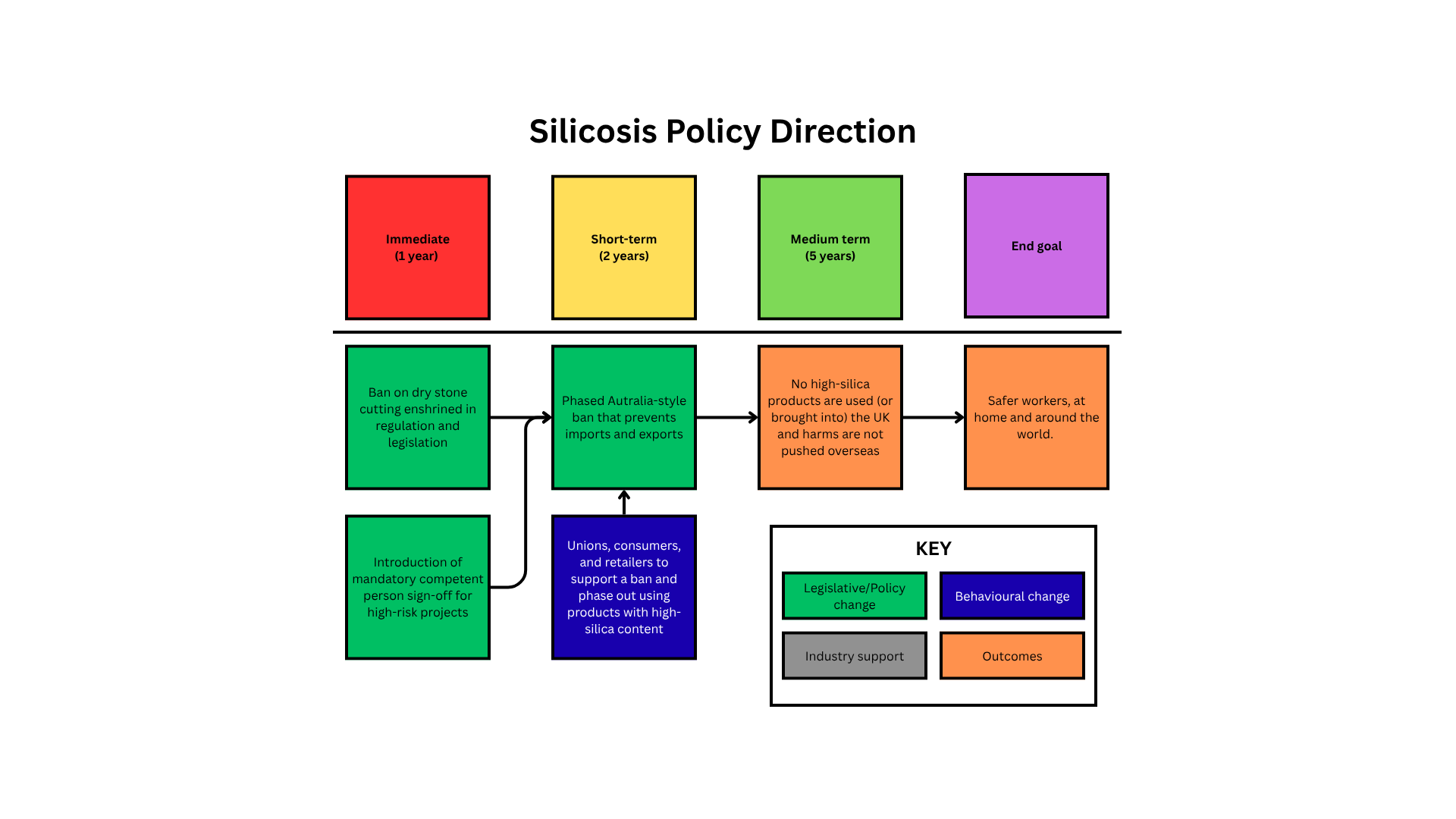
British Safety Council is calling on government to immediately ban the dry cutting of stone without control measures and to require competent person sign-off on high-risk work, the firm floor beneath which no worker should be asked to operate. From there, an Australia-style ban with import and export controls to prevent this from becoming a problem we simply shift overseas.
This needs to be accompanied by a willingness from retailers and a decisive consumer shift toward low- and no-silica materials, so that demand moves in a safer direction; rather than simply seeking out the cheapest, least-protected pair of hands on the planet.

Discover the risks, the evidence, and what needs to change.
Learn more about our campaign to stop silicosisHidden Hazards is British Safety Council's flagship campaign to expose overlooked workplace health hazards. By raising awareness and helping employers, employees and decision-makers take action before harm occurs, we're creating safer workplaces where everyone can get home safely.
Find out more