

Indoor air quality is often overlooked in workplace health and safety strategies. Yet the air we breathe has a direct and measurable impact on cognitive performance, productivity, and overall wellbeing.
Understanding this connection can help organisations create healthier environments and improve both employee experience and business outcomes.
The invisible factor we take for granted
Breathing is an unconscious action we perform around 20,000 times a day. Every breath delivers oxygen to the body while removing carbon dioxide. Despite its importance, air quality is rarely given the same attention as other workplace risks.
Indoor air is a complex mixture, primarily nitrogen and oxygen, with small amounts of other gases, particles, and biological agents. These components can significantly influence how comfortable and healthy an environment feels.
Indoor air quality is not just about physical health. It also has psychological and cognitive implications, making it a critical factor in workplace performance.
Why indoor air quality is a growing concern
Air pollution is increasingly recognised as a major public health issue. It is considered one of the top global health hazards, with around 50% of illnesses thought to be caused or aggravated by poor air. Indoor environments can be particularly problematic, with air sometimes 10 to 200 times more polluted than outdoor air.
A key challenge is that many of the effects are long-term and cumulative. This makes it difficult to identify the source of issues and reinforces the need for a proactive approach.

How pollutants affect the body and brain
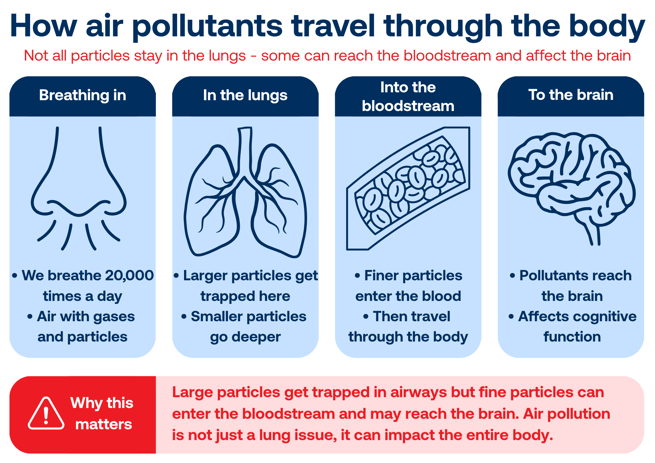
When we inhale, air travels through the respiratory system, where gas exchange occurs. However, very small particles can bypass the body’s natural defences and enter the bloodstream.
Larger particles tend to be trapped in the upper respiratory tract, while finer particles travel deeper into the lungs. The smallest particles can enter the bloodstream and circulate around the body, reaching organs including the brain. This ability to travel means that air pollution is not just a respiratory concern, but a whole-body issue with potential neurological effects.
The link between air quality and cognitive performance
Air quality has a direct effect on brain function, particularly when it comes to concentration and decision-making.
Carbon dioxide is commonly used as an indicator of ventilation levels. While official exposure limits are relatively high, research shows that much lower concentrations can still affect performance. At around 800 to 1,000 parts per million, individuals may begin to experience symptoms such as headaches and fatigue. At similar levels, studies have demonstrated a reduction in cognitive performance of around 30%.
This can influence decision-making, reaction times, and the ability to think strategically. Even slight increases in indoor pollutants have been linked to measurable declines in performance, particularly in environments that demand sustained focus.
Productivity and workplace impact
Poor indoor air quality does not just affect how people feel. It can have a measurable impact on how they perform.
Evidence shows that reduced air quality can increase error rates and lower productivity, particularly in roles that require concentration and accuracy. In practical terms, something as simple as a poorly ventilated meeting room can lead to reduced engagement and poorer decision-making.
For organisations, this highlights the link between environmental conditions and business performance.
The role of scent and chemical exposure
Fragrances and scented products are often overlooked sources of indoor air pollution. A significant proportion of fragrance chemicals are synthetic, with many derived from petroleum. Some are known to be associated with adverse health effects, and a notable percentage of the population reports sensitivity to them.
Exposure can lead to headaches, respiratory irritation, and difficulty concentrating. Despite this, fragrance ingredients are not always fully disclosed, making them harder to assess and control within indoor environments.

Vulnerable groups and long-term risks
While poor air quality affects everyone, certain groups are more vulnerable. Children, for example, are more at risk due to their developing organs and immune systems. Individuals with existing health conditions and pregnant women may also be more susceptible to the effects of air pollution.
There is growing evidence linking air pollution to reduced cognitive development in children, as well as mental health conditions such as anxiety and depression. It has also been identified as a risk factor in conditions such as dementia.
Why indoor air quality is often overlooked
Indoor air quality presents several challenges. It is largely invisible, its effects are often delayed, and responsibility for managing it is not always clearly defined within organisations.
Unlike more obvious workplace hazards, poor air quality does not always produce immediate symptoms. This can make it harder to prioritise, even though the long-term impacts can be significant.
Practical steps to improve indoor air quality
Improving indoor air quality does not have to be complex. It begins with awareness and a willingness to look more closely at the environment people are working in.
Ensuring adequate ventilation is one of the most effective steps, helping to dilute pollutants and maintain a steady supply of fresh air. Monitoring simple indicators such as carbon dioxide levels can provide useful insight into whether a space is well ventilated or not.
It is also important to consider and manage pollution sources. This may include reviewing the use of scented products, materials, or activities that contribute to indoor contaminants. Alongside this, organisations should encourage open conversations, so employees feel comfortable raising concerns about symptoms such as headaches or discomfort.
Finally, indoor air quality should be embedded into wider health, safety, and wellbeing strategies. Taking a joined-up approach ensures that it is treated as a core component of workplace wellbeing rather than a secondary consideration.

A collective responsibility
Improving indoor air quality requires a collective effort. Unlike some health initiatives, individuals cannot fully control the air they breathe in shared environments.
If we expect clean food and water, we should also expect clean air.
Final thoughts
Indoor air quality has a direct impact on cognitive function, productivity, and wellbeing. While it is a complex topic, meaningful improvements can start with simple actions such as education, monitoring, and better ventilation.
Organisations that prioritise indoor air quality will support employee health while also improving performance and long-term outcomes.
Related items

ISEP Pathways to Net Zero
Develop a deeper understanding of best practise in response to the climate crisis.
 Find out more

ISEP Foundation Certificate in Sustainability and Environmental Management
A 5-day globally recognised qualification aimed at anybody starting out in an environment or sustainability-focused role.