
A recent safety awareness day has highlighted the importance of contractors regularly practising emergency rescue from mobile elevating work platforms, rather than relying on one-off training sessions and paper procedures that are not always easy to follow during a fast-moving incident.
Features
Why paperwork alone isn’t sufficient MEWP rescue preparation
By
on 22 September 2026
Ask any site manager whether they have a rescue plan for mobile elevating work platforms (MEWPs) and the answer will almost always be yes. Ask when that plan was last tested by the people who would actually have to carry it out, under something resembling real time pressure, and the answer becomes far less certain. This gap between the plan that exists in a method statement and the plan that a team can actually execute in an emergency is one of the most under-discussed problems in work at height safety, and it deserves far more attention than it currently receives across many industries.
Live exercise
A recent live MEWP awareness and safety day, run by Horizon Platforms for a group of contractors and site personnel working on a fit-out project, offers a useful illustration of just how wide that gap can be. The exercise combined classroom training with practical, simulated rescue scenarios, and the results were certainly not isolated to one company or industry who use access platforms. Written rescue plans existed for every machine on site, as regulations require, yet many of those plans weren’t always easy to read under pressure and had never actually been rehearsed under anything like emergency conditions. Nominated ground rescue personnel, the people who would be first on the scene if an operator became suspended, injured or unresponsive at height, had in several cases rarely practised a rescue themselves.
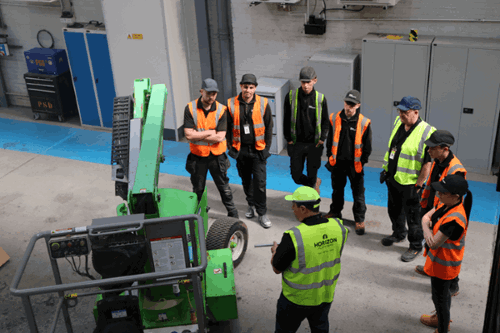
That point matters more than it might first appear. MEWPs from different manufacturers can look broadly similar from the ground, sharing similar baskets and control panels, but their operational logic and rescue controls can vary from one machine to the next. During the training day, attendees were told that identical control inputs could produce opposite movements depending on which machine they were standing in front of. In a genuine emergency, with an operator potentially incapacitated at height and every second counting, confusion over different control movements might turn a manageable incident into a serious one very quickly.
A rescuer who hesitates while working out which lever does what, on a machine they have not used before, is a rescuer who is already behind the clock.
A method statement can describe, in careful and compliant detail, the sequence of steps a ground rescue team should follow. Reading that document cannot prepare a team for the disorientation of an actual emergency, the noise and pressure of a live site, the physical difficulty of reaching controls quickly, or the reality that the machine in front of them on the day is not familiar to them. Plans that exist only on paper often give a false sense of security precisely because they look thorough on review. A team that can recite the correct steps in a classroom will not necessarily be able to perform them under pressure, and only regular, physical practice closes that gap.
Starting point
So, what does good practice actually look like in real terms? The starting point is treating rescue practice as a recurring operational requirement. Ground rescue personnel should physically walk through a rescue on every machine type present on site, not only the one they originally trained on, and this should happen at a frequency that keeps the skills current. Where a site uses MEWPs from multiple manufacturers, which is increasingly common on larger fit-out and construction projects, machine familiarisation needs to be treated as a distinct and ongoing task, with time set aside for it specifically, rather than assuming that one type of machine behaves much like another.
It also helps enormously to strip rescue guidance down to something that can be used under pressure. During the training day referenced above, a simplified rescue process flow chart was introduced, designed to guide decision-making in an emergency without relying on written procedures buried deep within a method statement. Feedback from participants was that this kind of visual, at-a-glance decision aid performed far better under simulated emergency conditions than trying to recall or locate a lengthy written procedure.
Selection of equipment plays a role here too. Employers responsible for MEWP use should be thinking about rescue capability at the point of hiring or purchasing a machine. That means understanding the specific descent and lowering controls of the machines being used, checking that ground-level controls are accessible and clearly marked, confirming that rescue equipment such as harnesses and lowering devices is compatible
with the machines in use, and ensuring that risk assessments genuinely reflect the equipment on
site rather than being generic documents carried over from project to project. Standards and guidance from bodies such as the International Powered Access Federation and the Health and Safety Executive set out clear expectations for training, equipment selection and rescue planning, and these are worth revisiting regularly rather than checked once during procurement and then filed away.
Training for platform rescues
Training itself sits at the centre of closing this gap, as it is essential that platform operators, and those managing platform use, have the necessary training to conduct platform rescues, and that this training goes beyond theory into genuine practice.
Reputable platform equipment resellers and hire companies provide a full range of platform training, covering safety aspects such as rescues, and some can arrange dedicated training days where rescues are practised in realistic, supervised conditions using the actual machines a site will be working with. The value of practical, scenario-based training, under simulated pressure and using a rescue plan flow chart, over classroom theory is that people are more likely to be better prepared.
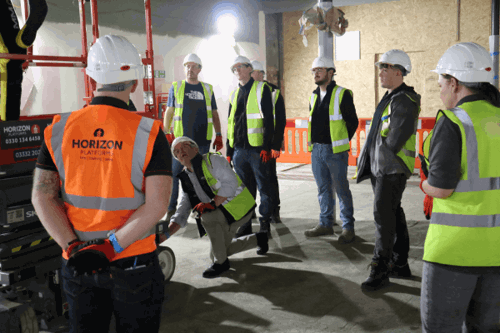
Many organisations already run fire drills, first aid refreshers and emergency evacuation exercises as a matter of routine, accepting that a written procedure alone is not sufficient preparation for a genuine crisis. Rescue from height deserves exactly the same treatment, yet it is still too often treated as a one-off compliance milestone rather than an ongoing safety discipline. The companies who took part in the safety day mentioned above certainly follow this notion and are being proactive in ensuring workers are prepared. Building rescue practice into a site’s regular safety calendar, alongside toolbox talks and other recurring activities, signals to the whole workforce that this is taken seriously rather than filed away and forgotten. It also creates natural opportunities to refresh knowledge as new machines arrive on site, as personnel change, and as the makeup of a project team shifts over time, all of which can quietly erode readiness if left unchecked.
None of this requires an enormous amount of additional resources, but it does need a shift in how rescue planning is understood and treated across industries, moving away from a compliance document and towards a practical skill that is taught, rehearsed and refreshed on a genuine schedule. The organisations got the most out of the training day discussed by being willing to test their plans honestly, discover where the gaps actually were, and act on what they found. That willingness to test rather than assume is, in the end, the real difference between a rescue plan that reads well and one that actually works when it matters.
Every site using MEWPs should be asking itself the same question that prompted this exercise. If an operator needed rescuing right now, would the team on the ground actually be able to do it, quickly, correctly, and on whichever machine happened to be in use that day? For most sites, an honest answer to that question, followed by a practical training day built around it, will do more for safety than another round of paperwork ever could.
Further guidance on safe MEWP use and rescue planning is also available from the International Powered Access Federation and the Health and Safety Executive. Horizon Platforms shares regular safety guidance and training updates via its website and social media channels, and welcomes contact from any organisation wanting to discuss rescue planning, training days or safe MEWP use in more detail:
horizonplatforms.co.uk
resources.horizonplatforms.co.uk/mewp-awareness-safety-day-expert-led-workshop-book-now
linkedin.com/company/horizon-platforms-ltd
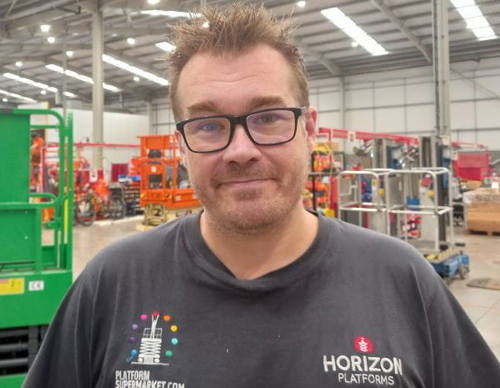
Ben Hughes is training and compliance manager at Horizon Platforms.
FEATURES
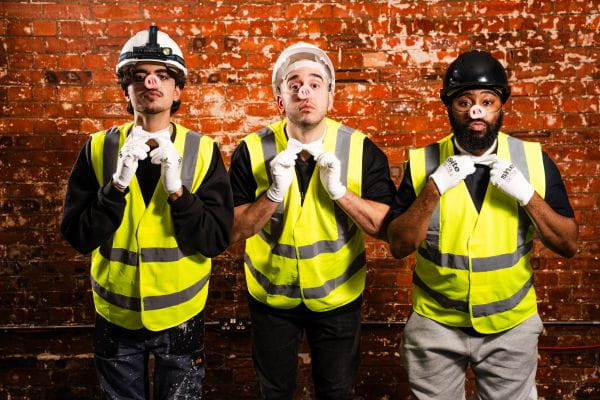
Who is the wolf in your life? Listening to the people behind the hard hat
By Inna Cebotari, Kinth Square on 02 October 2026
A new play explores the lives of migrant construction workers in the UK, using humour, real-life experiences and physical theatre to capture the banter, friendships and absurd moments that make life on site bearable, alongside the pressures that often go unseen. Ahead of the play’s premiere in London on 12-14 November, playwright Inna Cebotari explains how Three Little Pigs aims to add to the public debate about how best to support the wellbeing of construction workers.

Eliminating barriers in reporting: how conversational AI can unlock safety engagement
By Julian Taylor, ecoPortal on 04 October 2026
Online reporting systems that require lengthy and cumbersome form filling and typing can discourage workers from reporting safety incidents and concerns. However, AI-powered mobile apps that allow reporting simply by speaking can simplify and speed up the process, boosting reporting rates and overall staff engagement with safety systems and culture.

Why UK employers need to rethink recruitment, retention and support for older workers
By Orchie Bandyopadhyay on 04 October 2026
With workers over the age of 50 now comprising almost one third of the entire UK workforce, recruiting and retaining older workers is now core to the success of the economy. However, not all employers are offering what’s needed to retain and recruit older workers, and ageist attitudes, limited flexible working opportunities, and employment support that doesn’t fit with health, caring, or other responsibilities are leaving too many people locked out of the labour market.