

Over the years, the tower industry has made huge strides in improving safety. The introduction of design standards for equipment, structured training and clearer guidance have helped make towers a safe and widely used way to work at height. Yet some misconceptions still persist. They may seem harmless, but they can lead to poor decisions and unsafe practices if left unchallenged. Here, PASMA examines five common tower myths and explains the reality behind them.
Features
What people get wrong about towers
By
on 21 September 2026
Myth 1: “Towers are only for very simple jobs.”
Many people think that towers are only useful for quick, straightforward tasks. However, they are far more versatile than that.
The most common type of tower is a straight-up-and-down mobile access tower, but that’s only one option.
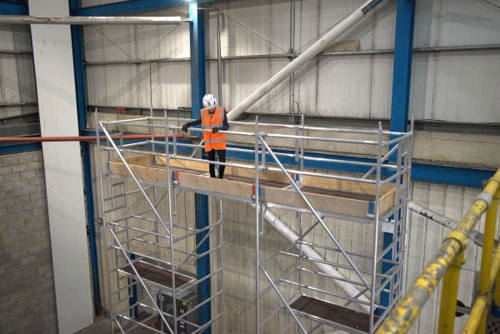
There is also a range of more advanced tower configurations designed to overcome site constraints and provide safe access to more challenging work areas. These include towers with cantilevers, towers on stairways, linked towers, towers with bridges and large deck towers.
They’re flexible enough to span whole façades, navigate obstacles, access multiple levels and provide large working platforms. They can quickly adapt to changing requirements and allow you to work on staircases.
For situations where a standard configuration isn’t suitable, bespoke towers can be designed to meet specific site requirements, allowing operatives to work safely at height in awkward-to-reach locations.
Towers are ideal for simple jobs, but that’s not all they can do. In reality, they can provide safe access for a wide range of complex work at height tasks.
Myth 2: “If someone has a PASMA card, they can build any tower.”
Towers come in a range of configurations, so there’s a range of PASMA qualifications too.
The basic skills to work safely with mobile access towers are taught on a PASMA Towers for Users course. But the more complex configurations require new skills due to the different assembly techniques and components involved.
These are taught on a series of more advanced PASMA courses, each covering a different configuration of tower:
- PASMA Towers on Stairways (A5)
- PASMA Cantilever Towers (A6)
- PASMA Towers with Bridges (A7)
- PASMA Linked Towers (A8)
- PASMA Large Deck Towers (A9).
A common mistake is to quickly make sure an operative has a PASMA card, without checking whether they’re qualified for the specific tower they’re about to build.
Don’t just check for a PASMA card. Always make sure the qualification matches the tower being used.
How to check PASMA qualifications
PASMA has a free quick reference guide to help you carry out the required qualification checks. It covers:
- Different tower configurations and their applications
- What PASMA training course covers each tower
- How each qualification is shown on a PASMA card
- What to do if you have doubts about an operative’s competence
- Physical vs. virtual PASMA cards – what they look like
- Four checks to do on every PASMA card
- The benefits of using towers over other forms of access.
Download it here.
Myth 3: “A tower only needs inspecting when it’s first assembled.”
Regular inspections are a legal requirement and an important opportunity to identify problems before they lead to an incident. Inspecting a tower after assembly and before use is essential, but it’s not the only time an inspection should be carried out.
Towers must be re-inspected at least every seven days. They should also be re-inspected after any alterations or following any event that could affect safety. It’s easy to assume that because a tower was safe yesterday, it must still be safe today. Unfortunately, that isn’t always the case.
To complete an inspection, check that each component is in the right place, exactly in accordance with the user manual. Make sure the ground conditions have not changed, the tower is level and upright, and that the wheels and stabilisers are in contact with the ground, with the castor brakes locked.
Inspections can be done by anyone who has completed a PASMA Towers for Users or Towers for Managers course, as this training provides the knowledge needed for the task.
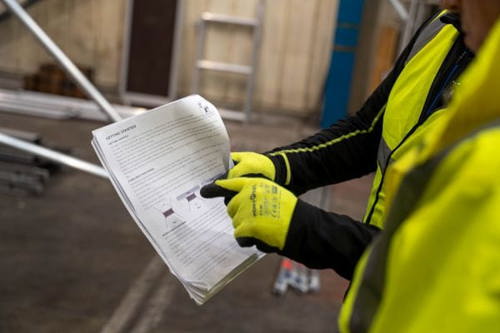
A copy of the instruction manual for the make and model of tower being used is essential for doing an inspection properly, and a copy should be available on site whilst the tower is standing.
Record the details of each inspection, and you must keep a copy for three months after the job
is complete.
If you spot a problem that can’t be fixed straight away, display a warning sign at the access point and physically restrict access to the tower – for example, using barriers.
Remember, inspections are not a one-off task. Tower safety depends on ongoing checks throughout the life of the tower.
TowerSure™ by PASMA: making tower inspections easier
There’s a lot to remember when it comes to tower inspections, from the checks that must be carried out to the information that must be recorded. That's why PASMA developed TowerSure, a digital tool that helps operatives complete inspections consistently and provides managers with greater visibility of tower safety across their sites.
With TowerSure, you can:
- Ensure consistent tower inspections with built-in PASMA checklists
- Create, store and share inspection records electronically
- View photos of towers on site
- Access inspection history instantly
- Check PASMA qualifications using virtual PASMA cards
- Identify trends and common mistakes to support continuous improvement.
The system automatically creates digital inspection records, making it easier to demonstrate compliance while reducing paperwork.
Find out more here.
Myth 4: “Experience matters more than following the manual.”
Experience is valuable, but it’s no substitute for the instruction manual.
On PASMA courses, operatives are taught to follow the instruction manual whenever they assemble, move, inspect or dismantle a tower – no matter how many times they’ve built one before.
In fact, it’s a legal obligation to have a copy of the manual on site. It should be provided by the manufacturer or hirer, and a library of manuals is also available on the PASMA website.
The manual contains critical safety information, including:
- A list of components you need to assemble the tower safely
- How to assemble the tower without ever standing on an unprotected platform
- The bracing pattern, which gives the tower its strength and must be followed exactly
- The maximum safe working load
- How to stabilise the tower to prevent it toppling over – for example, by using stabilisers, outriggers, ballast, or by tying it into an adjacent structure
- Information about hazards.
Instruction manuals are so important for tower safety that they even have their own standard, EN 1004-2.
Problems occur when people rely on memory, take shortcuts or assume that one tower is the same as another. Missing braces, incorrectly positioned stabilisers or other deviations can affect the tower’s strength and stability.
Following the manual is the only way to ensure the tower has all the strength, stability and safety features that its manufacturer intended.
Experience alone doesn’t keep people safe. Even the most experienced operatives need the instruction manual for the specific tower they are building.
Myth 5: “Toe boards are the least important component.”
Toe boards are sometimes seen as an optional extra, but that’s a mistake. They should never be left out, because they play an important role in preventing injuries.
Toe boards are designed to stop tools, equipment and materials falling from platforms and onto people or property below. That’s why they are supplied with towers and why regulations require them wherever there is a risk of objects falling and causing injury.
Even lightweight objects can become dangerous when dropped from height. Toe boards provide a simple but effective barrier, helping to prevent items from being kicked, knocked or blown off working platforms during work activities.
It’s not compulsory to use them on non-working platforms, unless a risk assessment identifies that items may be stored there.
Toe boards come in various sizes, but they should be at least 150mm high. They may be separate pieces or joined together with hinges to form a single folding unit.
Always check that toe boards are undamaged, secured correctly to the platform and fitted in accordance with the instruction manual. If you’re hiring a tower and toe boards haven’t been supplied, contact the hire company immediately.
The reality is that toe boards may be one of the simplest components on a tower, but they play an important role in protecting everyone below.

Remember, toe boards are only one part of preventing falling objects. During assembly, alteration and dismantling, there is an increased risk of components being dropped, which is why exclusion zones should be established to keep others out of the danger area. Consider using tool lanyards where appropriate, and never use ‘ad hoc’ methods for storing tools and materials such as boards or other sheet materials placed across the guardrails.
Towers help people carry out an extraordinary range of work safely and efficiently. From maintaining buildings to supporting major construction projects, they provide a flexible solution for working at height.
Their versatility is one of their greatest strengths, but it’s also why competence, planning and good practice matter so much. As safety professionals, it’s crucial to ensure the right equipment is selected, the right people are involved and the right procedures are followed.
The myths explored here may be common, but the reality is straightforward: when towers are planned, assembled, inspected and used correctly, they provide a safe and effective means of access for countless applications.
Don Aers is technical director at PASMA.
For more information see:
pasma.co.uk
E. [email protected]
T. +44 (0) 345 230 4041

FEATURES

Who is the wolf in your life? Listening to the people behind the hard hat
By Inna Cebotari, Kinth Square on 02 October 2026
A new play explores the lives of migrant construction workers in the UK, using humour, real-life experiences and physical theatre to capture the banter, friendships and absurd moments that make life on site bearable, alongside the pressures that often go unseen. Ahead of the play’s premiere in London on 12-14 November, playwright Inna Cebotari explains how Three Little Pigs aims to add to the public debate about how best to support the wellbeing of construction workers.
Eliminating barriers in reporting: how conversational AI can unlock safety engagement
By Julian Taylor, ecoPortal on 04 October 2026
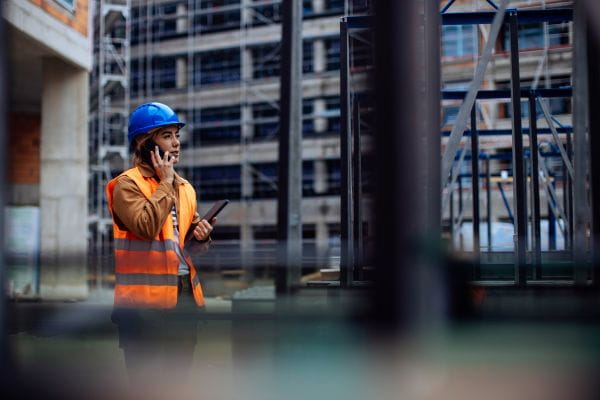
Online reporting systems that require lengthy and cumbersome form filling and typing can discourage workers from reporting safety incidents and concerns. However, AI-powered mobile apps that allow reporting simply by speaking can simplify and speed up the process, boosting reporting rates and overall staff engagement with safety systems and culture.

Why UK employers need to rethink recruitment, retention and support for older workers
By Orchie Bandyopadhyay on 04 October 2026
With workers over the age of 50 now comprising almost one third of the entire UK workforce, recruiting and retaining older workers is now core to the success of the economy. However, not all employers are offering what’s needed to retain and recruit older workers, and ageist attitudes, limited flexible working opportunities, and employment support that doesn’t fit with health, caring, or other responsibilities are leaving too many people locked out of the labour market.