

AI technology can make it quicker and easier to spot and analyse occupational safety hazards, trends and opportunities, but it is likely to generate incomplete, unreliable or inaccurate conclusions and recommendations unless an organisation already has good safety systems, reporting procedures and culture in place to generate the required high-quality data for automated analysis.
Features
AI won’t fix a broken safety culture, but it can scale a strong one
By
on 15 July 2026
Artificial intelligence (AI) is no longer a future idea in workplace safety. Across industries, organisations are moving from curiosity to evaluation, investment and implementation, and for good reason.
There is genuine potential to better protect people at work through these cutting-edge technologies, although there is still a long way between the promise of AI and what happens once a tool meets frontline reality. Whether AI makes workplaces safer has more to do with companies’ safety posture before switching on the technology than with the software itself.
Two-and-a-half decades of building environment, health and safety (EHS) technology for frontline teams has made it clear that safety progress doesn’t happen through individual decisions. It accumulates through culture, consistency and the slow work of earning credibility with the people whose lives depend on getting it right.
 "Thin AI" refers to systems built on limited, inconsistent or poorly understood data. Photograph: iStock
AI can accelerate that process, but only where solid foundations already exist. When it is treated as a shortcut, it can leave people more exposed than they were before.
Our latest workplace safety research shows that tension, with seven in 10 employees (71%) saying they would feel safer if their organisation used more digital health and safety tools, a figure that has grown from 67% last year.
However, that confidence erodes quickly when people are asked about AI being that tool, as only half of workers (47%) think AI can improve safety outcomes and plenty of them are quick to add that it only works when there is real human expertise alongside it. Appetite for these tools is rising, but trust has not kept pace. That scepticism deserves respect, because it usually comes from having technology dropped on people rather than built with them.
Where AI adds value
When organisations invest in a shared technology journey, between the safety teams and frontline workers, as well as the wider business and its overall AI strategy, AI can meaningfully improve how safety risk is identified and acted upon.
It can identify and ‘surface’ an EHS pattern that would take a person weeks to notice, thereby lifting the drudgery off a safety professional’s desk, by taking on the more mundane tasks so they can spend their time on the calls that require human input.
Some of the most effective applications are also the most straightforward. On a site inspection, AI in health and safety might flag a hazard that a seasoned worker would walk straight past, while that same worker catches the things the system misses because they can read the room and the way people are really working that day.
The result is not a handover to the machine but a sharper conversation and a better decision at the end of it. In this case, their ‘digital twin’, to use the modern AI phrase, is like having two safety professionals in the most dangerous places.
There’s also a broader opportunity that connects to the ‘wisdom of crowds’ concept: the idea that aggregating diverse, independent perspectives produces better judgements than any single expert view.
AI, particularly when built with true Retrieval-Augmented Generation (RAG) capabilities, can function as this kind of aggregated insight drawing on patterns across teams, sites and historical data to extend knowledge beyond the safety function and into frontline operations.
 Used responsibly, technology helps organisations make faster, better-informed decisions. Photograph: iStock
RAG takes that wisdom-of-crowds effect further still, helping organisations build on collective intelligence at scale. The point is to spread what is known, not replace the people who know it.
The problem with thin AI
A great deal of the AI safety software on the market does none of this. We call this thin AI: systems built on limited, inconsistent or poorly understood data, launched without adequate user training or feedback mechanisms and sold on demonstration rather than real-world evidence.
These systems can recognise patterns at speed, but spotting is not the same as understanding. They cannot tell you why someone makes the call they make under pressure, or why trust takes years to build and seconds to lose.
The way it goes wrong is quite predictable. For example, if a logistics company introduces AI risk monitoring before it has reliable incident reporting in place, it will have no solid data to work from, and the AI could flag the wrong things while quietly missing others.
Within a few months, the near miss reports from the workforce will have dried up, not because the site has become any safer, but because nobody feels it is their responsibility any longer.
That matters enormously in safety-critical environments. When workers automatically simply defer to algorithmic outputs, human judgement gradually weakens and anomalies get passed through because the system hasn’t caught them.
In sectors like construction, which still accounts for more workplace fatalities than any other industry, there is no margin for that kind of error. Frontline trust is the difference between registering a near miss and someone not going home.
Foundations before automation
What our worker research keeps showing is a fairly modest ask. People want tools that are easy to use, and digital health and safety software systems that work on a phone as well as they do on a desktop. That means giving people on the ground the ability to flag a hazard easily and then see that something comes from it.
Mobile readiness remains a significant gap in many organisations, but it’s a prerequisite for meaningful AI adoption. Participation has to come first, then data discipline. Only then does AI have anything worth working with.
AI needs a human in the loop
The leaders who get this right treat AI as an extra pair of eyes. The ‘digital twin’ of AI technology reads far more EHS data than any human team could but still leaves the decision to a person.
Critically, employees need to be part of how AI is deployed, understanding what the system can and can’t do, and how their input improves it over time. Clear feedback loops protect not just physical safety, but psychological safety too. People need to feel that technology is working with them, not instead of them.
This is also where AI’s limits need to be stated plainly. These systems don’t understand fear, fatigue or the ethical complexity of decisions made under pressure.
Scaling better safety, not hype
AI has a genuine role in the future of workplace safety. Implemented thoughtfully, it can help organisations move from reactive compliance to proactive risk management, extend expertise across dispersed teams, and prevent harm that would otherwise go unchecked.
But resilience is built through depth, not speed.
The question safety leaders should be asking isn’t “how quickly can we deploy AI?”, it’s “what needs to be true before AI actually makes us safer?”
For most organisations, that means focusing on six practical steps when implementing AI:
- Connect safety AI to the wider business strategy.
Safety teams should not adopt AI in isolation from the organisation’s broader AI transformation. Leaders need to understand what governance, policies and priorities already exist, and how safety use cases fit into that bigger picture. - Assess the foundations first.
Before choosing a tool, organisations need to look honestly at their current safety programmes, reporting habits, mobile readiness and data quality. If incident reports, audits, observations and corrective actions are inconsistent, AI will have very little reliable material to work with.
- Involve frontline teams early.
Workers will know quickly when AI gets something wrong, and when it genuinely adds value. Pre-concept testing, practical feedback sessions and early user involvement help ensure AI supports real work rather than adding another layer of process.
- Define where human judgement sits.
AI should support safety professionals, not quietly shift accountability away from them. Leaders need to be clear about what the system can recommend, what requires human review, when outputs should be challenged, and who owns the final decision. - Build assurance into the workflow.
Safe implementation does not end at launch. Organisations need simple ways to test accuracy, capture feedback, review false positives and missed risks, and improve AI-infused workflows over time. - Choose a partner, not just a product.
The right vendor should support this approach, not work against it. Look for providers who can explain how their AI works, test it in real-world conditions, involve users through beta programmes and feedback, and improve over time. Be wary of tools that make AI the hero. In safety, the goal is human expertise, scaled.
None of this slows innovation. It makes innovation safer, stronger and more likely to last.
AI can only inherit what already exists: the systems, the culture, the data and the trust. In industries where the cost of getting it wrong is measured in lives, those foundations will always matter more than the tools themselves.
That’s also where technology makes its greatest contribution, not as a shortcut, but as a multiplier for the people doing the hard work of keeping others safe. Used responsibly, it helps organisations make faster, better-informed decisions and plays a meaningful role in protecting people and the planet for generations to come.
Tom Goodmanson is CEO of EcoOnline
For more information see:
ecoonline.com
FEATURES

Who is the wolf in your life? Listening to the people behind the hard hat
By Inna Cebotari, Kinth Square on 02 October 2026
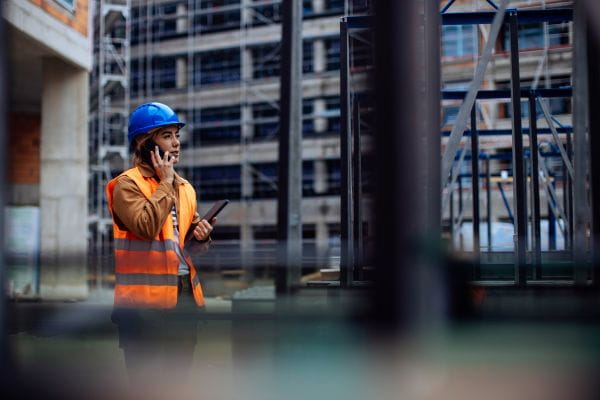
A new play explores the lives of migrant construction workers in the UK, using humour, real-life experiences and physical theatre to capture the banter, friendships and absurd moments that make life on site bearable, alongside the pressures that often go unseen. Ahead of the play’s premiere in London on 12-14 November, playwright Inna Cebotari explains how Three Little Pigs aims to add to the public debate about how best to support the wellbeing of construction workers.
Eliminating barriers in reporting: how conversational AI can unlock safety engagement
By Julian Taylor, ecoPortal on 04 October 2026
Online reporting systems that require lengthy and cumbersome form filling and typing can discourage workers from reporting safety incidents and concerns. However, AI-powered mobile apps that allow reporting simply by speaking can simplify and speed up the process, boosting reporting rates and overall staff engagement with safety systems and culture.

Why UK employers need to rethink recruitment, retention and support for older workers
By Orchie Bandyopadhyay on 04 October 2026
With workers over the age of 50 now comprising almost one third of the entire UK workforce, recruiting and retaining older workers is now core to the success of the economy. However, not all employers are offering what’s needed to retain and recruit older workers, and ageist attitudes, limited flexible working opportunities, and employment support that doesn’t fit with health, caring, or other responsibilities are leaving too many people locked out of the labour market.