

Safety professionals can future proof their jobs by getting out more and talking to people on the shop floor – a skill that can’t be replaced by Artificial Intelligence (AI) – an audience at SHW Live heard yesterday.
News
"AI can’t take your job": why communication skills are safety profs' best tool at SHW Live
By
on 03 July 2026
While there is concern that AI is taking many jobs, Stuart Hughes, head of health and safety at Mercedes‑AMG Petronas Formula One Team said that there is instead an opportunity for the health and safety community to grasp, if we recognise the challenge.
“When anyone can put into an [AI tool] a question around rules, regulations, and create documentation and get a 99.9% accurate response, we have to ask what the value of what we do is,” Hughes said.
“I think it moves us from compliance to this idea of care and the humanisation of the workforce. I think it forces us out to have conversations on the shop floor,” he continued, speaking as part of a panel chaired by NEBOSH’s Dee Arp on the Future of the OSH profession.
 SHW Live brought health and safety professionals together to hear the challenges shaping the industry and the opportunities. Photograph: SHW Live/LinkedIn
Communication – specifically how to get better results and win influence as a safety professional – was a key theme running through the two-day show held at Olympia London on 1-2 July.
Becky Ray, CEO of consultancy and leadership development company, Culture Kick, urged safety professionals to “break the cycle” which sees workers moaning about problems which, if unaddressed, can cement as resentment.
She coaches safety professionals to start the day with a question for their team: “What’s frustrating you today?” She urges safety leaders to be bold about taking steps to tackle problems raised proactively, giving tangible examples of how a simple phone conversation has helped break down silos and resentments.
“Let’s break the cycle of the safety conversation being [about complaining] let’s make it responsive, proactive and human,” she said.
Ray’s views were echoed on the ‘Changing the Safety Conversation’ panel by Natalie von Tersch, founder of Mint HS, a safety consultancy: “Never send a snotty email unless you have a conversation first. You can process body language instantly. We were there before AI,” she said.
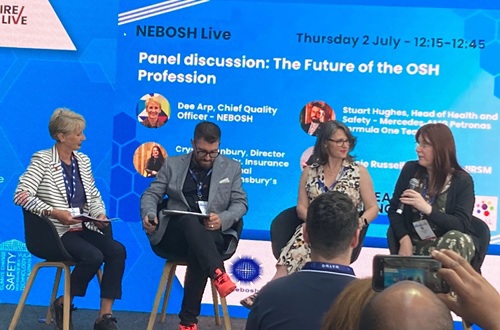 NEBOSH’s Dee Arp chaired a panel on the Future of the OSH profession at Olympia London. Photograph: SHW Live/LinkedIn
Safety professionals’ work requires people to change – either to adopt healthier or safer behaviours, or to adopt new systems. Change can be hard for all of us, shared Dr Nick Bell, lecturer at Cardiff Metropolitan University and chartered member of the British Psychological Society.
Therefore, a technique to encourage change known as motivational interviewing, can be very powerful and he shared the structure of how it works in a conversation in real-time.
The technique helps a person find and express their own motivation for change, rather than coming as an edict they have to comply with. “We need to work in partnership with people, and we need to show compassion,” he said, noting that “telling people they are at risk and giving them information" is not enough to get people to adopt healthier or safer behaviours.
The sessions underlined a major opportunity for the safety community to sharpen their communication skills, with AI unable to replace simple conversation and human presence.
“Our profession at the end of the day is about people,” shared Crystal Danbury, director of group safety at Sainsbury’s. “AI can’t take your job, our job is to operate in the grey, to interpret legislation and apply it to real work, to overlay psychological safety. Lots of that can’t be done by a machine that’s rule-based.”
SHW Live show website here
For more updates on the show, follow Safety, Health & Wellbeing Live on LinkedIn here
NEWS
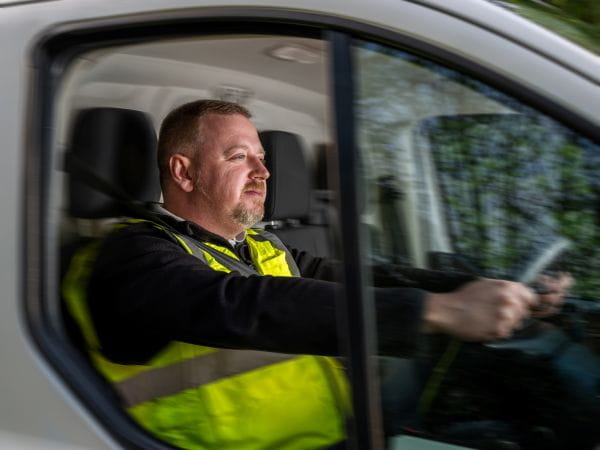
Scheme to recognise commitment to transport staff wellbeing launched by Road Haulage Association
By Orchie Bandyopadhyay on 01 October 2026
A new Wellbeing Recognition Scheme designed to allow organisations across the HGV, coach and van sectors to demonstrate their commitment to improving the health, wellbeing and resilience of the industry’s workforce has been launched by the Road Haulage Association (RHA).
Cost-of-living pressure is cutting into UK workers’ productivity, says report
By Orchie Bandyopadhyay on 04 October 2026
The cost of living is the single largest financial stressor for 62% of UK workers, far outweighing concerns about retirement savings (12%) and building emergency funds (8%), a new study has revealed. Sixty-two per cent of workers admit they do not fully understand the workplace retirement plan they pay into each month, according to TELUS Health’s Q2 2026 TELUS Mental Health Index.

Employers must meet staff to discuss flexible working requests, says first secretary of state
By Orchie Bandyopadhyay on 01 October 2026
Bosses must meet with employees who request flexible working and explain their reasons for any refusals, said Louise Haigh, first secretary of state, in a speech to the Trades Union Congress (TUC) in Brighton on 15 September.