

Employers often try to prevent musculoskeletal problems associated with display screen work by buying equipment, ranging from more expensive chairs to standing desks and posture correctors. The evidence suggests that what makes the difference is not the equipment itself but whether people are shown how to use it, encouraged to keep changing position and given timely, personalised advice based on their actual workstation and risk profile. Dr Nicola Tik and Dr Shane Lowe of Vitrue Health examine five common myths and explain how digital DSE assessment and training can help close the gap.
Features
The five DSE ergonomics myths costing employers money
By
on 07 October 2026
Desk-related pain is one of the few workplace risks employers respond to by buying something. The evidence suggests that what an employee is given matters far less than whether they use it, whether it suits them, and whether anyone ever checks. Here are five expensive assumptions, and the harder question underneath all of them.
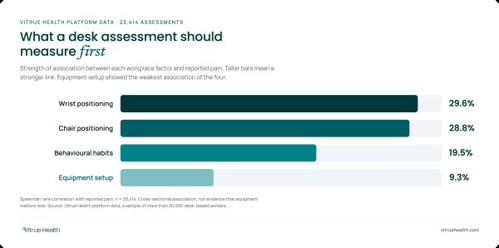
Our own data shows a consistent pattern (Vitrue Health platform data, from a sample of more than 20,000 desk-based workers). Around one in three assessed workers reported discomfort significant enough to affect their concentration. The pain is already in the building, even though it often does not show up in an employer’s internal reporting systems.
The official figures capture the extent of the problem. In Great Britain in 2024/25, 511,000 workers reported suffering a work-related musculoskeletal disorder (MSD), and 7.1 million working days were lost to these conditions. Back problems accounted for 43% of cases, and upper limb and neck problems for a further 41%.

These figures cover all causes, including manual handling and other non-desk work, so they do not isolate cases linked to desk and display screen equipment (DSE) work. For organisations with desk-based workers, the evidence suggests there may be significant numbers of people at work experiencing discomfort, working more slowly than they otherwise would, and not showing up in any internal or public statistics at all.
Most organisations concerned about the health risks posed by DSE work do something reasonable but in fact largely ineffective. They buy equipment – chairs, risers, converters, gadgets. The spending is well intentioned, and it is auditable, which is part of its appeal. But the evidence base behind several of the most common purchases is a good deal thinner than the figures on the invoices suggest.
Myth one: a more expensive chair will fix back pain
Chairs are not useless. A systematic review of workplace chair interventions found a consistent trend towards reduced musculoskeletal symptoms, though the authors rated the evidence as moderate at best and could not pool the studies. The detail that tends to get skipped is what those studies had in common – in every one of them, participants were trained in how to use the chair’s adjustable features.
The most informative trial in this area was a large field study of office workers that tested these options directly. Over 12 months, ergonomics training for DSE users on its own did not produce a statistically significant improvement in musculoskeletal symptom progression or productivity compared with no intervention.
By contrast, providing a highly adjustable chair together with the same training reduced symptom growth over the workday and improved productivity. These findings indicate that training and equipment are complementary rather than interchangeable: a highly adjustable chair that is not paired with training, and support for its correct use, is unlikely to deliver its full potential. In fact, research suggests that many employees with adjustable chairs make few or no changes to the default settings.
What helps instead: budget for 10 minutes of suitable and effective instruction on the correct use and adjustment of the chair once provided, rather than assuming the chair carries the benefit by itself. This should be followed by a check a few months later to see if the chair is still set up and being used correctly. In short, chair adjustment should be taught as an ongoing behaviour that can help reduce the risk of discomfort and MSDs, not simply treated as a tick box during specification and purchasing.
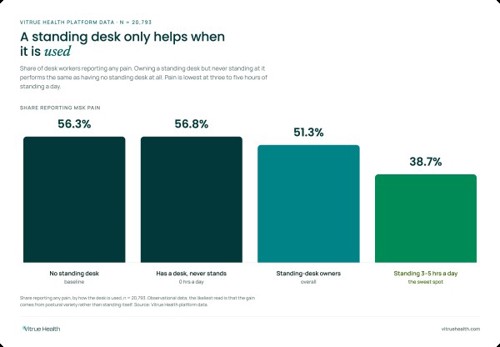
Myth two: a standing desk will solve problems related to prolonged sitting
The 2018 Cochrane review on workplace interventions for reducing sitting time is often quoted in support of sit-stand desks. It is worth reading what it actually says. Sit-stand desks, alone or combined with information and counselling (advice and coaching), reduced sitting at work by around 100 minutes a day in the short term.
That fell to roughly 57 minutes at three to 12 months, on the strength of just two studies. The evidence overall was rated low quality, and there was no evidence at all on whether the effect survives beyond a year.
One further point gets lost. The review measured sitting time, not pain, so a reduction in sitting is not in itself evidence of reduced musculoskeletal risk. Separately, there is good reason to think that standing for long unbroken periods carries its own load, particularly through the lower limbs. Replacing eight static seated hours with eight different static hours is not progress.
What helps instead: treat the goal as variation between sitting and standing, so that people regularly change posture and position, rather than encouraging long periods of standing alone. A desk that moves is useful only to someone with a reason and a prompt to move it.
Myth three: a treadmill desk gives you movement for free
It does not. In a randomised comparison of slow treadmill walking against sitting, net typing speed was around 13 words per minute lower in the walking group, and accuracy was worse. Verbal learning was about 7% lower and sustained attention about 9% lower, though both groups remained within normal ranges.
That is not an argument against treadmill desks – it is an argument against the version of the pitch that promises movement at no cost. There is a cost and it lands on cognitively demanding work. It is also, in our experience, why so many of these units are enthusiastically used for a fortnight and then quietly parked against a wall.
What helps instead: separate movement from focused work rather than layering one on top of the other. Brief walking meetings and walking phone calls tend to fit well into a normal working week. Drafting a board paper at 2.5 kilometres an hour is a good deal harder than doing it at a desk.
Myth four: kneeling chairs and alternative seating correct poor posture
Here, the honest answer is that the evidence is not there to support the claim either way. A small number of pilot studies have been carried out that sought to measure spinal angles over short periods. There is no body of research showing that alternative seating reduces pain in desk workers over a working year, which is the claim buyers think they are paying for.
It is also worth separating two different things. Changing the shape of the spine is not the same as changing a symptom of musculoskeletal pain or discomfort. And alternative seating tends to reduce the number of positions a person can comfortably adopt rather than increase them, which is the opposite of what most desk workers need.
What helps instead: the best seat is usually the one someone can comfortably change position in, and change position in often.
Myth five: posture correctors fix poor posture
This is the most expensive myth in proportion to its evidence, because it rests on a premise that does not hold. A review of the literature on posture and low back pain concluded that if there is any association between the two, it is slight. Measurements such as lumbar lordosis and pelvic tilt do not reliably separate people with back pain from people without it, and where a relationship does appear, causality often runs the other way: pain changes how people hold themselves, rather than posture producing the pain.
What the evidence does consistently point to is movement. A device designed to hold the body in one position, however correct that position is thought to be, works against the mechanism that actually helps.
What helps instead: stop treating posture as a shape to be achieved and start treating it as something that should keep changing.
The thread running through all five
All of these equipment purchases are based on flawed logic. Objects can be specified, procured, delivered and counted, but behaviour cannot. So, organisations buy the thing they can put on a purchase order and hope the behaviour follows.
A 2025 meta-analysis of 24 randomised controlled trials covering more than 4,000 DSE workers found that ergonomic interventions did reduce pain, but modestly, and did not significantly improve functional disability. The authors noted that training raises awareness but produces minimal long-term behaviour change unless it is combined with physical and ergonomic changes. Equipment alone is not sufficient. Neither, on its own, is education.
Which leads to the question most organisations skip.
Why employees ignore the advice they are given
Almost every DSE user in a well-run organisation will have completed an assessment. Far fewer will have changed anything as a result. The gap between completion and change is where the money goes. Four things drive it.
- The advice arrives at the wrong time. Annual assessments mean guidance lands on a date chosen by the compliance calendar, not by the employee’s body. Someone with no symptoms in March is asked at that point to think carefully about a risk that will become real in October, by which point the assessment email, and any advice it contained, is long forgotten.
- The advice is generic. A 26-year-old on a laptop three days a week in a shared space and a 58-year-old at a fixed dual-screen setup have almost nothing in common, and telling both of them to keep the top of the monitor at eye level helps neither of them very much. Guidance that could apply to anyone tends to be acted on by no one.
- Nobody is measuring the right thing. DSE assessment completion rates are measured because they are easy to measure and they satisfy an audit. Whether anyone raised their monitor is not measured at all. What gets reported gets managed, and what is being reported here is paperwork.
- Nothing visibly happens. This is the one that does the real damage. An employee flags wrist discomfort in an assessment, hears nothing back, and draws an entirely rational conclusion about whether raising it again is worth the effort. That is the mechanism behind the copied answers by some DSE users. People do not repeat last year’s responses because they are lazy. They repeat them because last year’s responses produced no consequence.
What closes the gap
The characteristics of guidance people actually act on are not mysterious. Effective guidance is timely, and arrives when a symptom is present rather than when the calendar says so. It is personalised to the person’s actual setup, working pattern and reported discomfort. It is simple and easy enough to do now, because a single specific adjustment usually gets made, while a 12-point action list often does not. And it is visibly responded to, so that flagging something produces a reply and a change.
None of that is achievable through an annual form. It is achievable through better instrumentation of something organisations are already doing.
AI-powered online platforms and software can now make the process of DSE risk assessment and DSE user training considerably more effective. An online platform can record how users assess their own workstations, record and flag concerns about aches, pains and unsuitable furniture, identify trends over time that point to emerging musculoskeletal problems among individuals and teams, provide targeted instruction on safe use, and enable employers to manage risk across multiple sites and countries, including among home-based workers. The compliance exercise stays intact. What changes is that it starts producing usable information rather than a completion percentage.
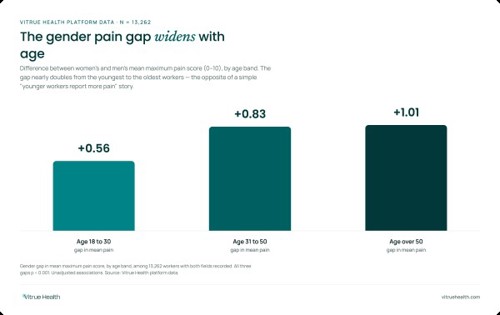
That information turns out to be valuable well beyond health and safety. Patterns in reported discomfort by team, role, age and working arrangement are exactly the sort of evidence that makes a business case for prevention rather than a request for more chairs.
The five myths persist because they offer something appealing: a problem that can be solved by purchasing equipment. The more accurate picture is less convenient. Desk-related pain responds to timely, specific, repeated support that matches how a particular person actually works. The goal is not just a completed assessment. It is an earlier intervention, at a scale that no ergonomist visiting desk-by-desk could ever reach.
What the evidence actually supports
- Equipment and instruction only work effectively when delivered together. Chair studies that reduced symptoms provided both. The one trial that tested training without new furniture found no effect.
- Variation beats posture. Regular changes of position support the body better than any single position.
Movement is separate from DSE-based work. Active workstations carry a measurable cost to typing accuracy and sustained attention. - Equipment alone is not enough. A 2025 meta-analysis of 24 trials found ergonomic intervention reduced pain only modestly and did not improve functional disability.
Timing matters more than content. Guidance given when a symptom is present is acted on. The same guidance given annually is not.
Five signs your DSE programme has become a paperwork exercise
- You can report completion rates but not what changed as a result
- A significant share of responses are identical to last year’s
- Reported discomfort does not trigger anything automatically
- The same advice goes to home workers, hybrid workers and fixed-desk workers
- Your equipment budget has grown but your MSK-related absence has not moved.
Three questions worth asking of your own data
- Which teams report the most discomfort, and why? Role and working pattern usually explain more than furniture does.
- How long is the period between someone first reporting a symptom and anything happening? If nobody knows, that is the answer.
- Who has reported discomfort more than once? Repeat reporters are your highest-value intervention group, and most organisations cannot identify them.
Vitrue Health publishes free guidance on DSE risk management and workplace musculoskeletal health, including webinars and practical guides for health and safety teams. For more details, see:
vitruehealth.com
vitruehealth.com/reportsandguides (free reports and guides)
linkedin.com/company/vitruehealth
Dr Nicola Tik is head of clinical at Vitrue Health, and Dr Shane Lowe is CEO & co-founder of Vitrue Health.
References – verified sources
1. HSE, Work-related musculoskeletal disorders statistics in Great Britain, 2025: 511,000 workers, 7.1 million working days lost, back 43%, upper limb and neck 41%.
2. van Niekerk SM, Louw QA, Hillier S, The effectiveness of a chair intervention in the workplace to reduce musculoskeletal symptoms, BMC Musculoskeletal Disorders, 2012;13:145: consistent trend supporting chair interventions, moderate evidence quality, training in adjustable features present in all five studies. Only one of the five studies was conducted with office workers.
2b. Amick BC et al., Effect of office ergonomics intervention on reducing musculoskeletal symptoms, Spine, 2003: the office-worker study inside the above review. Training alone produced no significant effect (p = 0.461); chair plus training did (p = 0.012). Source for the “not substitutes” point in Myth one.
3. Shrestha N, Kukkonen-Harjula KT, Verbeek JH, Ijaz S, Hermans V, Pedisic Z, Workplace interventions for reducing sitting at work, Cochrane Database of Systematic Reviews, 2018: low-quality evidence, 100 minutes per day short-term reduction, 57 minutes at 3 to 12 months, no evidence beyond one year.
4. Larson MJ et al., Cognitive and typing outcomes measured simultaneously with slow treadmill walking or sitting, PLOS One, 2015: net typing approximately 13 wpm lower, accuracy worse, verbal learning approximately 7% lower, sustained attention approximately 9% lower.
5. Narrative review on posture and low back pain, Bulletin of Faculty of Physical Therapy, 2021: association between posture and pain is slight, causality may run from pain to posture.
6. Efficacy of Ergonomic Interventions on Work-Related Musculoskeletal Pain: A Systematic Review and Meta-Analysis, Journal of Clinical Medicine, 2025: 24 RCTs, 4,086 workers, VAS mean difference -0.28, no significant improvement in functional disability, training alone produces minimal long-term behaviour change.
Key references
Amick, B. C., III, Robertson, M. M., DeRango, K., Bazzani, L., Moore, A., Smith, M. J., & Moore, A. (2003). Effect of office ergonomics training and a highly adjustable chair on musculoskeletal risks in office workers. Applied Ergonomics, 34(6), 549-558. doi.org/10.1016/S0003-6870(03)00039-3
Robertson, M. M., Huang, Y.-H., O’Neill, M. J., & Schleifer, L. M. (2013). Flexible office space design and employee behaviour: A pilot study. Applied Ergonomics, 44(6), 939-946. doi.org/10.1016/j.apergo.2013.02.005
FEATURES

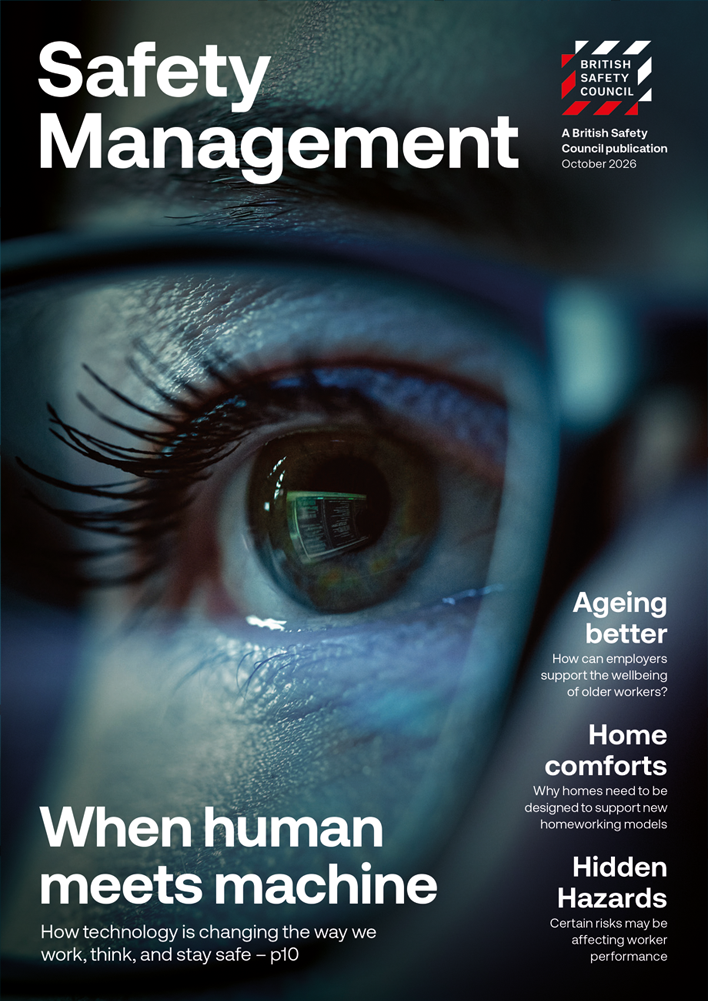
The five DSE ergonomics myths costing employers money
By Dr Nicola Tik & Dr Shane Lowe, Vitrue Health on 07 October 2026
Employers often try to prevent musculoskeletal problems associated with display screen work by buying equipment, ranging from more expensive chairs to standing desks and posture correctors. The evidence suggests that what makes the difference is not the equipment itself but whether people are shown how to use it, encouraged to keep changing position and given timely, personalised advice based on their actual workstation and risk profile. Dr Nicola Tik and Dr Shane Lowe of Vitrue Health examine five common myths and explain how digital DSE assessment and training can help close the gap.

Confined spaces: why training is key to keeping workers safe
By Adam Barker, Draeger Safety UK on 22 September 2026
Suitable training plays an essential role in preventing fatalities and dangerous situations during work in confined, hazardous spaces like tanks, silos and sewers, but it’s essential that any course selected genuinely reflects the specific tasks, hazards and risks workers will be faced with.
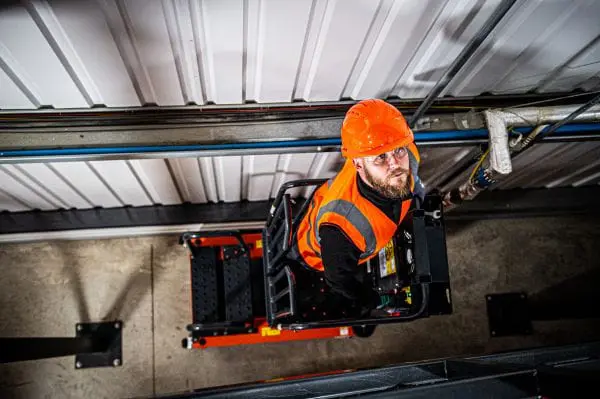
Why the future of low-level access starts with rethinking old habits
By Samuel Butterworth, JLG Power Towers on 22 September 2026
Low-level access equipment like powered lifts can help make work at height safer by providing a secure, enclosed working platform, but they can also bring other benefits, such as avoiding the need for awkward stretching to reach work areas, which helps to prevent musculoskeletal injuries.