
Wearable technology powered by AI analysis is now regularly deployed to prevent safety problems like musculoskeletal injuries and collisions between forklifts and pedestrians, and future developments mean the technology looks set to make it easier to manage other safety challenges, like site evacuations.
Features
AI-powered wearables: transforming workplace health and safety
By
on 08 December 2025
Artificial intelligence (AI) has moved from pilot projects to practical deployment in occupational safety. A new generation of wearable devices – belts, sensors, exoskeletons and smart tags – now provides real-time monitoring, predictive analytics and instant feedback that help organisations prevent injuries before they occur. The result is a decisive shift from reactive incident management to proactive risk control, with tangible benefits for worker wellbeing, operational performance and compliance.
Why AI wearables matter now
The business impact of workplace injuries remains significant, especially when manual handling and repetitive tasks are part of everyday operations. Musculoskeletal disorders (MSDs) are a persistent driver of absence and reduced productivity in the UK. Recent Health and Safety Executive figures for 2024/25 indicate more than half a million people experienced work-related MSDs, leading to millions of working days lost – predominantly due to back issues. That is a cost borne by individuals and employers alike, and it is precisely where digital ergonomics can make a measurable difference.
At the same time, interactions between people and moving equipment – such as forklifts – continue to pose serious risks. Historic data shows that a large proportion of forklift incidents involve pedestrians, often where visibility is compromised. AI-enabled wearables now provide an additional layer of control: they detect proximity, warn both the driver and the pedestrian, and record near misses to enable better decision-making.
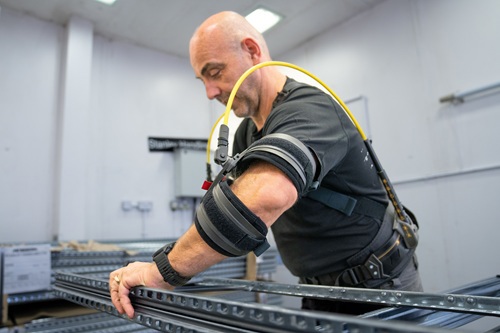 Safety wearables are moving toward mainstream adoption and are likely to become an expected component of personal protective equipment (PPE). Photograph: Stanley
What ‘AI wearable safety’ looks like in practice
Modern safety wearables combine multiple elements:
- Sensing and telemetry: accelerometers, gyroscopes, pressure and strain sensors, temperature, light and noise detection, complemented by ultra-wideband (UWB) and Bluetooth Low Energy (BLE) for location and proximity.
- Edge intelligence: on-device algorithms that assess posture, frequency of risky movements (for example, deep flexion, torsion), exposure to adverse conditions, and potential collision scenarios.
- Feedback loops: haptic cues (vibration), visual prompts, and audio warnings that coach the wearer in real time.
- Data pipelines: secure transmission to cloud dashboards for trend analysis, training design, compliance reporting and continuous improvement.
These capabilities underpin solutions such as the Modjoul SmartBelt and WearHealth AI-based ergonomic analysis tool. The Modjoul SmartBelt is an AI data-driven wearable device that monitors whether workers are making the appropriate ergonomic movements while carrying our manual handling tasks. The device detects risky bending, lifting, twisting or stretching, and alerts the worker via a haptic buzz, therefore providing a reminder to follow the manual handling training they have been given. The system also sends real-time data to the management team, enabling them to identify any workers who are struggling with the physical demands of handling tasks, identify where manual handling has failed and understand where refresher training is needed.
WearHealth, meanwhile, uses AI and data-driven insights to enable employers to buy the right exoskeleton solution from the world’s top manufacturers. Experts analyse the ergonomic risk of specific workplace activities using a combination of video scanning of tasks that pose MSD risks, AI and biomechanics. The data is processed through an algorithm to produce a bespoke report that identifies the exosuit most suitable for the job.
The worker then wears the recommended suit along with sensors to test and analyse its performance. The use of appropriate exoskeletons can reduce ergonomic and MSD injury risks by supporting areas like the back, shoulders and arms during tasks involving physical exertion, prolonged postures and repetitive movements.
AI-based ergonomic solutions like the Modjoul SmartBelt and WearHealth therefore help identify high-risk tasks, reshape behaviour and reduce incident rates. The common thread is actionable insight: precise information that safety teams can use immediately.
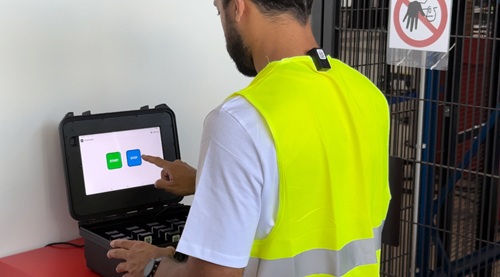 WearHealth uses AI and data-driven insights to enable employers to buy the right exoskeleton solution from the world’s top manufacturers. Photograph: WearHealth
Exoskeletons: targeted support for demanding tasks
Exoskeletons are wearable frames that offload strain and assist posture during strenuous or repetitive work. They aim to protect the body rather than increase lifting capacity beyond safe limits. Two broad categories exist:
- Active exoskeletons use powered systems – motors, batteries or hydraulics – to deliver assistance. They are well suited to tasks with frequent, high-load movements but require charging and maintenance.
- Passive exoskeletons employ mechanical means – springs, elastic elements or rods – to store and release energy. They offer simplicity, lighter weight and minimal upkeep, making them attractive for day-long use.
In manufacturing, logistics, construction and care settings, exoskeletons can reduce the ergonomic risk from activities like frequent lifting, overhead work, trunk flexion and sustained awkward postures. The actual selection process for the exoskeleton matters as much as the device itself. Leading providers conduct structured assessments that combine video-based task analysis, evaluation by an ergonomist and wearable sensor-derived metrics (for example, angles, duration, frequency) to determine the best match for the task profile. The goal is to align the exoskeleton’s assistance curve with the actual movement pattern, ensuring benefits without restricting mobility.
A robust selection and trial method
A best-practice approach typically includes:
- Task mapping: identify specific operations with the highest risk profile – lifting from low racking, patient transfers, palletising, repetitive assembly.
- Objective measurement: use video scanning and wearable sensors to quantify bending, twisting, reaching and carry durations.
- Expert review: combine ergonomic standards with AI-driven insights to recommend possible suitable exoskeletons.
- On-the-job trial: fit and coach operators; trial over 1–2 weeks to allow for adjustment and observe natural usage.
- Before/after comparison: re-run measurements and solicit worker feedback to confirm reductions in strain and fatigue.
- Deployment plan: scale up with training, maintenance routines and usage protocols aligned to shift patterns.
This evidence-led cycle ensures the chosen solution addresses the actual risk, not the perceived one.
Case study: care sector trial
In a residential care setting, caregivers routinely perform patient transfers and repositioning, which can result in cumulative strain. An assessment using video analytics examined two high-demand tasks: moving a resident in and out of bed and lifting a resident from a seated position. The ergonomics review concluded that a passive back-support exoskeleton would be the most appropriate, as it can provide assistance through the trunk flexion phase and support during controlled lifting and lowering.
Over a two-week trial period, participants reported noticeably lower fatigue and no injuries were recorded. Sickness absence dropped to zero during the trial window. While anecdotal sentiment is never the sole basis for deployment, it aligned with the quantitative data: reduced high-risk bends and a lower overall ergonomic risk index. Based on these results, a broader implementation plan was developed, including training modules, fit-and-forget routines and clear guidance on when the device should be used versus when traditional handling aids are more appropriate.
Case study: heavy profiles in construction supply
A construction supplier needed to manage risks associated with lifting 10–30 kg aluminium profiles from low racking and staging them for dispatch. Operators frequently bent deeply and rotated while carrying loads to shoulder height, leading to back and knee strain. After a one-week familiarisation period with Hapo Back exoskeletons, a second week of sensor-based analysis compared pre- and post-adoption metrics.
Two workers – one in his 60s and one in his 20s – both reported immediate relief. Data indicated a substantial reduction in trunk flexion severity and duration. Modelling suggested the approach could reduce lower back injury risk by around 40 per cent for those tasks. The company opted to acquire additional exoskeletons and continues to track outcomes across near misses, self-reported discomfort and return-to-work metrics.
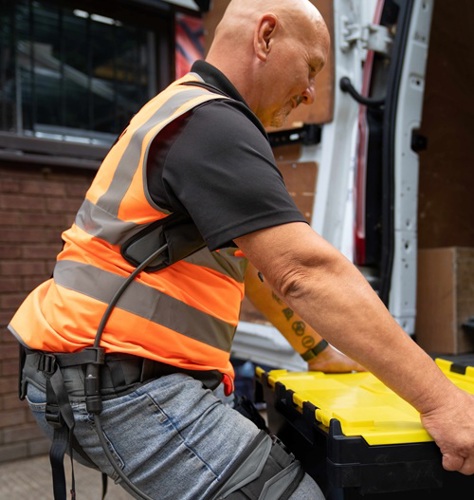 Photograph: Stanley
Reducing pedestrian–vehicle risk with proximity intelligence
Wherever people share space with materials handling equipment, visibility, speed, congestion and distraction can combine to create dangerous conditions. Proximity-enabled wearables tackle this by:
- Detecting risk: Ultra-Wideband Beacon (UWB) and Bluetooth Low Energy (BLE) beacons can be installed on materials handling equipment and in areas like warehouses and goods loading bays to determine distance and direction between a forklift and a pedestrian’s wearable device with high accuracy.
- Warning in both directions: pedestrians receive haptic alerts on their belt or tag, alerting them a forklifts nearby, and drivers are notified via in-cab visual and audio cues – especially valuable at blind corners, intersections and busy staging areas.
- Logging near misses: each alert becomes a data point for heatmaps, route redesign and targeted briefings.
This ‘mutual awareness’ model helps reduce the frequency and severity of unsafe encounters between materials handling equipment and pedestrians, while providing the evidence needed to adjust layouts, speed limits, mirrors and signage.
Dynamic provisioning, access control and emergency roll call
Wearables can also improve how sites manage personnel and visitors:
- Dynamic provisioning: a tagged device is issued to personnel and visitors at reception; scanning the device associates it with the person’s profile instantly, enabling accurate mustering and reporting.
- Zoning and restricted access: beacons can create digital boundaries, so only those with the right permissions can enter, and any attempts to enter prohibited areas will trigger alerts.
- Emergency response: during evacuation, dashboards show who has exited and who remains inside, accelerating mustering and reducing uncertainty for incident commanders.
These capabilities strengthen site security, streamline inductions and contribute to faster, more accurate emergency procedures.
Monitoring environmental exposure
Certain workplaces involve prolonged exposure to cold, heat, noise or poor lighting. Wearables equipped with environmental sensors can:
- Alert a worker who has exceeded the safe exposure time in chilled or heated zones.
- Flag sustained noise levels above recommended thresholds so hearing protection practices can be reinforced.
- Identify areas that are consistently too dim or overly bright, informing facilities adjustments.
Over time, this creates a dataset that helps those responsible for ensuring safe working conditions prioritise engineering controls and optimise shift rotations to manage cumulative exposure.
Data-driven training, onboarding and behaviour change
The real power of AI wearables emerges when real-time feedback is coupled with targeted coaching. For example:
- New-starter focus: the likelihood of being injured at work is typically higher in the first two months of employment. Wearable analytics highlight where new colleagues experience the riskiest movements, enabling tailored micro-learning and supervision.
- Personalised coaching: haptic prompts train the body to adopt safer movement patterns – for example, cueing a hip hinge rather than a rounded back to reduce MSD risks.
- Role-specific modules: warehouse pickers, CNC (Computer Numerical Control) machine operators and care workers each face distinct ergonomic risks; dashboards help safety managers identify the top three behaviours to address for each role, to reduce MSD injury risks.
- Proof of improvement: before/after charts verify that training translates into fewer high-risk events, boosting engagement and accountability.
This continuous coaching model complements traditional training by embedding safe habits on the job, not just in the classroom.
Integrating with the organisation’s safety management system
AI wearables are most effective when embedded within a structured safety framework, such as ISO 45001, the international standard that provides a structured approach to managing occupational health and safety risks. Therefore, when using AI wearables as part of efforts to improve the organisation’s overall health and safety management system, points to remember include:
- Hazard identification: wearable sensor data can be used to refine the organisation’s risk register and risk profile, as the data provides objective evidence of where and how safety risks exist and are being assessed and managed.
- Controls and hierarchy: when seeking to manage safety risks, employers should always prioritise engineering and administrative controls, as the safe design of work is the most effective way of controlling safety risks. Therefore, AI wearables should be adopted as an additional layer to boost safety, and not be used as a substitute for the safe design of work, systems and equipment.
- Action management: effective management of safety risks involves having appropriate systems in place to regularly review and – where necessary – improve safety procedures, so any safety insights arising from the use of AI wearables must be used to inform corrective and preventive actions. People within the businesses must be given formal ownership to ensure any necessary steps are taken, and dates must be set for this to happen.
- Audit and review: metrics arising from the use of wearables must be incorporated into safety committees, toolbox talks and management reviews – for example, so everyone is aware of any safety problems revealed by the data, and any necessary corrective action is taken.
- Supplier collaboration: employers should consider share anonymised insights from wearables data with equipment manufacturers so they can consider ways of improving safety guarding, ergonomics and layouts.
Integrating data from safety wearables into the safety management system is therefore good governance and means the businesses can prove and check it has acted on the results of the safety data, including making improvements where necessary.
Privacy, ethics and change management
To ensure the successful adoption of AI wearables, organisations need to be transparent and fair in how they use data, as workers may be fearful the data will be used to target them – for example, leading to disciplinary action if they inadvertently do something unsafe. Employers should therefore consider the following:
- Purpose clarity: define and explain what is being measured and why – injury prevention and training – not performance policing.
- Data minimisation: only collect the necessary data; avoid audio recording and precise location tracking unless this is considered essential.
- Anonymisation and aggregation: report trends at team/role level wherever possible; and restrict individual-level access to trained safety professionals.
- Consultation: engage employee representatives, unions and works councils early; address concerns and incorporate feedback.
- Voluntary pilots with opt-out: build trust with clear policies, consent pathways and easy support.
- Secure handling: apply strong access controls, retention limits and regular audits.
Respectful governance builds the cultural foundation for sustained results when deploying AI wearables for safety purposes.
Implementation roadmap
When selecting and deploying AI wearables for safety purposes, it is advisable to follow a staged process.
Phase 1: Discovery (duration 2–4 weeks)
- Map high-risk tasks and locations; review injury and near-miss history.
- Prioritise two to three use cases (for example, manual handling in dispatch, pedestrian–forklift interaction).
- Define success criteria (for example, 40 per cent reduction in high-risk bends, 50 per cent fewer near-misses).
Phase 2: Pilot (duration 2–4 weeks)
- Fit a small cohort with wearable devices; deliver brief training and coaching.
- Run initial analysis, make quick layout/process tweaks, and iterate.
- Track leading indicators: high-risk event frequency, near-misses, exposure time; and lagging indicators: injuries and lost time.
Phase 3: Review and scale (duration 1–2 weeks)
- Compare baseline vs. pilot results; quantify benefits and capture lessons learned.
- Expand to adjacent teams; integrate dashboards into daily management routines.
- Formalise SOPs, maintenance and onboarding processes.
Phase 4: Continuous improvement (ongoing)
- Refresh risk assessments quarterly with new data.
- Rotate training focus based on seasonal trends (for example, peak season handling loads).
- Share success stories to maintain momentum.
Building the business case
For safety practitioners seeking to convince the board of the benefits of investing in AI wearables for safety purposes, there is compelling case in terms of both financial and human outcomes. These include:
- Injury prevention: fewer MSDs, slips and collisions translate into lower direct costs (claims, medical expenses) and lower indirect costs (overtime, training replacement staff, schedule disruption).
- Productivity and quality: reduced fatigue, smoother flow around equipment, fewer stoppages and higher consistency of output.
- Insurance and compliance: better risk profiles can influence premiums and improve audit readiness.
- Engagement and retention: demonstrating care for employee wellbeing improves staff morale and reduces turnover.
- Data-informed decisions: resources can be directed precisely where they will have the biggest impact.
Once the decision has been taken to deploy AI wearables, the above potential benefits should be linked to clear metrics, such as TRIR (Total Recordable Incident Rate), LTIFR (Lost Time Injury Frequency Rate), MSD rate per 100 FTE (full time employees), days lost, near-miss frequency, and average severity of incidents and accidents.
All these metrics should then be tracked and reported, to reinforce the case for continuing to deploy the safety technology.
Government interest and the evolving PPE landscape
Public policy is increasingly supportive of technologies that boost productivity and safeguard workers. During a recent visit to our Hertfordshire facility, the UK Minister for AI and Digital Government trialled an exoskeleton and discussed the role of AI-enabled devices in creating safer, higher-quality jobs. Interest at this level underscores a broader trend: safety wearables are moving toward mainstream adoption and are likely to become an expected component of personal protective equipment (PPE), alongside helmets, gloves and safety footwear.
Standards and interoperability will continue to mature, enabling organisations to integrate wearables with access control, time and attendance, learning platforms and enterprise safety systems.
What’s next: from point solutions to intelligent ecosystems
Looking ahead, three potential developments stand out:
- Convergence with building systems: wearables will be able to interact with fixed infrastructure – doors, conveyors, automated storage – so that equipment responds dynamically to human presence.
- Enhanced evacuation intelligence: wearables will be integrated into real-time roll calls, heatmaps of last-known locations and automated alerts to marshals.
- Digital twins for safety: sensor data will be fed into 3D facility models to simulate workflow changes before implementation, validating risk reductions in advance.
As these elements come together, organisations will move beyond compliance to a culture where safety, productivity and employee experience reinforce one another.
Practical takeaways
- Start with a small, high-impact wearables pilot and measurable objectives.
- Choose devices that fit the task – and involve end users in the selection.
- Treat wearables as a coaching tool, not a surveillance system.
- Embed data into the organisation’s ISO 45001 (or equivalent) safety systems and routines so improvements stick.
- Communicate early and often; celebrate quick wins and share the data.
Small, evidence-based steps compound into lasting change.
Graham Sharp is managing director at Stanley, which helps organisations design and deploy AI-enabled wearables and ergonomic solutions that reduce injuries, deliver workplace wellbeing, and improve operational performance. For more information see:
stanleyhandling.co.uk
[email protected]
T: +44 (0)800 298 2980
FEATURES

Who is the wolf in your life? Listening to the people behind the hard hat
By Inna Cebotari, Kinth Square on 02 October 2026
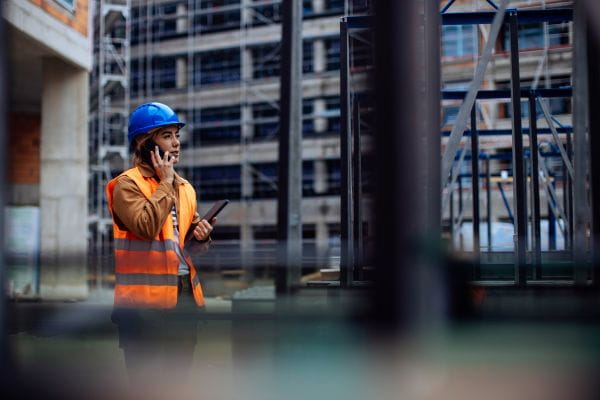
A new play explores the lives of migrant construction workers in the UK, using humour, real-life experiences and physical theatre to capture the banter, friendships and absurd moments that make life on site bearable, alongside the pressures that often go unseen. Ahead of the play’s premiere in London on 12-14 November, playwright Inna Cebotari explains how Three Little Pigs aims to add to the public debate about how best to support the wellbeing of construction workers.
Eliminating barriers in reporting: how conversational AI can unlock safety engagement
By Julian Taylor, ecoPortal on 04 October 2026
Online reporting systems that require lengthy and cumbersome form filling and typing can discourage workers from reporting safety incidents and concerns. However, AI-powered mobile apps that allow reporting simply by speaking can simplify and speed up the process, boosting reporting rates and overall staff engagement with safety systems and culture.

Why UK employers need to rethink recruitment, retention and support for older workers
By Orchie Bandyopadhyay on 04 October 2026
With workers over the age of 50 now comprising almost one third of the entire UK workforce, recruiting and retaining older workers is now core to the success of the economy. However, not all employers are offering what’s needed to retain and recruit older workers, and ageist attitudes, limited flexible working opportunities, and employment support that doesn’t fit with health, caring, or other responsibilities are leaving too many people locked out of the labour market.