

The decentralisation of work away from fixed workplaces, the rise of Ai and demographic changes are creating new opportunities for people to carry out ‘hands-on’ work in the home, such as production of fashion, textiles, food and drink, and delivery of health services and therapies. However, our existing housing stock is not designed to accommodate such functions, so it’s essential that future town planning creates homes that support different kinds of enterprise, both to support business success and the wellbeing of these new home-based workers.
Opinion
Rethinking homes as centres of economic activity (amongst other things)
By
on 08 October 2026
For many years now, we’ve been aware that we are not building enough new homes in the UK. Every political party promises to build more. But it hasn’t been happening at anywhere near the scale required.
Amidst the debates about numbers, affordability, tenure and sustainability, no one seems to be asking what may be the most important question: what are homes for in the mid-21st century?
This question needs to be asked in the context of several continuing or emerging trajectories of transformative change:
- The continuing decentralisation of work due to advancing digital technologies
- The increasing capabilities of artificial intelligence, automation and robotics
- Demographic changes, most particularly living longer lives
- Aspirational changes towards better balance, harmony or integration between work and the rest of life.
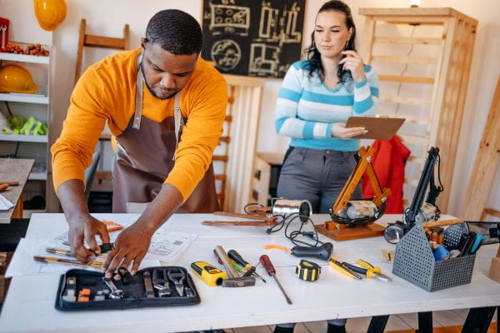
The decentralisation of work is about much more than the “home versus office” debate. Digital evolution since the 1980s has enabled many types of work to be carried out from a much wider range of locations than before. Knowledge work has boomed during this time, as manufacturing work has declined.
The digital decentralisation of work has reversed the Industrial Age imperative to concentrate people and resources in the same place for efficiency and economies of scale. It has changed fundamentally how and where people work – across organisation-owned premises, field locations, customer locations, third-party serviced offices, coworking spaces, public spaces, on transport, and, of course, in personal spaces in and around homes as well.
It has also transformed the way businesses relate to and communicate with each other. And it has enabled the development of online platforms used by almost everyone, from global companies to freelancers and startups.
Significantly, but usually under the radar when thinking about home-based working, it’s also created new possibilities for individuals and companies operating in more traditional “hands-on” sectors, such as fashion and textiles, food and drink, arts and crafts, music, health, therapies and more. They have opportunities to market and sell their products and services online, communicate with customers, partners and suppliers virtually, and in many cases integrate into supply chains that were previously out of reach.
So we need to abandon at the outset any assumptions that home-based working is all about corporate employees doing a bit of knowledge work at home two days a week. It’s much wider than that, and involves all kinds of complex interrelationships.
The impacts of AI on where and how people work
There is much debate about whether AI will lead to a “Jobpocalypse” or create more opportunities for work. It’s clear that AI does impact many tasks currently carried out by humans. It will probably lead to a “hollowing out” of certain types of administrative, professional and technical occupations, but will probably also lead to new kinds of AI-augmented work, plus new models of strategic and supervisory work.
Where will these be carried out? I see two trajectories of change at work here. AI for white-collar work is an accelerator for decentralising work. Much of the work in activities such as data analysis, software development, monitoring, diagnostics, programming and aspects of maintenance can in principle be carried out from many locations. That can be as individuals or as teams. There is a range of reasons why people might need or want to be working in the same place – security, confidentiality, learning, socialisation, etc. – but the overall drift will be away from traditional offices.
At the same time, rapid developments in automation and “physical AI” – that’s AI + robotics – have the effect of turning many elements of hands-on, site-specific or direct customer-facing work into knowledge work.
Again, much of that can be done at a distance, but there’s a stronger need in many cases to be located, for at least part of the time, close to the hands-on or site-specific location: places such as labs, facilities developing or deploying robotic tools, in fast expanding industries like space and defence, in fields like policing and surveying where drones are increasingly deployed, etc.
That creates demand for office-type environments located within or close to production facilities, while also providing possibilities for doing much of the work in other locations too.

Demographic and aspirational change
Added into this ferment of change are the impacts of an ageing society. More people are working past retirement age. And more people in their forties and fifties are rethinking what they want to do with their lives.
In both cases, people are looking for more flexibility and more control over not only the time and place of work, but also what they want to do. And that is often to be their own boss, to move in a new career direction, or to develop an interest or side-hustle that may or may not lead to financial reward. Having more meaningful and satisfying work is a big part of the story for many.
The days of working for a single employer over the whole of a working life are long gone for most of us. That has been replaced by working for a series of employers between education and retirement. But that is evolving now too.
We’re starting to see a new pattern emerging for being able to flex between periods of employment, self-employment/freelancing/startup/side-hustle, learning, and caring, spread over working life that extends beyond pensionable age.
Digital technologies and AI provide new opportunities for leading a successful and varied career along these lines. And increasingly this is home-based.
Addressing the varieties of home-based and local working
So there is a combination of trends that creates momentum towards carrying out work, learning and caring for others within the same environment.
The problem is that homes are not designed to cater for this range of activity. Instead, the trend since the 1970s has been to make homes ever smaller and more standardised¹. That effectively designs out the ability to work from home or have the flexibility needed for these other purposes.
It’s a trend that has been encouraged by both developers and planners, informed in part by profit and in part by outdated assumptions about the relationship between sustainability and high
urban density.
The risk is that, should a government succeed in delivering new houses at scale, they will be homes designed for yesterday rather than tomorrow.
Despite fine talk about mixed-use developments and 15-minute neighbourhoods, in practice what happens is a top-down approach to some adjacency of different uses, not the kind of integration of uses that would stimulate new local and domestic enterprise.
Homes just aren’t being designed to accommodate the various kinds of work many people are seeking to do. Designating a tiny bedroom or an odd space on the landing as a home office doesn’t cut it.
So what should be the type of workspaces available in the housing stock? Figure 1 below sets out some examples:
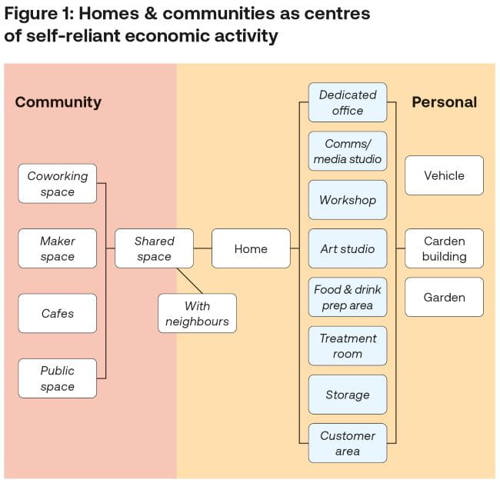
Spaces I’ve highlighted here are:
- Office – for primarily knowledge work, with good ergonomic set-up, adjustable-height desk and chair, multiple screens, capacity for large wall-mounted screen for communication if needed, comfortable alternative place to sit away from screen (for example, to read, watch broadcasts, participate in less formal online interaction, etc)
- Comms room – space for more immersive collaboration, potentially with space and surfaces for 3D holographic work and participation in project or innovation work with distant colleagues. Could also be used for home-based learning
- Sound-proofed studio – for music rehearsal and teaching, and audio or video production or broadcast
- Workshop – room with sufficient space for fabrication, whether high tech or in traditional crafts, or small-scale lab space, with space for storage as needed
- Food and drink preparation area – this could be a larger kitchen, or a dedicated space for preparation and packaging/bottling for distribution
- Treatment room – for those in health and beauty occupations, which may have specific requirements for patient privacy, safety, statutory compliance, etc as well as room for treatment chairs or tables and other specialist equipment
- Storage – modern homes are mostly woeful when it comes to storage. Home-based businesses need storage space for incoming supplies, products in development, inventory to sell, equipment for working when on the move, and more
- Customer area or shop front – mainly for homes in town centres or in neighbourhood centres, a space fronting onto the street for, for example, a workshop, studio or showroom in which customers can be met and products ordered or sold.
We should note also that work is not necessarily contained within exclusively personal spaces. There are a few examples of developments with shared access to workspace, but there should be many more.
Local coworking space is an important option for many small businesses and freelancers, and increasingly for corporate employees looking for professional workspace nearer home. There is a quite amazing variety of forms of this with different specialisations catering to specific fields or customer groups².
This sector now incorporates new models of shared or serviced “maker space”. These provide flexible workspace-as-a-service where there are significant requirements for hands-on work. They also have an impact on the possibility for “hybrid” home-based businesses that also use the maker space for specific purposes – for example, for 3D printing or other forms of computer-aided fabrication.
So what we are seeing is an increase in blurred boundaries: hybrids of virtual and physical work, as well as hybrid arrangements in the sense of working between home and other locations.
Regulating domestic enterprise
What types of work can be done within or near a domestic environment is limited by planning legislation. Our planning regulations hail from an era when many kinds of work were dirty, noxious or hazardous. Separating residential and work environments became embedded in mindsets, policy and legislation. That has had a powerful impact in shaping the communities we live in and the transport infrastructure that goes with the separation of home and work.
The rise of large supermarkets and housing shortages have created pretty much a one-way street in changes of use from commercial uses to residential. Many are the villages that have lost every local service to residential – the general store, bakeries, butchers, pubs and post office all gone. New communities are often built with only a limited range of local services, frequently dominated by national chains.
To revive local enterprise and services, we need policy that supports greater variety of housing stock, which in turn can provide the basis for self-reliant domestic enterprise.
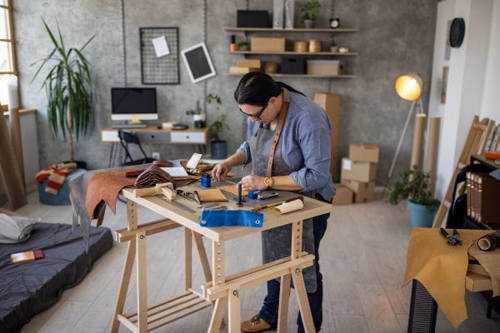
We need much more flexibility to allow mixed commercial and residential use in the same dwelling. Some local authorities have tried to nail down certain kinds of uses through policies and guidance on “live/work space”, but these are mostly still rooted in old ways of thinking and not fit for purpose.
We also need developers and architects to think differently. What is needed is to bring workspace design principles into residential as well, to create homes that support different kinds of enterprise, and are adaptable to different uses over time.
Regulating domestic enterprise
The presumption against business uses (other than tapping away at a laptop) needs to end. Instead, work uses at home still need to comply with all existing laws and standards – for example, on health and safety, noise mitigation, use and storage of hazardous materials, floor loading, acoustics, etc.
Beyond those, a “neighbourhood nuisance test” could apply in terms of how uses might affect the amenity of neighbours. But in communities well designed for domestic and local enterprise, a greater degree of tolerance for disturbance might be expected as part of a vibrant and active local economy.
Finally
I offer these as thoughts to what might lie ahead, if we actively embrace the possibilities brought about by changes in the nature of work.
These changes are well underway. But people are currently setting up and running enterprises in often unsuitable and improvised working environments within their homes. The constraints they work under are neither conducive to their health nor to the success of their businesses.
We need to adapt. A good starting point for debate is to extend our concept of workplace to include all the places people work, and ask ourselves, given the trajectories of change we see, what would good look like for work, economy and society in 20 years’ time?
I’m exploring these and many other issues in my current work-in-progress book, Halfway House to the End of Work.
About the author
Andy Lake is a specialist in flexible working, particularly changes to working practices, workplaces, technology and culture. He has worked on dozens of implementations and evaluations across the private, public and voluntary sectors. He has also worked as an advisor in this field for the UK Cabinet Office and the European Commission.
Andy is the author of Beyond Hybrid Working – A Smarter and Transformational Approach to Flexible Working (Routledge, 2024), and numerous other publications exploring smart/flexible working and the future of work.
Contact Andy Lake at:
flexibility.co.uk
E. [email protected]
linkedin.com/in/andylakewriter
References
1. Research by LABC Warranty found that houses built in 2018 are 19% smaller than those built in 1970. Average home size increased from the 1930s to the 1960s, but has been on a downward trajectory since. theguardian.com/business/2018/apr/08/uk-living-rooms-have-shrunk-by-a-third-survey-finds
2. I summarise these in chapter 7 of Beyond Hybrid Working – A Smarter & Transformational Approach to Flexible Working (Routledge, 2024)
OPINION
Rethinking homes as centres of economic activity (amongst other things)
By Andy Lake, Flexibility.co.uk on 08 October 2026
The decentralisation of work away from fixed workplaces, the rise of Ai and demographic changes are creating new opportunities for people to carry out ‘hands-on’ work in the home, such as production of fashion, textiles, food and drink, and delivery of health services and therapies. However, our existing housing stock is not designed to accommodate such functions, so it’s essential that future town planning creates homes that support different kinds of enterprise, both to support business success and the wellbeing of these new home-based workers.

Learning that saves lives
By Mike Robinson, chief executive, British Safety Council on 11 September 2026
Success can sometimes be a problem. The better we become at preventing incidents, the harder it can be to see what is actually preventing them.

Migraine in work: a test of the Government’s plans to Keep Britain Working
By Rob Music, The Migraine Trust on 07 September 2026
Migraine can have a profound, and often avoidable, impact on people’s working lives and careers. The Government’s growing focus on workplace health offers an important opportunity to change this, but only if this common, often disabling and frequently invisible neurological condition is properly understood and addressed by Government, the NHS and employers.