
Algorithmic management is reshaping how work gets done. But protecting the health and wellbeing of workers requires more than good technology – it calls for genuine respect for autonomy and thoughtful change management. Long-standing OSH guidance can help.
Opinion
It’s the autonomy, stupid
By
on 06 July 2026
Struggling to keep up with your work? Microsoft’s new AI tool, Scout – “an always-on agent that proactively takes work off your plate” – may be coming soon to a device near you. “Instead of waiting for a prompt”, Microsoft claims, “it stays connected to your priorities, monitors what matters, and helps keep work moving… understanding your workflow and taking action on your behalf within the controls your organisation sets.”
While the timetable for its rollout is still unclear, if you’re working in a Microsoft 365 environment you can be sure that when it does go live, it will be implemented organisation-wide, overnight. One day it’s not there. The next day, not only will you be unable to do your work without it, it will also perform tasks on your behalf.
Welcome to the world of autonomous agents.
This article isn’t about the safety risks of machines making decisions without human oversight. Or the information security implications of granting AI unfettered access across previously siloed data environments.

Or even the strategic risks of ceding sovereignty over AI to jurisdictions beyond our national control. Though I have concerns about all of these.
My focus here is on the impact of algorithmic working on the mental health and wellbeing of workers. And the extent to which the discipline of occupational safety and health (OSH) can provide a framework for managing the risks of human-machine interaction, to act as a check on the blanket adoption – if not imposition – of AI on workers across multiple occupations.
AI can take many forms. Like the word ‘transportation’, it refers to a collection of technologies as diverse and distinctive as bicycles to rockets.
I have no doubt the implementation of AI in some use cases – for example, to analyse large volumes of data to identify risks or exceptions, or to predict impending equipment failure – is unquestionably beneficial, assisting human decision-making by performing tasks at scale that a worker could not do either quickly or alone.
Yet productivity is only one side of the equation. The more important question is whether the gains delivered by AI are achieved at the expense of the very people it is supposed to assist? I believe OSH has something important to contribute to answering that question.
That lies not in a new regulatory initiative, but in the wisdom embedded in guidance published more than two decades ago in one case, and in an international standard approaching its fifth anniversary in the other.
Wisdom doesn’t age
The central promise of a tool like Microsoft Scout is that it will augment human capability, enabling work to be completed more efficiently while increasing worker productivity. Translating that promise into real-world improvements, however, is often more challenging than the marketing
would suggest.
I was struck by the comments of Lord Patrick Vallance, UK minister of state for the Department of Science, Innovation and Technology (DSIT), at a recent conference, who described just how difficult it had been for his department to implement AI successfully, despite a strong commitment across the organisation to realise its potential benefits.
It provides a useful reminder that the adoption of AI is not about the technology alone, but about the way technology is implemented into existing work processes.
Speaking at the same conference, Kate Field, global head of human and social sustainability at BSI, offered a timely reminder of the relevance of ISO 45003 Psychological health and safety at work, as a framework for assessing the risks of technological change.
That prompted me to cast my mind even further back, to the HSE Management Standards published on 3 November 2004.
The Management Standards were developed to help organisations identify, assess and control the causes of work-related stress, defined as ‘the adverse reaction people have to excessive pressure or other types of demand placed on them’.
They span six areas of work design that, if not properly managed, are associated with poor health, lower productivity and increased accident and sickness rates. They still apply today.
In terms of control, they require employers to consider how much say a worker has in the way they do their work, and to encourage their employees to develop skills and use their initiative when performing their work.
Where organisational change is concerned, they seek to ensure employees are consulted meaningfully, and are given an opportunity to influence proposed changes (big and small) before they are implemented. The workbook accompanying the Management Standards reminds employers not to underestimate the effects of minor changes.
ISO 45003 was published on 8 June 2021. It is fundamentally concerned with psychosocial hazards arising from how work is designed, organised, managed, supervised and experienced. As with the HSE Management Standards, autonomy is a central theme, emphasising the importance of workers having influence over how their work is performed. It identifies risk factors where workers have:
- Little control over work methods
- Little influence over decisions affecting them
- Limited discretion in scheduling or prioritisation, and
- An inability to adjust work processes.
Section 8.1.3 addresses organisational and work-related changes and their influence on psychosocial risks. It points to situations requiring careful management, including:
- Changes to work processes
- Changes to work tasks
- Changes to workflow, and (most tellingly, where AI is concerned)
- Developments in knowledge and technology.
Microsoft’s introduction of Scout presents a paradox when assessed on these terms. The desired benefits of AI could actually result in undermining worker autonomy; and large-scale implementation could worsen outcomes rather than improve them.
The adoption of an autonomous agent such as this would almost certainly be classed under ISO 45003 as a ‘significant technological change’ affecting how work is organised.
The irony that the imposition of such productivity tools on workers could, per the Management Standards, lead them to experience poorer health, lower productivity and increased accident and sickness rates – the paradox of autonomy – should not be lost on anyone caught up in the hype surrounding AI.
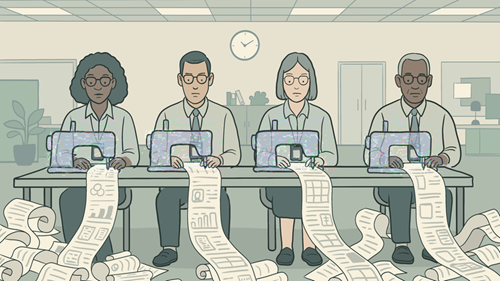
This doesn’t just apply to agentic software like Scout: we’re all platform workers now. Many everyday work applications promise to empower us by freeing up our time. In practice, however, they dictate our workflows, set our priorities, limit our decisions, and quietly monitor our compliance. Stripped of our agency, we’ve become a workforce of “virtual employees of virtual factories managed by invisible managers”.
This isn’t just about software either. HSE has announced welcome new guidance for utilising cobots in the workplace. But public statements suggest its focus will be primarily on physical safety, ensuring robots can “work safely alongside humans”, in compliance with health and safety law. It’s worth considering whether this guidance will address psychosocial safety too?
A physical cobot and an AI-driven platform may appear very different, but they share a common feature. Both claim to be autonomous technological systems introduced into a human work process. That raises questions such as:
- Do workers retain meaningful control?
- Does the technology increase or reduce worker autonomy?
- Does it increase workload or merely change its form?
- Does it create uncertainty about responsibility?
- How should workers be consulted before deployment?
Does AI-enabled working really increase productivity? Or does it increase demands, reduce control, or introduce poorly managed change in ways that create psychosocial risk? Are the psychosocial risks of algorithmic working being seriously considered by employers?
It is easy to look to other disciplines – such as procurement, operations or information technology – for answers.
But these are questions that impact on worker health and wellbeing. An AI deployment can be a psychological hazard – not because it automates work, but because it strips workers of control over their pace, sequencing, priorities and execution. OSH already possesses the tools needed to assess and mitigate these risks.
An opportunity for OSH
I firmly believe AI can be implemented in a way that creates beneficial outcomes for organisations, workers and for society. But I have concerns that the blanket adoption of AI tools and agents across all types of work will result in reduced productivity and worse outcomes for workers’ mental health and wellbeing across the board.
I believe OSH practitioners should see this as an opportunity.
ISO 45003 provides an effective framework for assessing the risks of technological change. And the HSE Management Standards provide guidance designed to help employers tackle the causes of work-related stress.
These documents contain wisdom that has stood the test of time, if only we were to recognise its relevance today. Nearly 70% of line managers still don’t know how to undertake a stress risk assessment or even understand when they are needed, cited in Sam Downie’s article in Safety Management in May 2026. It’s a shame these long-established standards are so readily overlooked in practice.
Algorithmic systems create psychosocial risks not by simply automating tasks but by shifting the balance between demands and control.
Promises of higher productivity often mask their true cost: intensified workloads, tighter monitoring and shrinking discretion that erode autonomy, worsen wellbeing, and ultimately undermine the very productivity they profess to deliver.
We shouldn’t need to be reminded that autonomy – having a say in our work and the way it’s done – is vital to our health and wellbeing.
Embracing algorithmic working isn’t something we should let a software company simply dictate to us. It’s something we should decide for ourselves, a task that OSH practitioners are uniquely qualified to undertake.
David Sharp is CEO of health and safety learning provider International Workplace. He is a Fellow of the Institute for Workplace and Facilities Management (IWFM), and a Technical Member of IOSH. He holds a Master’s in AI Ethics and Society from the Leverhulme Centre for the Future of Intelligence at the University of Cambridge.
For more information see:
internationalworkplace.com
[email protected]
T. +44 (0)333 210 1995
OPINION
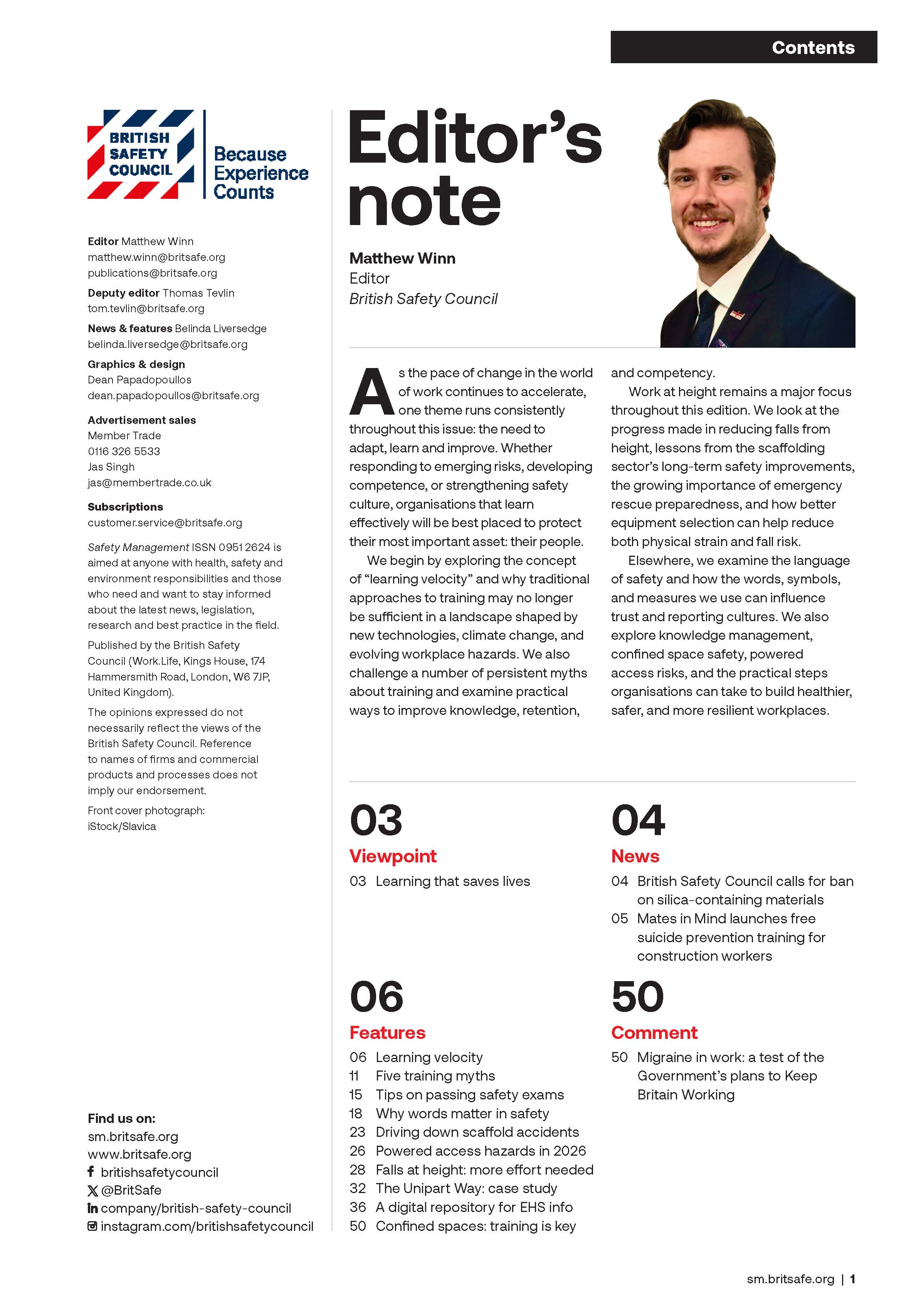
Learning that saves lives
By Mike Robinson, chief executive, British Safety Council on 11 September 2026
Success can sometimes be a problem. The better we become at preventing incidents, the harder it can be to see what is actually preventing them.

Migraine in work: a test of the Government’s plans to Keep Britain Working
By Rob Music, The Migraine Trust on 07 September 2026
Migraine can have a profound, and often avoidable, impact on people’s working lives and careers. The Government’s growing focus on workplace health offers an important opportunity to change this, but only if this common, often disabling and frequently invisible neurological condition is properly understood and addressed by Government, the NHS and employers.
Noise risk and multi-track enforcement: what EHS managers need to know
By Emma Tattersdill, Bexley Beaumont law firm on 17 August 2026
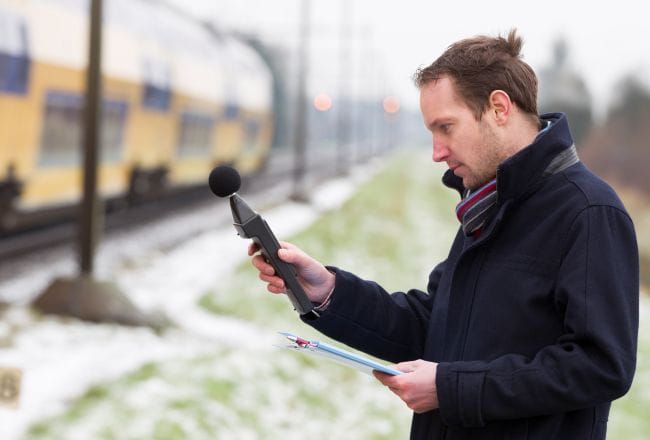
Noise nuisance from an industrial or commercial site can result in costly and time-consuming legal action from regulators and neighbours, but there are practical ways of ensuring noise levels do not exceed acceptable limits and trigger complaints from nearby businesses and residents.