
The climate crisis is coming home. This year has smashed heat records for the UK, with the record for the hottest June day obliterated and the first year on record to see temperatures of 35°C or above in May, June and July.
Opinion
Heat Strike: how trade unionists and climate activists have joined forces to pressure the government to improve heatwave health and safety at work
By
on 21 August 2026
This came as people faced tropical nights with no chance of respite as temperatures remained in the 20s overnight for weeks on end.
It also coincided with the release of studies showing the extreme June heatwave alone may have caused 2,200 heat related deaths across England and Wales alone – although we will never know precisely how many avoidable accidents have been caused by this country’s failure to prepare for the impacts of the climate crisis coming home.
This came as people faced tropical nights with no chance of respite as temperatures remained in the 20s overnight for weeks on end. It also coincided with the release of studies showing the extreme June heatwave alone may have caused 2,200 heat-related deaths across England and Wales – although we will never know precisely how many avoidable accidents have been caused by this country’s failure to prepare for the impacts of the climate crisis coming home.
That’s 440 deaths a day across England and Wales alone at the June heatwave’s peak. For comparison, around four people die each day as a result of road traffic collisions.
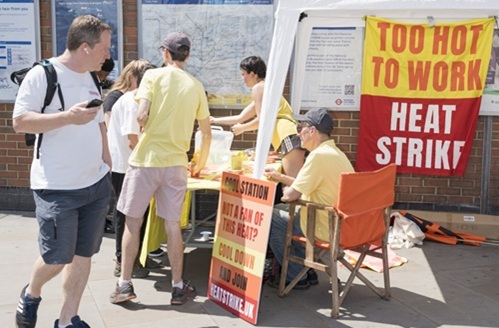 The Heat Strike saw people setting up Cool Stations to hand out health and safety advice as well as water in town centres from Exeter to York. Photograph: Heat Strike
Strike while it’s hot
With weather forecasts predicting temperature highs of 40°C and schools set to close, a group of trade union members and climate activists came together to call a Heat Strike in June 2026. Over 1,000 people took part in the campaign across the UK, calling for a maximum working temperature, a heatwave furlough scheme, and a climate action plan.
The Heat Strike saw people setting up Cool Stations to hand out health and safety advice as well as water in town centres from Exeter to York, and sharing photos of thermometers in their workplace on social media.
Whether they took part by unfurling a 23-metre banner from Brighton Pier reading “Heat Strike Now”, held up a paper sign on their lunch break, or just shared advice on using section 44 of the Employment Rights Act 1996 (ERA) to remove themselves from a dangerous workplace in WhatsApp groups, from Brighton to Bradford, the Heat Strike brought together bus drivers, teachers and so many more to demand measures to protect workers this summer – and create a safer future for everyone.
The media are now paying attention to the issue of workplace temperature and ministers are now considering setting a maximum temperature.
Meanwhile, some MPs have launched Private Members’ Bills and tabled Early Day Motions, calling for a maximum working temperature, beyond which employers would have a statutory duty to introduce effective control measures to protect workers from health and safety risks arising from high temperatures and humidity at work.
Other political parties and unions have also begun calling for a maximum temperature, while the Unite union said it would provide bus drivers with an official letter that they can show their employer when conditions become too hot in drivers’ cabs, informing the company that the driver is stopping work for safety reasons.
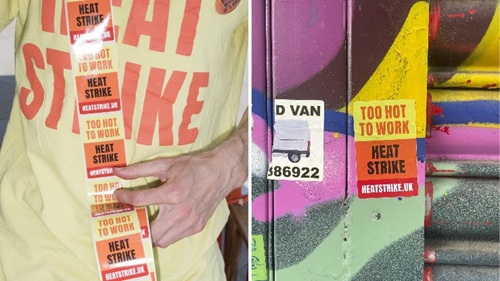 Photograph: Heat Strike
We know some schoolteachers removed themselves from dangerous classrooms when temperatures exceeded 40°C after seeing Heat Strike materials shared on social media and in WhatsApp groups.
Section 44 of the Employment Rights Act 1996 provides employees protection from detriment (i.e. dismissal, disciplinary, or a pay cut) if they withdraw from and refuse to return to a workplace that is unsafe and, in their opinion, presents a real risk of “serious and imminent danger” which they could not be expected to avert. This is true for any employee in the UK, but union members can usually access more support or advice from their union when exercising this right.
Where did the campaign idea come from?
But where did this campaign come from? The Bakers, Food and Allied Workers’ Union (BFAWU) has been calling for a maximum working temperature for over a decade with the support of the TUC.
But since 2023, a broad coalition has been bringing new momentum to demands to protect workers from heat, and building solidarity between trade unions - including the BFAWU, Fire Brigades Union and Equity - who have all passed motions to support the Heat Strike campaign; in alliance with climate justice groups, including Greenpeace, War on Want and Extinction Rebellion.
The idea for a ‘Heat Strike’ was inspired by the UK’s hottest day ever in July 2022. The group wanted to find a way to capture the UK public’s concern about climate change and the need for action to protect people and the planet when they could feel the effects of the climate crisis here at home.
In the hopes of raising the profile of a demand the Bakers’ Union has made for over a decade, as well as mobilising pressure for broader climate action, the coalition is demanding a maximum working temperature, as well as a heatwave furlough scheme, and a climate action plan.
Robbie Woodland, president of the Kernow (Cornwall) branch of the BFAWU, a hygiene operative working in West Cornwall, said: “We’ve been calling for a maximum workplace temperature for over a decade as bakers regularly see extreme temperatures at work. It’s great to finally see people listening. Last week, colleagues shared photos of workstations well over 40 degrees, way above safe temperatures.
“Now heatwaves are becoming more frequent and extreme, it’s not just about bakeries anymore. This affects all of us. The government must set a maximum workplace temperature. Till then, Heat Strike will continue to tell them to Cool It!”
How can you get involved?
You don’t have to be a union member to get involved. There are so many ways to get involved once you’ve signed up at HeatStrike.UK
Once you’ve signed up, you’ll get access to a flatpack with resources such as a heat health and safety poster to display at work.
If you are responsible for health and safety in your workplace, the pack includes advice on developing or updating your own workplace’s policy on protecting workers from extreme heat and humidity now before the next heatwave strikes.
If you are in a union, there are draft motions to pass in your branch or at the union’s national conference.
If you are in a community group, you could start planning how to have a ‘Cool Station’ ready to roll out. Cool Stations are designed to provide places for people to take shelter from the heat and have outreach conversations, and are staffed by volunteers who support the campaign.
Cool Stations are generally established in locations such as outside busy stations, local warehouses or office blocks, and involve campaigners handing out water and advice to help the local community – including workers – to stay safe in the heat.
People are encouraged to sign up to support Heat Strike, and workers are encouraged to take their workplace’s temperature by snapping a pic of a thermometer at work and sharing it on social media with the tags #HeatStrike and @heatstrike.uk to demand a maximum workplace temperature.
For those planning a Cool Station, it could be as simple as a gazebo where people can step out of the sun to hear about the campaign and obtain drinking water, or a community group could make plans to open up a church or community hall as a ‘cool space’ the next time the UK faces temperatures in the high 30s.
Over the rest of this summer, local Heat Strike campaign groups will continue to set up Cool Stations to promote the campaign and share safety advice.
However, we will only call another national Heat Strike when extreme temperatures are predicted. When the UK faces another unprecedented and dangerous heatwave, everyone who has signed up will receive the signal to ‘Heat Strike’, and be given advice on the different ways they can join in.
Too hot to work?
In May 2026, the Government’s own independent climate advisors released a report that backed up what unions have been saying for over a decade, by advocating for a maximum working temperature. The Climate Change Committee’s report made clear the UK is built for a climate that no longer exists.
This summer, as deadly heatwaves have continued across Europe, it has become clearer than ever that the UK’s infrastructure, workplaces and homes are not designed to keep people safe in high temperatures and there is growing need to improve worker safety during extremely hot weather.
Until there are solid government policies to achieve this, we are headed for a health and safety emergency in a car with no brakes. It’s up to us to look after our colleagues and keep our community safe. So next time it’s too hot to work: Heat Strike.
For more information see:
heatstrike.uk
instagram.com/p/DLFl3xgtOkb/
E. [email protected]
Liam Geary Baulch is a campaigner at Heat Strike.

OPINION

Building a future worth working in
By Mike Robinson FCA, British Safety Council CEO on 12 October 2026
It’s easy to become myopic about the future of work. Take a quick look at the world today and the signs can seem discouraging: political instability, economic volatility, the accelerating disruption posed by AI and climate change. Together, these factors paint a picture of uncertainty that can make our belief in progress seem naïve and tempt us into believing that the future can be no better than the past, that our best days are now behind us. That would be a profound failure of imagination.

Rethinking homes as centres of economic activity (amongst other things)
By Andy Lake, Flexibility.co.uk on 08 October 2026
The decentralisation of work away from fixed workplaces, the rise of AI and demographic changes are creating new opportunities for people to carry out ‘hands-on’ work in the home, such as production of fashion, textiles, food and drink, and delivery of health services and therapies. However, our existing housing stock is not designed to accommodate such functions, so it’s essential that future town planning creates homes that support different kinds of enterprise, both to support business success and the wellbeing of these new home-based workers.

Learning that saves lives
By Mike Robinson, chief executive, British Safety Council on 11 September 2026
Success can sometimes be a problem. The better we become at preventing incidents, the harder it can be to see what is actually preventing them.