
The Office for Environmental Protection is an independent body set up to hold government and public authorities to account for their environmental commitments. A key part of its remit is to annually assess how government is progressing against its legally binding environmental targets and goals in its Environmental Improvement Plan (EIP). The EIP is regarded as government’s roadmap on how it will restore England’s environment.
Opinion
Government is off-track to meet its legally binding commitments to protect and improve the environment and must act urgently, says the OEP
By
on 17 March 2026
Earlier this year (13 January) the OEP published its fourth statutory report on government’s progress delivering its EIP covering the 12 months up to the end of March 2025.
Our headline is disappointingly familiar. Our latest EIP progress report shows how government remains largely off track to meet its environmental targets and obligations. This includes biodiversity targets set under the Environment Act and the UK’s twin ‘30 by 30’ commitments to protect and effectively manage at least 30 per cent of land and sea and, additionally, to restore 30 per cent of the areas of degraded ecosystems, both by 2030.
Government now has to make a decision on whether it is going to meet those targets. That is why what happens now matters.
Our report comes at a time when government is focused on economic growth. Nature has a role to play here, an important role. As government has itself made clear in the EIP, nature is not a blocker to growth – rather it enables, drives and protects economic growth.
 Professor Robbie McDonald: "Our recommendations are still the biggest levers government has to pull."
Nature’s recovery is a pre-requisite of prosperity, health and wellbeing. Recent analyses, led by the Cabinet Office, of the chronic risks facing this country are sobering. They talk of accelerating climate change, biodiversity loss, and pollution having cascading, compounding impacts, which will amplify threats to national and international security, the economy and communities.
It is in that context we provided this latest annual assessment of how government is working towards improving the natural environment, and so towards a more prosperous and more secure future.
We have previously called for government to speed up and scale up its efforts if it is to achieve its environmental ambitions and commitments, and we renew that call now. While we have seen more progress in this year than in the previous reporting period, it was not the step change needed to turn things around.
Progress in the reporting period
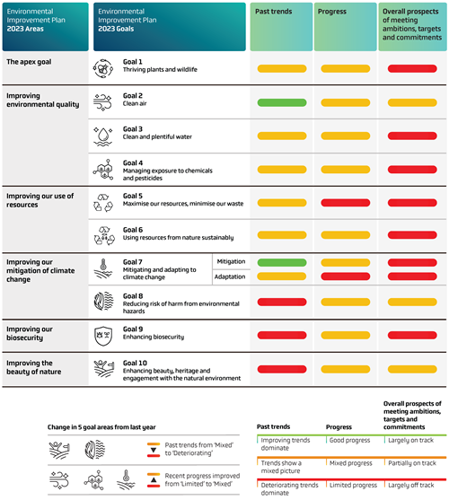
Of 43 individual targets and commitments assessed, good progress has been made towards 12, mixed progress towards 19, and limited progress towards 12.
Of these 43 targets and commitments, 13 are set under the Environment Act 2021 (EA21 targets). For these 13, our assessment is that good progress has been made over the annual reporting period towards four, mixed progress towards seven and limited progress towards two. There was good progress in creating and restoring wildlife-rich habitat and in reducing phosphorus loadings from treated wastewater.
Summary of progress report findings
 Credit: Office for Environmental Protection
There was limited progress in improving the condition of Marine Protected Areas and in reducing residual waste.
When compared to our 2023/2024 progress report, a higher proportion of targets and commitments show good progress and a lower proportion show limited progress. In summarising progress at the level of the 10 goal areas of the EIP (2023), we concluded that progress was mixed in eight goal areas and for climate change mitigation, and limited in one goal area and for climate change adaptation.
When compared to our last progress report on 2023/2024, there is improvement in relation to the goal areas of clean air, and managing exposure to chemicals and pesticides, and to climate change mitigation, where our assessment of progress has moved from limited to mixed.
Clean air showed more progress in the year due to positive steps to reduce vehicle emissions such as reinstating the 2030 phase-out date for new petrol and diesel cars and increased funding for active travel. Chemicals showed more progress due to actions to eliminate the use of PCBs and other specific chemicals.
 Engagement with nature among adults and children has decreased and is very low compared to other countries. Photograph: iStock
Environmental trends
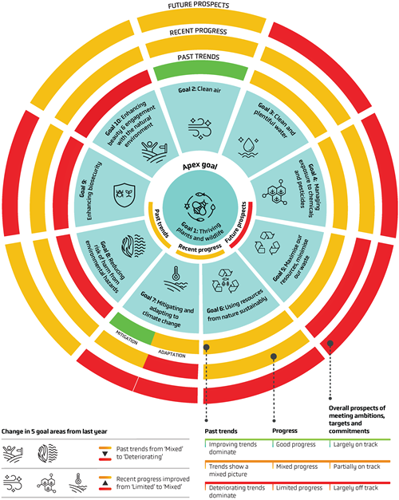
Our assessment of 59 recent trends shows that 24 are improving, 11 are static, 16 are deteriorating and eight were not assessed due to data availability. These proportions are broadly similar to last year.
In summarising trends at the level of the 10 goal areas of the EIP23, we concluded that improving trends dominate in two goal areas (clean air and climate mitigation), deteriorating trends dominate in three goal areas (reduced risk of harm from environmental hazards, enhancing biosecurity, and enhancing beauty, heritage and engagement with the natural environment) and for the other five goal areas and for climate change adaptation, trends are mixed.
When compared to our 2023/2024 progress report, the two goal areas of reduced risk of harm from natural hazards, and enhancing beauty, heritage and engagement with the natural environment have fallen back from showing mixed trends to deteriorating trends dominating.
The estimated number of properties at risk of surface water flooding has increased along with a decrease in the condition of flood or coastal risk management assets. Wildfire incidents continue to increase. Engagement with nature amongst adults and children has decreased and is very low compared to other countries. This is particularly concerning given the current crisis in childhood vulnerability, and the importance of a connection with nature for a strong start in life.
 Credit: Office for Environmental Protection
Overall prospects
Our assessment of the prospects of meeting 43 individual targets and commitments is that government is largely on track towards meeting five, partially on track towards meeting 16, and largely off track towards meeting 21, while the prospects of meeting one target could not be assessed due to a lack of sufficient evidence. For the 13 EA21 targets, our assessment is that the government is largely on track for meeting three, partially on track for five and largely off track for five.
When compared to our 2023/2024 progress report, a slightly lower proportion of targets and commitments are considered largely on track and a slightly higher proportion largely off track.
In summarising progress at the level of the 10 goal areas of the EIP23, we conclude that in three goal areas government is partially on track, and in seven government is largely off track. Compared with our 2023/2024 progress report, our assessment ratings have not changed.
Recommendations
With our progress reports, we always seek to make recommendations that can assist the government in getting on track. This year we repeat the key recommendations that we made last year. We are unapologetic for saying the same thing repeatedly.
I must stress – without that stepping up of pace and scale needed in this past year, the recommendations remain pertinent. They are still the biggest levers government has to pull.
They are:
- Get nature-friendly farming right
- Maximise the contribution of protected sites for nature
- Speed up action in the marine environment
- Set out clear mechanisms for reconciling competing demands for land and sea
- Develop a circular economy framework.
They also include three cross-cutting areas aimed at securing effective implementation of the EIP:
- Mobilise investment at the scale needed
- Regulate more effectively
- Harness the support needed.
Revised EIP
Government published a revised EIP in December 2025. That was too late for us to consider it as part of this reporting cycle. However, we have published our initial assessment of the revised EIP25 alongside this progress report.
We had provided advice on how the EIP should be updated, and our initial view is that much of that has been taken on board. The new EIP25 is a more coherent plan and offers more transparency and an increased focus in delivery.
Delivering all that is planned would improve substantially the chances of government achieving its environmental ambitions.
However, there are places where EIP25 could be stronger still. Some commitments remain broad statements of intent. There are gaps in the plans to monitor progress. Resources, particularly for higher tier agri-environment schemes such as Landscape Recovery, appear as stretched as ever.
Alongside the new EIP, government continues to work on a number of other important plans and initiatives, including a long-awaited Land Use Framework, a new Farming Roadmap, Food Strategy, Circular Economy Strategy and a UK Marine Strategy, all alongside significant planning and water sector reform.
There is now a real opportunity for all of these reforms to complement the revised EIP, to provide coherence from the strategic policy level through to local decision making. As we have long said, the most important thing now is effective delivery of the plan.”
To read the full report, Progress in improving the natural environment in England 2024/2025, and a briefing note on the OEP’s initial assessment of the revised EIP, see:
theoep.org.uk/report/progress-improving-natural-environment-england-20242025
Professor Robbie McDonald is Chief scientist at the Office for Environmental Protection

OPINION

Learning that saves lives
By Mike Robinson, chief executive, British Safety Council on 11 September 2026
Success can sometimes be a problem. The better we become at preventing incidents, the harder it can be to see what is actually preventing them.

Migraine in work: a test of the Government’s plans to Keep Britain Working
By Rob Music, The Migraine Trust on 07 September 2026
Migraine can have a profound, and often avoidable, impact on people’s working lives and careers. The Government’s growing focus on workplace health offers an important opportunity to change this, but only if this common, often disabling and frequently invisible neurological condition is properly understood and addressed by Government, the NHS and employers.

Noise risk and multi-track enforcement: what EHS managers need to know
By Emma Tattersdill, Bexley Beaumont law firm on 17 August 2026
Noise nuisance from an industrial or commercial site can result in costly and time-consuming legal action from regulators and neighbours, but there are practical ways of ensuring noise levels do not exceed acceptable limits and trigger complaints from nearby businesses and residents.