
Taking an integrated approach to managing sustainability and safety risk increases the chances of achieving the highest performance in these areas, and also means the business is well-placed to seize commercial, reputational and other benefits.
Features
Safety and sustainability: integrating the duty of care into your net zero strategy
By
on 31 March 2026
Organisations nationwide, in their continued efforts to achieve net zero targets, are discovering that sustainability is deeply intertwined with occupational health and safety (OSH). In recognition of the 11th annual Sustainability Week (2–4 March 2026) and the Net Zero Summit in London (4–5 March 2026), where ESG commitments and policies will continue to be discussed at length, it’s only prudent to explore how to align health and safety management with the fervent talking point of sustainability.
Fundamentally, the intersection between sustainability and health and safety initiatives represents more than an alignment of procedures. It indicates a broader shift in how organisations approach their duty of care to their employees. For sustainability, OSH and human resources (HR) professionals, understanding this is vital for developing effective policies that protect people as well as the planet.
 There’s a surprising amount of synergy and overlap, as far as risk assessments, documentation and cultural requirements when it comes to health and safety and sustainability. Photograph: iStock
Why sustainability is a safety issue
Both health and safety management and environmental sustainability rest on the same principles of prevention, risk management and continuous improvement.
For instance, when organisations implement ISO 14001:2015 environmental management systems alongside policies, systems and arrangements in line with the ISO 45001:2018 occupational health and safety standard, there’s a surprising amount of synergy and overlap, as far as risk assessments, documentation and cultural requirements are concerned.
The fundamental duty of care that underpins UK health and safety legislation covers work activities, for which employers must ensure – so far as reasonably practicable – the health, safety and welfare of their employees and anyone else who could be put at risk, such as on-site contractors.
In moral terms, arguably a duty of care naturally extends to mitigating (again, as far as reasonably practicable) the organisation’s impact on the environment – considering how pivotal a sustainable planet and natural resources are to human health and wellbeing.
Take air quality, for example. Installing energy-efficient ventilation systems reduces carbon emissions while simultaneously improving indoor air quality for workers. Meanwhile, reducing the use of harmful chemicals in, for example, a manufacturing process, both protects employees and the surrounding environment, such as by reducing ambient air pollution, greenhouse gas emissions and the risk of groundwater pollution. These examples just scratch the surface as far as unveiling the common ground between sustainability and safety, however.
Where environmental action becomes a safety issue
Looking more broadly, the global transition to net zero presents organisations with new workplace considerations and safety hazards which require proactive intervention and assessments.
From solar panels and battery storage to hydrogen fuel, these upgrades to the energy infrastructure and power sources are considered necessary as the world moves gradually towards greener infrastructure. However, when constructed or installed – for example, when creating of large-scale solar farms – they also present a range of health and safety hazards that will often require specialist knowledge to ensure adequate management of the associated injury, accident and fire risks.
For instance, Universal Safety Practitioners, a consultancy specialising in the management of safety during the construction, operation and maintenance of renewable energy plants, have highlighted how projects like large-scale solar energy/photovoltaic (PV) installations require meticulous planning to control the risks arising from electrical, fire and thermal hazards and to ensure suitable emergency response procedures are in place, particularly in remote locations.
As Kevin Kerin, managing director of Universal Safety Practitioners, notes in a blog discussing solar PV safety: “The careful planning and implementation of project safety processes and procedures, together with robust management of workable health and safety solutions is fundamental to execution of a successful and safe project.”
This emphasises that the safety risks arising
from sustainability programmes and initiatives, such as the construction and operation of large-scale renewable energy plants, must be carefully assessed and managed to ensure the safety of workers who erect, operate and maintain the plant.
Another example of how safety risks can arise from a drive to boost sustainability is retrofitting energy efficiency upgrades to older buildings. Although boosting the energy efficiency of a building will reduce carbon emissions, these projects can expose workers to safety hazards, such as asbestos and lead paint in the fabric of building and structural vulnerabilities – for example, when the replacement of roof sheets with more energy-efficient materials poses a fall from height risk.
As a result, when seeking to jointly achieve environmental and safety goals, it is essential that both categories of risk are comprehensively addressed in a coordinated way at the planning stage of a project.
The same approach is vital when planning and implementing climate adaptation measures at a premises or site, such as flood defences, green roofs and thermal insulation to reduce energy demand for cooling and solar heat gain. If executed properly with the correct materials, these approaches will usually improve the building’s sustainable performance.
However, the installation of these features may create new fire safety, structural and emergency egress risks. As a result, following installation, aspects of the site’s fire safety, structural and other policies and procedures will require careful reassessment, to ensure the climate adaptation measures do not compromise the validity and effectiveness of the site’s safety measures.
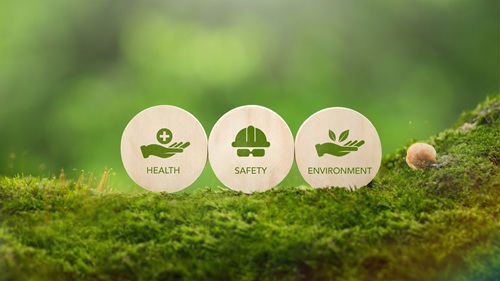 Image: iStock
Aligning policy and process
Successfully integrating sustainability into a broader organisational health and safety framework involves more than simply amending policies with additional clauses. A systematic review of the decision-making, risk assessment and success measurement processes should be a priority. Ways of achieving this include:
- Organisations already operating an OSH risk management system in alignment (or formal compliance) with ISO 45001:2018 can extend their risk management framework to incorporate principles and elements from ISO 14001:2015 (or vice versa), to ensure environmental and safety principles, risks and measures are subject to equal and appropriate scrutiny and management
- Workplace OSH risk assessments can also consider broader ecological factors (such as the risk of a chemical spill in a nearby water reservoir) as opposed to simply the immediate, short-term hazards to workers (such as chemical burns) – ultimately producing more comprehensive perspectives
- Sustainable procurement policies can be updated to specify both environmental criteria and safety standards for suppliers, mandating lower-carbon materials and evidence of ethical supply chain processes. This ultimately strengthens due diligence effectiveness.
Benefits of alignment
Integrating the management of sustainability and occupational safety also usually has a financial upside. A coordinated approach reduces operational costs by optimising resources, minimising waste and avoiding any associated environmental and OSH hazards.
For example, when selecting new equipment or new materials for a manufacturing or other work process, focusing on identifying equipment that offers the best energy efficiency while incorporating the most effective safety features will result in financial savings from reduced power usage, improved performance and lower safety risks.
When sustainability and safety are managed in a coordinated way, this also generally reduces regulatory compliance costs. Risk assessments, inspections, audits and reports all overlap, and integrated systems for managing each aspect of these processes reduce administrative workloads and improve confidence in organisational compliance.
Regulations around sustainable development and worker protection are also predicted to continue to converge, meaning organisations who implement aligned processes at an early stage will gain a long-term competitive advantage.
Businesses that are overt about their efforts to achieve high standards of sustainability and safety are also likely to find it easier to attract new talent. Research suggests prospective employees, particularly Gen Z candidates, are more inclined to join responsible, transparent employers that demonstrate a genuine, authentic commitment to both sustainability and safety.
What does integration look like?
Before embarking on this integration journey, businesses should start by mapping existing policies and procedures to identify where sustainability and safety considerations already overlap.
This initial check is likely to uncover additional opportunities for streamlining and gaps that require attention, which can be addressed by systematically aligning these disciplines. Other points to note when seeking to align and integrate sustainability and safety management systems include:
- Bringing together health and safety experts, environmental managers, facilities teams and operational staff allows multiple diverse perspectives to be considered, and helps avoid siloed thinking
- Reciprocal training programmes –sustainability, safety, facilities and operational teams delivering training to each other and to key personnel, like supervisors and workers – helps everyone understand new challenges, ideas, approaches and systems, therefore reinforcing environmental and safety responsibilities and implications
- Key performance indicators (KPIs) should be reviewed to ensure they are as comprehensive and aligned as possible. KPIs should be set and measured for different environmental outcomes and safety improvement rates in unison to provide a clear and cohesive picture of progress being made collectively
- Conducting joint safety and environmental impact assessments from the outset will prevent more problems from arising down the line.
Effective integration requires visible commitment from the top down. Leadership and executive teams must demonstrate their commitment to achieving a successful and integrated approach to sustainability and safety by setting a good example, visibly prioritising safety and environmental stewardship, ensuring neither ends up taking a backseat to the other, or to other priorities, challenges and demands facing the business.
A clarity of commitment should cascade seamlessly throughout the company, influencing resource allocation, procurement, manufacturing, logistics, customer engagement and other functions, both internal and external.
It is important for leaders and managers to communicate to all staff how sustainability choices can affect workplace safety. Take ePower Trucks’ implementation of electric utility vehicles for example. The trucks have proven capable of reducing physical strain, enhancing workplace ergonomics and, with advanced safety controls and features, offer zero emissions.
This is a good example of informed decision-making at all levels of the organisation, whereby work-place safety and sustainability are both prioritised.
Leadership development programmes should also equip managers to make informed decisions about which aspects of the company’s sustainability achievements are championed, and managers should ensure that any sustainability initiatives and measures do not create unnecessary administrative burdens and red tape, which can obstruct the company’s progress towards its climate goals.
In theory, taking an integrated approach to managing sustainability and safety challenges and risks sounds feasible and achievable, but there will often be obstacles in execution. Budget constraints will mean that some organisations are forced to prioritise certain sustainability and/or safety measures over others and it can be difficult to obtain funding for investments to worker safety and environmental performance – for example, from company investors.
There may also be internal resistance to integrating sustainability and safety management processes and systems. There may be silos between the environmental and safety functions in a business, making it difficult to integrate the two into a holistic management system. Ways of overcoming this include setting up joint projects involving the sustainability and safety teams to break down barriers and build mutually beneficial relationships, and emphasising that integration of the company’s approach to the two will deliver better overall outcomes.
Gaps in technical knowledge can sometimes be another challenge when attempting to align sustainability and safety systems. Safety professionals may not be environmentally savvy, and conversely, sustainability specialists may not fully grasp broader safety risks, rules, procedures and desired outcomes. To reduce knowledge gaps, employers should invest in cross-departmental training and, if necessary, obtain help from external experts, who can boost the knowledge and skills of the sustainability and safety teams.
If an organisation is genuinely committed to achieving the highest possible sustainability and safety standards, aligning the two in a coherent management system provides an excellent framework to excel at both. Organisations have a duty of care for the safety of their teams, but environmental best practice also has positive impacts on human health – for example, by preventing air and water pollution close to the company’s site.
In the coming years, sustainability rules, duties and regulations are predicted to tighten, and by extension, stakeholders’ expectations for the environmental performance of business will change, placing further pressure on companies to achieve excellent sustainability performance.
It is also predicted that climate experts will research and identify new information that will further reshape global initiatives and attitudes towards preserving the planet’s finite resources. As a result, the organisations best positioned to succeed long-term will be those that identify and manage emerging risks, demonstrate resilience to regulatory changes, and present themselves as more rewarding and fulfilling to talent, customers and investors who value an authentic commitment to both sustainable and safe working practices.
It is therefore now important that safety professionals realise that sustainability targets and their own day-to-day duties of care for worker safety should no longer be approached as separate disciplines.
And if safety and sustainability practitioners successfully align the company’s approach to the two challenges, they will be able to expand their influence over the company’s decision-making and planning, and demonstrate the tangible value of their roles and functions. In the long run, OSH practitioners that embrace an integrated approach to sustainability and safety will position themselves as strategic partners in organisational evolution, rather than someone serving an arbitrary and narrow compliance function.
Note: This article explores the strategic alignment of environmental sustainability and occupational health and safety. The transition to net zero involves complex regulatory requirements and specialist technical hazards. For specific guidance on implementing ISO standards, managing renewable energy risks, or ensuring legal compliance during retrofitting projects, please consult with qualified health, safety, environmental and quality (HSEQ) practitioners and legal counsel.
Chloe Miller is a business graduate and freelance writer, specialising in industry insight and the latest best practice for marketing, business and HR. Contact her at:
chloe-miller.co.uk
E. [email protected]
FEATURES

Who is the wolf in your life? Listening to the people behind the hard hat
By Inna Cebotari, Kinth Square on 02 October 2026
A new play explores the lives of migrant construction workers in the UK, using humour, real-life experiences and physical theatre to capture the banter, friendships and absurd moments that make life on site bearable, alongside the pressures that often go unseen. Ahead of the play’s premiere in London on 12-14 November, playwright Inna Cebotari explains how Three Little Pigs aims to add to the public debate about how best to support the wellbeing of construction workers.

Eliminating barriers in reporting: how conversational AI can unlock safety engagement
By Julian Taylor, ecoPortal on 04 October 2026
Online reporting systems that require lengthy and cumbersome form filling and typing can discourage workers from reporting safety incidents and concerns. However, AI-powered mobile apps that allow reporting simply by speaking can simplify and speed up the process, boosting reporting rates and overall staff engagement with safety systems and culture.

Why UK employers need to rethink recruitment, retention and support for older workers
By Orchie Bandyopadhyay on 04 October 2026
With workers over the age of 50 now comprising almost one third of the entire UK workforce, recruiting and retaining older workers is now core to the success of the economy. However, not all employers are offering what’s needed to retain and recruit older workers, and ageist attitudes, limited flexible working opportunities, and employment support that doesn’t fit with health, caring, or other responsibilities are leaving too many people locked out of the labour market.