

Driving while fatigued greatly increases the risk of road traffic accidents, so it’s essential HGV fleet managers adopt suitable driving schedules that minimise the risk of tiredness and explore the use of technology to detect and alert the driver and employer before a problem arises.
Features
Tired at the wheel
By
on 12 November 2026
A potentially fatal accident was prevented on 12 July, when police intercepted a lorry driver who fell asleep at the wheel after he began swerving between lanes on the M18.
South Yorkshire Police shared footage of the HGV drifting across the busy motorway, with officers following the driver in an unmarked vehicle.
Pulling up alongside the truck, officers noticed the driver was asleep. Inside the vehicle, officers found multiple cans of energy drinks which he had been using to “overcome his tiredness”.
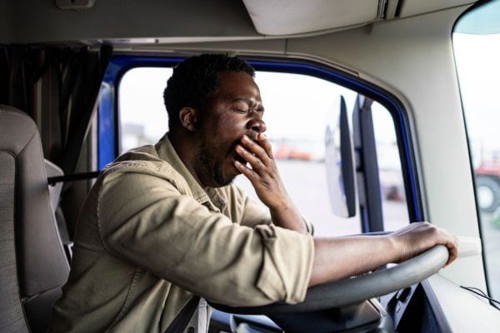
The practice of driving despite feeling fatigued is an open secret among bus and lorry drivers in the UK. Shocking stories about driver fatigue, sleep-deprived driving and the lack of toilet facilities adding to drivers’ woes have been told time and again. And they do not seem to stop.
Almost half of UK drivers have admitted to driving after less than five hours’ sleep. “However, it is likely that the true figures are far higher because fatigue is hard to spot and, unlike alcohol and drugs, police can’t test for tiredness,” states road safety charity Brake. Worldwide, it is estimated that between 10-20% of all road crashes are fatigue-related.
“Most sleep-related crashes happen on motorways and dual-carriageways, probably because of the monotonous road environment and lack of driver stimulation,” the charity adds.
The UK’s Department for Transport found 60% of HGV drivers regularly feel fatigued while driving, and 30% had fallen asleep at the wheel at least once in the past year, despite being fully legal on hours and working time.
In the UK, drivers are 20 times more likely to fall asleep at the wheel at 6am than at 10pm. National Highways, which maintains England’s motorways and major A roads, warns that fatigue-related deaths and serious injuries on motorways and major roads increase by 59% during the summer compared to other seasons.
In 2024, according to UK government data, HGVs and vans were involved in collisions resulting in the death of 91 pedestrians, 21 cyclists, 59 motorcyclists, 129 car occupants, 15 van drivers and five HGV drivers. Many more people were seriously injured.
Long working hours, inadequate rest facilities and limited access to toilets are factors contributing to driver fatigue.
In an interview with ITV News London, a bus driver highlighted the shocking working conditions she says drivers across the capital are forced to endure. She told ITV that workers have to choose between sleeping and eating on their long-awaited breaks, and that toilet access is so scarce she’s been forced to use a jar on the top deck of her bus in times of desperation. And she’s not alone.
Another bus driver said that, during summer heatwaves he is required to drive in 37°C heat with no air conditioning, frequently works for 13 days in a row without a break, and regularly urinates into plastic bottles due to a lack of toilets.
“Inside the cab, I am roasting in the summer months, and it drives me nuts,” said the serving driver, who wished to remain anonymous due to fear of punishment by his employer for speaking out. “After working for more than 15 years, I get the feeling I simply don’t matter.”
Lack of welfare facilities
The lack of suitable HGV parking and welfare facilities is a serious issue that contributes to driver fatigue, as drivers who are legally required to take regular breaks often struggle to find places to park, eat and access toilets.
BBC News recently reported how residents near the port of Felixstowe have repeatedly complained about lorry drivers parking overnight on residential streets and leaving bags and bottles containing human waste. The situation highlights the wider problem of inadequate facilities for HGV and other drivers who need somewhere to park and access basic amenities during their breaks.
Research by Unite the Union has found that over half of UK bus routes have no toilets available for drivers.
Even though UK employment law states that employers must provide “adequate” toilet facilities for everyone in the workplace, including those with disabilities, Unite’s research has found that over half of 420 routes operated by FirstBus, Stagecoach Group Limited, Arriva Group, Lothian Buses, National Express Ltd, Plymouth Buses, TransLink, Coastliner and Go-Ahead London have no toilets available for drivers.
“Toilet dignity is a basic right, but remains a major problem for bus drivers, with many saying they have been ‘caught short’ at work and have had to urinate in bottles, bags or in public, putting them at risk of disciplinary action,” states Unite. “Others have said they have been on the receiving end of passenger aggression after stopping the bus to find a toilet.”
According to Unite, one male driver said: “Passengers can complain and get aggressive if you have to stop the bus and go to the toilet. It’s like people don’t understand that you’re not a robot but you’re human and have to do these things. The lack of toilets also puts drivers in potentially dangerous situations when they are desperate to go.
“One of my colleagues, a young female driver, had to pull over and knock on doors of homes
and was let in by a man on his own. Luckily, it was OK in that instance but this could have been a different scenario.”
The lack of toilet facilities can also have serious consequences for women drivers. One female driver said: “I have polycystic ovary syndrome, which means my periods can be very heavy and painful and come without warning. Because of the lack of toilet access, there’s been a few times where I’ve soiled myself with blood on the driver’s seat and have had to call up my managers and explain. They have been good about it, but I feel embarrassed I am even in that situation.
“As a young female driver, I was shocked about the lack of the toilets when I first started driving. It just feels like there is a real lack of dignity and it’s very regressive. You just don’t expect these workplace issues to still exist.”
According to Unite, some drivers have even developed long-term health problems – or existing conditions have become exacerbated - due to being unable to use the toilet during the working day, with many saying they avoid drinking water to reduce the chance of needing the toilet during a shift.

Fatigue risks
As drivers continue to raise concerns over fatigue and working conditions, London buses were involved in 28,368 recorded collisions in 2025, according to Transport for London’s own figures. That is a staggering 78 collisions per day.
Fatigue among lorry, bus and coach drivers doesn’t just increase the risk of road traffic accidents; it also takes a toll on the health and wellbeing of drivers themselves. Chronic sleep deprivation is associated with a host of long-term health problems, such as obesity, diabetes, cardiovascular disease and depression.
Unite general secretary Sharon Graham has criticised bus companies for failing to address the underlying causes of fatigue. “Bus drivers are being overworked to the point of extreme fatigue by the bus companies,” she stated in a post on Facebook. “Making them watch videos on wellbeing or take a nap in a cupboard in their depot won’t cure the problem. These initiatives are insulting.”
Graham added that fatigue poses serious risks to both road safety and bus driver health, and is caused by long hours, unsuitable shift patterns and the poor workplace conditions experienced by bus workers every day. “It is time this issue was treated with the importance it deserves,” she says. “Anything less will not be accepted.”
In a further call for action, Graham told ITV News: “Bus driver fatigue is a safety issue; long hours, poor rotas and inadequate rest put drivers, passengers and other road users at risk. The solution is simple: safe staffing, proper breaks, sensible rotas and enough rest between shifts. Safe buses need safe working conditions.”
Driving at night
As the UK enters winter, shorter daylight hours and earlier nightfall mean that it becomes ever more crucial for commercial drivers to stay safe and alert when driving at night.
Many commercial drivers prefer to work late evening or late-night shifts, as there are generally fewer vehicles on the road and less roadworks, which makes driving quicker, easier and less stressful. However, driving a truck at night still poses serious risks, with 50% of traffic accidents occurring in the evening hours, many due to fatigue.
Commenting on how HGV drivers can stay safe, Matthew Briggs, CEO of Right Fuel Card, a fuel card provider, said: “It is particularly easy to get fatigued at night. Fatigue slows reaction times, impairs judgment, and reduces focus, increasing the likelihood of accidents. It’s vital to recognise the signs of tiredness, such as yawning, heavy eyelids, or drifting between lanes. A quick break, or swapping drivers, if possible, can make a significant difference in staying alert and safe on the road.”
The law states that employees must not drive for more than 10 hours a day, and must not be on duty for more than 11 hours in a working day when driving.
Driving hours should be recorded either on a weekly record sheet, an app or on a tachograph.
Preventing fatigue
However, complying with the law on driver hour limits alone may not be enough to prevent fatigue. In a post on LinkedIn, Rob Richards CMILT, an independent HGV transport compliance auditor, highlighted how drivers may be discouraged from reporting tiredness if doing so means losing pay.
Richards wrote: “Here’s something I’ve heard often enough to know it’s not rare. A driver says they’re tired, and gets: ‘Well, if you’re tired, go home now, we can’t legally let you carry on.’ No offer of a 15-minute break. No swap to a shorter or less monotonous run. Just an instant, unpaid end to the shift, dressed up as a safety response.
“That’s not a no-blame culture. It’s a punishment with a legal justification bolted on, and drivers work it out fast. The lesson isn’t ‘I can be honest about fatigue’. It’s ‘saying I’m tired costs me money, so I won’t say it next time’. If that’s what reporting fatigue leads to in your operation, you don’t have a reporting culture, you have a reason for drivers to stay quiet.”
Richards further suggested that shift schedules should be designed around biological fatigue windows (namely 2am to 6am and 2pm to 4pm), rather than just the legal minimums.
He also recommended a minimum break of at least 15 minutes after every two hours of driving, rather than taking a minimum 45-minute break after every 4.5 hours of driving.

When seeking to manage driver fatigue, experts say employers should ensure shift rosters do not require drivers to begin an early shift after a late finish and there are appropriate rest facilities at planned overnight stops. They also recommend driver hours compliance monitoring focuses on patterns of maximum-hours driving over consecutive days, and there is a genuine ‘fatigue reporting culture’ so drivers feel comfortable advising they feel unfit to drive due to tiredness without fear of penalty. They also argue that in-cab technology designed to detect signs of driver fatigue should be the last line of defence in the event of tiredness striking during a journey.
Transport safety experts say that, when a fatigue alert is triggered in a vehicle, the immediate response of the fleet manager should be to contact the driver and instruct them to stop at the next safe location for a rest break. Although driver fatigue is not a regulatory offence in itself, an individual driving while fatigued is. A driver who falls asleep at the wheel and causes an injury may be charged with dangerous driving under section 2 of the Road Traffic Act 1988. If a fatigue-related incident results in a death, the driver may face a charge of causing death by dangerous driving.
A tired driver who kills someone can be charged with death by dangerous driving or death by careless driving. The maximum penalty for causing death by dangerous driving is a life sentence.
In the event of a road traffic accident involving a fatigued commercial driver, the employer could be held liable under the Health and Safety at Work Act 1974 (HSWA). The HSWA places a duty on employers to ensure their work activities, including driving tasks on public roads, do not pose a risk to the health and safety of their employees and others, such as other road users. This means the HSWA implicitly requires employers to take all reasonably practicable steps to manage fatigue risk, including suitable rostering, break management, driver hours compliance, and fatigue-monitoring technology, where appropriate and reasonably practicable.Role of technology
Technology can also play a role in detecting and preventing driver fatigue.
The Driver Drowsiness and Attention Warning (DDAW) system is intended to monitor the driver’s physical state (including drowsiness) through direct or indirect means - for example, by analysing and recognising driving or steering patterns or using driver-monitoring cameras.
However, road safety experts say overreliance on technology can risk eroding drivers’ judgement rather than enhancing it. With the majority of UK HGV drivers now aged over 50, experts say this age cohort may struggle to cope with, and operate, driver and road safety apps and dashboard systems.
Experts insist that driver and vehicle safety technology must assist rather than alienate commercial drivers.
“We’re asking people who didn’t grow up with smartphones to juggle three apps before they start the engine,” said Gary Byrne, head of transport development at Evri, at a recent transport safety forum in the West Midlands, according to a report by Motor Transport magazine. “Technology should help, not hinder,” he added.
FEATURES
Tired at the wheel
By Orchie Bandyopadhyay on 12 November 2026
Driving while fatigued greatly increases the risk of road traffic accidents, so it’s essential HGV fleet managers adopt suitable driving schedules that minimise the risk of tiredness and explore the use of technology to detect and alert the driver and employer before a problem arises.

When roles change faster than support: rethinking wellbeing for a workforce in transition
By Chloe Miller, CC Consulting on 18 October 2026
Constant changes to job roles, tasks and working arrangements can create worries and stress among teams, so it’s essential to constantly review the support offered to ensure workers’ concerns about the need to learn new skills and the financial implications of switching jobs are adequately addressed.

When did health and safety become the science of human performance?
By Dr Julie Riggs, British Safety Council on 18 October 2026
British Safety Council’s Hidden Hazards campaign asks us to recognise workplace health risks that are easily overlooked because they are not always visible or immediate. The emerging science of human performance takes that challenge further, and we therefore need to ask: what if some hidden hazards matter not only because they can make people ill, but because they can quietly change how well people think, judge and respond while they work?