

It is time to end the “brinkmanship” and “get down to the real business” of reaching a global agreement on financial support to help developing countries cut emissions and cope with the effects of climate change, the United Nations’ climate chief told negotiators in Azerbaijan as the COP29 summit entered its final week.
News
‘Cut the theatrics’ and focus on solutions, UN climate chief urges COP29 delegates
By
on 19 November 2024
A report published by the Independent High-Level Expert Group during the first week of the COP29 talks in Baku set a goal to raise $1 trillion a year in external finance by 2030, to help developing countries, excluding China, meet the climate objectives set out in the Paris Agreement.
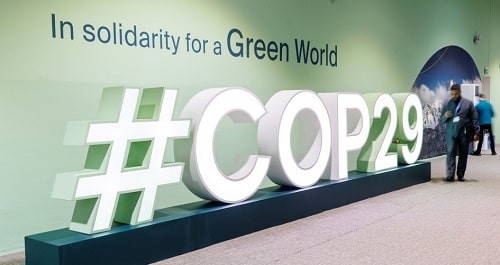 The COP29 climate summit in Baku, Azerbaijan has entered its final week with no agreement so far on financing the transition to net zero. Photograph: UN Climate Change/Kiara Worth
But after much political wrangling, the first week of negotiations ended with no agreement on a new collective quantified goal (NCQG) on financial support for developing countries beyond 2025.
As the talks entered their second and final week on 18 November, UN climate change executive secretary Simon Stiell urged decision-makers to “cut the theatrics and get down to the real business” of reaching a global financial agreement.
“I’ve been very blunt: climate finance is not charity; it is 100 per cent in every nation’s interest, to protect their economies and people from rampant climate impacts,” said Stiell. “Parties must wrap up less contentious issues early in the week, so there is enough time for the major political decisions.”
He urged government ministers who have just arrived in the Azerbaijani capital to “roll up their sleeves” and focus on tackling the most difficult issues, rather than becoming embroiled in “negotiating silos”.
“To put it another way, we can’t lose sight of the forest because we’re tussling over individual trees,” said Stiell. “We also cannot afford any outbreak of ‘you-first-ism’, where parties dig in and refuse to move on one issue until others move elsewhere. This is a recipe for going literally nowhere and could see global climate efforts go backwards at a time when we simply must move forward.”
Alongside the COP29 talks in Baku, leaders of the world’s 20 biggest economies are meeting in Rio de Janeiro for a G20 summit. In a statement released late on 18 November, G20 leaders said they “look forward to a successful NCQG outcome in Baku” and noted the “need for rapidly and substantially scaling up climate finance from billions to trillions from all sources”.
About half of the $1 trillion-a-year goal is expected to come from the private sector. In a joint letter to the G20 leaders meeting in Brazil, the We Mean Business Coalition – a non-profit organisation that works with businesses to accelerate the transition to a net-zero economy – said that businesses were playing their part, and expressed concern about the “lack of progress” on a climate finance agreement at COP29.
“Major international businesses are concerned about the lack of progress and focus in Baku,” said the letter. “Thousands of companies – representing 39 per cent of the global economy by market capitalisation – have already committed to reducing their emissions through targets aligned with climate science and are investing in clean energy technologies.
“G20 leaders can galvanise the negotiations at COP29 by recognising the urgency of the climate crisis, defining a clear and unequivocal direction towards a phase-out of unabated fossil fuels and accelerated growth of clean energy, and committing to climate finance for developing countries that will unlock multiples of private investment.”
Earlier this month, the European Union’s Copernicus Climate Change Service said it is “virtually certain” that 2024 will be the warmest year on record and the first year where the average global temperature was more than 1.5C above pre-industrial levels.
“This marks a new milestone in global temperature records and should serve as a catalyst to raise ambition for the upcoming COP29 conference,” said Samantha Burgess, deputy director of the Copernicus Climate Change Service.

NEWS
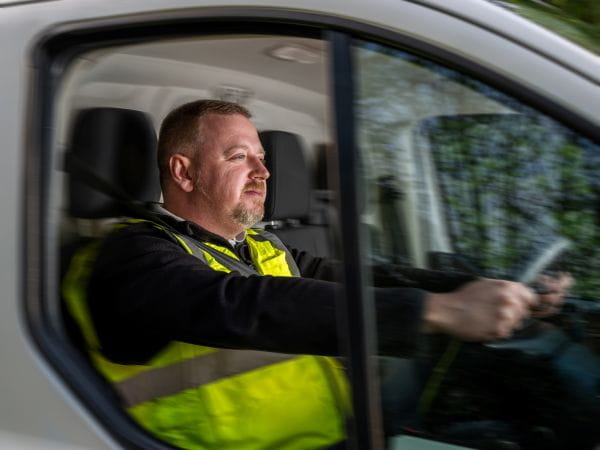
Scheme to recognise commitment to transport staff wellbeing launched by Road Haulage Association
By Orchie Bandyopadhyay on 01 October 2026
A new Wellbeing Recognition Scheme designed to allow organisations across the HGV, coach and van sectors to demonstrate their commitment to improving the health, wellbeing and resilience of the industry’s workforce has been launched by the Road Haulage Association (RHA).
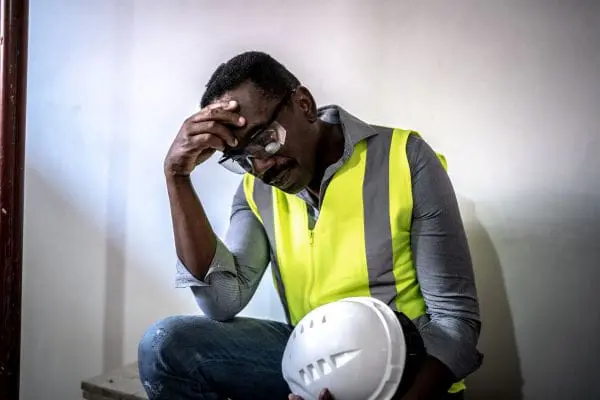
Cost-of-living pressure is cutting into UK workers’ productivity, says report
By Orchie Bandyopadhyay on 04 October 2026
The cost of living is the single largest financial stressor for 62% of UK workers, far outweighing concerns about retirement savings (12%) and building emergency funds (8%), a new study has revealed. Sixty-two per cent of workers admit they do not fully understand the workplace retirement plan they pay into each month, according to TELUS Health’s Q2 2026 TELUS Mental Health Index.

Employers must meet staff to discuss flexible working requests, says first secretary of state
By Orchie Bandyopadhyay on 01 October 2026
Bosses must meet with employees who request flexible working and explain their reasons for any refusals, said Louise Haigh, first secretary of state, in a speech to the Trades Union Congress (TUC) in Brighton on 15 September.