
The idea that ‘local knows best’ is a deeply rooted one. The UK’s national institutions such as the Home Office, even the monarchy or Church of England, are relative latecomers when compared to local structures like shires that originated with our Saxon or Roman heritage.
Opinion
Making common between the local and national
By
on 24 November 2020
When in government, Michael Heseltine frequently repeated that the only time a meeting he attended was about ‘a place’ rather than ‘a service’ such as ‘health or housing’ was when the riots occurred in Liverpool in 1981. The evolution from local to national has been two-thousand years in the making. From places to one place. The state; centred on London.
We are seeing once again something of this age-old struggle during the pandemic. Local lockdowns versus a national one. Whitehall versus local authorities. Who is ultimately responsible for controlling the pandemic, who is accountable, at what level is power most effective? Is the national interest best served by national or local government? For many people, it’s a case of holding up their hands and yelling: just tell us who is in charge?
Our members tell us they are caught in the crosshairs of this political and power divide. The policy on masks, for example, is putting far too many retail workers in an impossible position. They tell us that their biggest concern is the health implications of having to serve or deal with customers not wearing masks.
 Mike Robinson: "Giving people responsibility but lack of authority is a guarantee of anxiety."
Members tell us that this lack of compliance is not backed up by enforcement. Government say they are leaving it to local authorities, local authorities tell government they don’t have the capacity and tell businesses to act. For workers, this injunction to police the public, comes to little as their fears of catching the virus vie with fears of standing up to customers. The police dip their toes but quickly retreat. The HSE is ignored.
As we know from good safety and health cultures, giving people responsibility but lack of authority is a guarantee of anxiety and desperate measures, of individuals with little or no discretion about how to do a particular task.
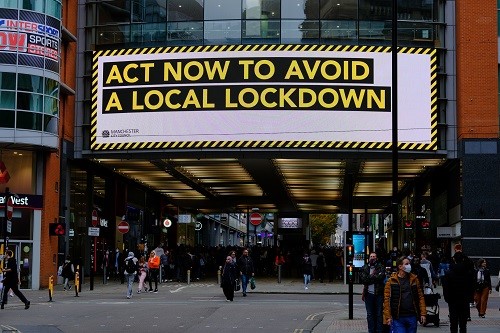 Market Street, Manchester on 17 October. Signage puts the agency on people to avoid a second lockdown
Whitehall can say they are taking a localised approach yet without the resources or capacity, local authorities are unable to discharge those duties. When they fail – as they inevitably will – they will be to blame and ministers escape accountability. Alternatively, ministers are constantly being told to take into account regional factors and when they do, people still complain they are shirking their responsibilities.
Yet there is no doubt that that some central planning is crucial for consistent and effective action. The national lockdown did work to reduce the R factor to below one. Recent evidence from Imperial College London that compared mortality across countries found that those that locked down quickly and strongly prevented more deaths than those that did not.
The analysis, published in Nature Medicine, reveals that countries that fared well also had effective and robust community-based test and trace programmes in operation throughout the first wave. These national actions powerfully built common purpose and drove common action.
It cannot continue like this for ever, of course. The country needs to function and there will always be local factors even within the same city.
The approach to getting on top of the pandemic has to be based on involvement and transparency: where local and national actors come together in a common quest to both contain the virus and allow people to live and work. It cannot be local versus the national, as much as we know it cannot be the economy versus health. One simply does not make sense without the other.
Mike Robinson FCA is Chief executive of the British Safety Council
OPINION
Building a future worth working in
By Mike Robinson FCA, British Safety Council CEO on 12 October 2026
It’s easy to become myopic about the future of work. Take a quick look at the world today and the signs can seem discouraging: political instability, economic volatility, the accelerating disruption posed by AI and climate change. Together, these factors paint a picture of uncertainty that can make our belief in progress seem naïve and tempt us into believing that the future can be no better than the past, that our best days are now behind us. That would be a profound failure of imagination.
Rethinking homes as centres of economic activity (amongst other things)
By Andy Lake, Flexibility.co.uk on 08 October 2026
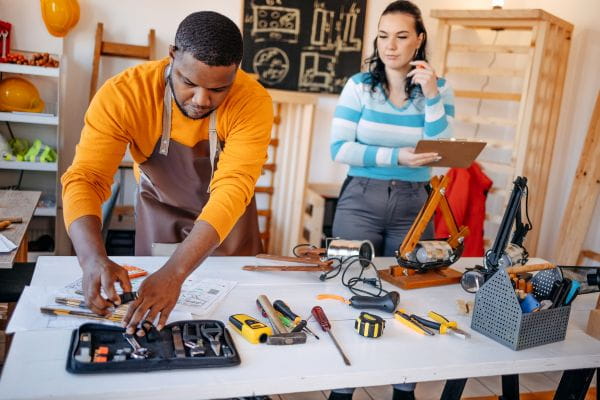
The decentralisation of work away from fixed workplaces, the rise of AI and demographic changes are creating new opportunities for people to carry out ‘hands-on’ work in the home, such as production of fashion, textiles, food and drink, and delivery of health services and therapies. However, our existing housing stock is not designed to accommodate such functions, so it’s essential that future town planning creates homes that support different kinds of enterprise, both to support business success and the wellbeing of these new home-based workers.
Learning that saves lives
By Mike Robinson, chief executive, British Safety Council on 11 September 2026
Success can sometimes be a problem. The better we become at preventing incidents, the harder it can be to see what is actually preventing them.