

It’s curtain up on the Employment Rights Act, the Government’s new blueprint for good work and the biggest reform of workers’ rights in a generation. Who better to steer us through the changes and what they mean for workplaces than British Safety Council’s head of HR, Menaka Gamage?
Features
From policy to practice: Delivering ‘good work’ under the Employment Rights Act
By
on 06 May 2026
“There are a lot of changes to UK employment law coming through in a relatively short space of time,” says Menaka. “And it’s not just about updating one policy in isolation.
You must look at how everything connects – contracts, processes and how they align with the organisation’s culture, values and behaviours.”
Less of a tweak and more of a whole system reboot (and we know how painful they can be!) the Employment Rights (ER) Act represents a significant change from the status quo.
From new safeguards against exploitative zero-hours contracts to enhanced family and carers’ leave, the legislation aims to stitch a more secure safety net into the fabric of the UK labour market.
For many, this is a welcome evolution. Supporters say it will reduce inequality, boost wellbeing, and improve long-term retention.
 More than 18 million employees – around 60 per cent of UK workers – stand to benefit from the upgrade to rights. Photograph: iStock
However, theory and practice are not the same thing. As businesses grapple with changes, not just as lines to be entered into employee handbooks but as culture shifts, we must ask what’s required to make the Act work in terms of meaningful actions.
There are also possible unintended consequences. Will the Act be a friend or foe to businesses and the people it employs?
We speak to our head of HR, Menaka Gamage, to navigate this new landscape and find out how British Safety Council is approaching the challenges.
A staggered rollout
The Employment Rights Bill became an Act of Parliament on 18 December. A staggered rollout with various reforms (see table) is coming onstream in waves across 2026 and 2027.
More than 18 million employees – around 60 per cent of UK workers – stand to benefit from the provisions according to government analysis.
The Act in practice
The ER Act might now be published in document form, but for it to have any real impact, it needs to live beyond the page.
“Policies on their own don’t drive change. It’s about how those policies are understood, how managers apply them, the language people use, and the behaviours that sit behind them,” Menaka explains. “It’s very much a collective effort – it’s not just HR or leadership; it’s the whole organisation.”
 Menaka Gamage: "It’s about getting the right balance between business priorities and people outcomes, rather than seeing them as competing agendas."
Managers are key to ensuring new rights are applied fairly and properly. “It’s been less about ‘have we delivered training for managers’ and more about ‘how do we know [that training is] landing and being applied consistently’”, says Menaka.
It’s led to discussions about how they might do this “whether through ongoing HR support, visibility of how cases are being managed, or using tools like pulse surveys to get a quick sense of how colleagues are experiencing the changes,” she adds.
Communication
Making sure the ER Act’s changes are rolled out and experienced properly, also means empowering employees by informing them of the changes that will affect them (positively!)
Workshops for employees alongside policy updates, will focus on what the changes mean in practice.
It’s about tailoring the approach: “For employees, the focus is on awareness, clarity, and reassurance. For managers, we provide more in-depth support through workshops and training sessions, looking at how to apply the policies in real scenarios, how to have conversations,” she says.
Culture eats strategy for breakfast?
These address some of the practical challenges involved, but as we have said, the ER Act is less a few tweaks and more a foundational pivot.
Whereas good employers may already be meeting (or indeed exceeding) the new provisions, the ER Act now codifies an agreed workplace ethos for all.
In short, it requires all UK companies to step up to the plate.
Menaka says that at British Safety Council, it helps that there is leadership buy-in to the ER Act, which is important in establishing a culture on which changes can take root.
“We’re fortunate in that our leadership team, and our CEO in particular, is very engaged and supportive,” she explains. “There is a strong emphasis on getting the right balance between business priorities and people outcomes, rather than seeing them as competing agendas.”
“We’re also lucky to have a strong, psychologically safe and open culture, which has been part of the organisation for a long time,” she adds.
“There are multiple forums where colleagues can speak up, and people feel comfortable raising concerns or sharing experiences, or constructively challenging our leadership too. Courage is one of our values – our history is shaped by it from our founder James Tye – and we continue that legacy of courage.”
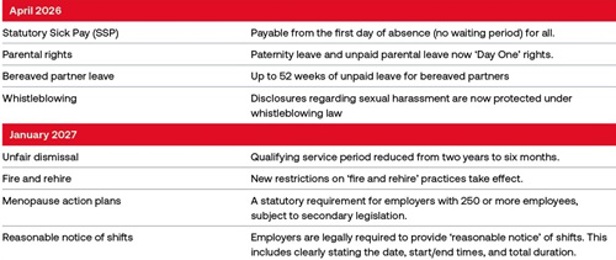
Table of employment rights - what's happening and when
A journey, not a destination
It’s perhaps helpful to see the ER Act less as a burden to comply with, and more as an evolution of an organisation’s culture journey.
Take the menopause. From April this year, organisations are being encouraged to draft Menopause Action Plans ahead of 2027, when plans will become mandatory for large employers.
Across the UK and at British Safety Council, work has already begun to bust taboos around the menopause and to communicate what support is available.
“Our leaders are open about their own experiences and challenges, which helps normalise conversations that might otherwise feel difficult,” says Menaka. “We have recently run menopause awareness sessions where colleagues, both male and female, engaged openly in discussion.”
Data collection and analysis can also help reveal where there’s work to be done. “For me, the starting point is always understanding where you are as an organisation. That’s where a more data-driven approach becomes really important. That then allows you to carry out a more meaningful risk assessment,” she explains.
For companies struggling to bridge the gap between policy and practice, the British Safety Council offers workshops, training and consultancy in culture change. “Organisations may want to tap into this support in response to these changes,” suggests Menaka.
Cost/benefit
We’ve explored how British Safety Council is managing the challenge, but what do we think about the ER Act’s broader purpose?
Will the pain – i.e. the time and cost of implementing it – be offset by the benefits in retention, wellbeing and psychosocial safety?
According to the government’s economic impact assessment, reforms will be net positive for the economy, largely by addressing the £6.5 billion lost annually to workplace-related stress and anxiety.
Changes like enhanced protections for new fathers, more predictability for zero hours workers (notice of shifts) and bereavement leave will reduce stress.
TUC further estimates that by making work more attractive and secure (especially for those with caring responsibilities), the Act could boost labour market participation by £1.3bn to £4bn.
 Reforms like rights for new fathers, will, say government be net positive for the economy, addressing the £6.5 billion lost annually to workplace-related stress and anxiety. Photograph: iStock
Problems and unintended consequences
However, there may be problems. The CIPD has published a report looking at scenarios of how the Act might play out in practice.
The (unintended) consequences of the Employment Rights Bill report found a potential shift to more temporary forms of employment, particularly in transport and storage and the arts and entertainment sectors.
Menaka agrees this is a concern: “I’ve heard reports that some companies are shifting towards hiring more fixed-term contractors, due to the change in employment rights coming in earlier [see ‘unfair dismissal’ rights in table]. This is a potential emerging trend we need to keep an eye on.”
Menaka also wonders if the Act does more to strengthen protections for those already in work, with less focus on how to create opportunities for those trying to enter the workforce.
“There is a risk that, without additional support or incentives, organisations may simply hire less or look elsewhere to manage the oncost, which could have longer-term implications for the UK labour market, which we are already witnessing,” says Menaka.
Indeed, CIPD flagged that “some employers will become more reluctant to hire workers who are perceived to need more support, such as young workers or those with health conditions, as a result of the ER Act measures.”
Final thoughts
So, in conclusion, is the Act a Friend or Foe?
We’ve taken a long time to get to this point. Matthew Taylor’s Good Work Review is nearly ten years old and it was here that ideas around flexibility, security, and rewarding work – even for those in non-traditional or gig-based roles – were developed seriously into recommendations for government.
Now they are being applied, and it’s a real opportunity to crack perennial issues like retention, engagement and stress.
It nonetheless represents a substantial effort, and requires skill to get the changes right – not just as policies but as practical changes to working life.
“There’s a significant implementation effort, particularly for HR teams. For smaller organisations with limited resources, this can be quite intensive,” cautions Menaka.
If changes are implemented well, however, then there’s no reason not to be optimistic.
“From a people perspective, enhanced support around areas like parental leave and menopause can contribute to a more inclusive and supportive working environment, which in turn can improve engagement, wellbeing, and retention.
“There is definitely a case that, over time, some of the initial investment could be offset by those longer-term gains.”

FEATURES

Who is the wolf in your life? Listening to the people behind the hard hat
By Inna Cebotari, Kinth Square on 02 October 2026
A new play explores the lives of migrant construction workers in the UK, using humour, real-life experiences and physical theatre to capture the banter, friendships and absurd moments that make life on site bearable, alongside the pressures that often go unseen. Ahead of the play’s premiere in London on 12-14 November, playwright Inna Cebotari explains how Three Little Pigs aims to add to the public debate about how best to support the wellbeing of construction workers.

Eliminating barriers in reporting: how conversational AI can unlock safety engagement
By Julian Taylor, ecoPortal on 04 October 2026
Online reporting systems that require lengthy and cumbersome form filling and typing can discourage workers from reporting safety incidents and concerns. However, AI-powered mobile apps that allow reporting simply by speaking can simplify and speed up the process, boosting reporting rates and overall staff engagement with safety systems and culture.

Why UK employers need to rethink recruitment, retention and support for older workers
By Orchie Bandyopadhyay on 04 October 2026
With workers over the age of 50 now comprising almost one third of the entire UK workforce, recruiting and retaining older workers is now core to the success of the economy. However, not all employers are offering what’s needed to retain and recruit older workers, and ageist attitudes, limited flexible working opportunities, and employment support that doesn’t fit with health, caring, or other responsibilities are leaving too many people locked out of the labour market.