

HSE’s annual work-related fatalities statistics for Great Britain today reveal that 126 workers lost their lives in work-related incidents in 2025/26.
News
Britain records lowest ever annual worker fatalities, HSE statistics show
By
on 01 July 2026
This toll is provisionally the lowest number recorded in a single year, notes the regulator, comparing to 217 fatalities twenty years ago (2005/06) and 495 in 1981.
Falls from height remain the most common cause of fatal injuries, accounting for 31 deaths – around a quarter of the total worker fatalities in 2025/26. Notably, workers aged 60 and over accounted for nearly a third of all fatalities (40 deaths), despite making up just 12 per cent of the workforce.
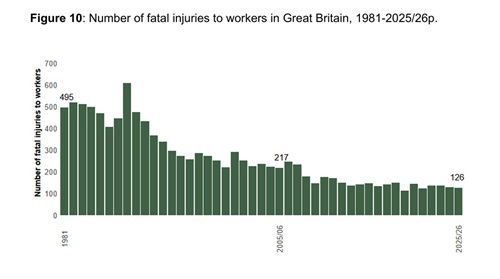 Apart from the years affected by the coronavirus pandemic, the number of worker deaths in 2025/26 is the lowest number recorded in a single year. Graph: HSE
Commenting, HSE's Chief Executive Sarah Albon said: “Every one of these numbers represents a loved one lost; serving as a powerful reminder of the importance of the work we do.”
“We can be proud that Great Britain remains one of the safest places in the world to work. The new analysis we have developed this year, for the first time, allows us to compare our safety record with a wide range of other advanced economies.”
The new HSE analysis compares for the first time the level and trend of fatal worker injuries in Britain against 35 other nations. The data confirms Britain’s standing as one of the safest countries in the world to work.
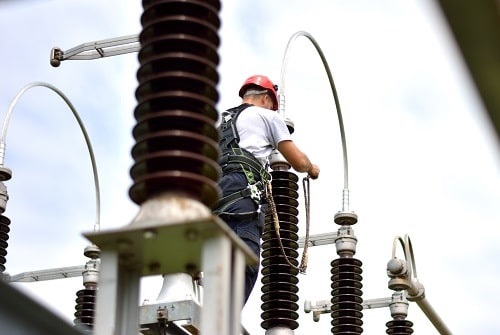 Falls from height remain the most common cause of fatal injuries, accounting for around a quarter of the total number killed at work. Photograph: iStock
However, HSE's report also highlights a contrasting trend: 104 members of the public were killed as a result of work-related incidents in 2025/26. This represents an increase of eight fatalities compared with the previous year’s total of 96.
The 104 incidents included 32 on railways (for which the Office of Rail and Road has enforcement responsibility) and 59 in other service sector industries (including 23 in Health and Social Work Activities). Of the 13 deaths to members of the public in non-service sector industries, seven were in agriculture, forestry and fishing, three in construction and three in waste and recycling.
Additionally, HSE published the annual figures for mesothelioma, a cancer caused by past exposure to asbestos. These show that 2,146 people died from the disease in Great Britain in 2024, representing a fall of 109 compared with 2023 and substantially lower than the average of 2,508 deaths per year over the ten-year period 2011-2020.
The statistics for 2025/26 are currently provisional and will be finalised in July 2027 to accommodate any necessary retrospective adjustments.
Work-related fatal injuries in Great Britain, 2026. Read the report here

NEWS
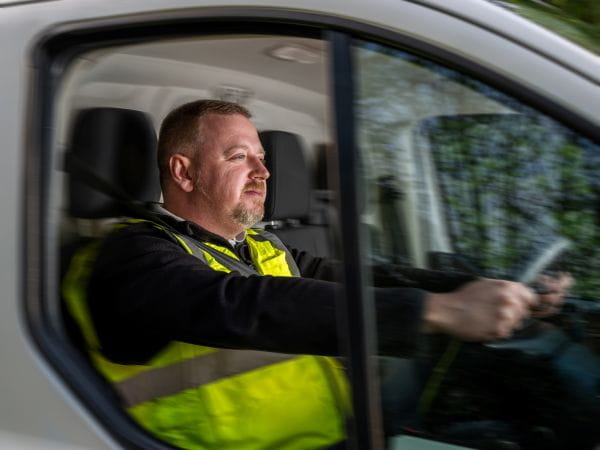
Scheme to recognise commitment to transport staff wellbeing launched by Road Haulage Association
By Orchie Bandyopadhyay on 01 October 2026
A new Wellbeing Recognition Scheme designed to allow organisations across the HGV, coach and van sectors to demonstrate their commitment to improving the health, wellbeing and resilience of the industry’s workforce has been launched by the Road Haulage Association (RHA).

Cost-of-living pressure is cutting into UK workers’ productivity, says report
By Orchie Bandyopadhyay on 04 October 2026
The cost of living is the single largest financial stressor for 62% of UK workers, far outweighing concerns about retirement savings (12%) and building emergency funds (8%), a new study has revealed. Sixty-two per cent of workers admit they do not fully understand the workplace retirement plan they pay into each month, according to TELUS Health’s Q2 2026 TELUS Mental Health Index.

Employers must meet staff to discuss flexible working requests, says first secretary of state
By Orchie Bandyopadhyay on 01 October 2026
Bosses must meet with employees who request flexible working and explain their reasons for any refusals, said Louise Haigh, first secretary of state, in a speech to the Trades Union Congress (TUC) in Brighton on 15 September.