

We need to fill evidence gaps in key and emerging areas of safety, a leading voice in engineering risk management and major hazard industries has said.
News
Lloyd’s Register Foundation’s Global Safety Evidence Centre celebrates with official launch
By
on 09 December 2025
Speaking at the official launch reception of the Lloyd’s Register Foundation’s Global Safety Evidence Centre last week in London, Martin Cottam said that the centre’s launch was timely – with boards increasingly wanting to fund evidence-backed projects.
Cottam, who chairs the Centre’s expert advisory panel, told the audience that the increasing interest and involvement of company boards in their organisational safety performance is a positive development.
“While this is welcome interest and can bring support and open the door to greater investment in safety, it can of course also imply greater scrutiny by boards who want to be convinced that proposed investments are well founded.”
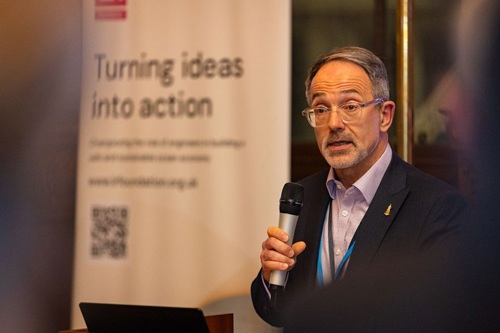 Martin Cottam at the launch of Lloyd’s Register Foundation’s Global Safety Evidence Centre last week in London. Photograph: Lloyd’s Register Foundation
Defending the basis on which a particular initiative or intervention has been selected, and what evidence there is for its effectiveness “can be very challenging questions” for a safety practitioner: “Often there’s little in the way of objective evidence to provide an answer to these questions,” he said giving the example of the widely adopted ISO 45001 standard.
Although applied by “hundreds and thousands of organisations around the world” he asked how much evidence is there that its application leads to better OHS performance. “Standing here today I can only point to three studies from the USA, Denmark and Italy,” he said. “These do provide some objective evidence on the topic. But this is just one example illustrating the evidence that we so often encounter in the field of safety today.”
The Lloyd’s Register Foundation Global Safety Evidence Centre is a £15 million initiative. It describes itself as a “hub” for anyone who needs to know ‘what works’ to make people safer in the face of a range of global safety challenges, including workplace accidents and injuries.
With a soft launch earlier this year, it has already awarded £500,000 in funding to four new projects looking at how data can improve safety.
Looking ahead to 2026, the Centre will be funding a project focused on protecting the psychological safety of disaster and first responders. The research is being carried out with the Society of Occupational Medicine to address the occupational health needs of first responders. It will also spearhead a project with the International Standards Organisation looking at safety leadership.
More information on Lloyd’s Register Foundation’s Global Safety Evidence Centre here
NEWS

British Safety Council calls on UK Government to ban silica-containing materials
By British Safety Council on 20 August 2026
British Safety Council has called on the UK Government to ban the import and export of high silica-containing products within the next five years to protect workers from the risks associated with high-concentration silica-containing materials.
Mates in Mind launches free suicide prevention training for construction workers
By Thomas Tevlin on 13 August 2026
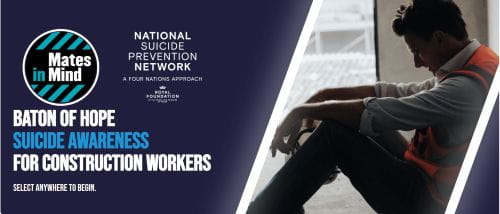
Mental health at work charity Mates in Mind has launched new digital training aimed at increasing awareness and reducing suicide amongst sole traders and self-employed construction workers to support World Suicide Prevention Day on 10 September.
Hidden Hazards. Recognise Risks. Protect Lives
By British Safety Council on 30 July 2026
British Safety Council launches new flagship campaign to shine a light on hidden hazards in the workplace.