

Confidence among UK businesses that the country can meet its net zero targets has fallen, despite improved clarity around policy direction, a new poll has shown.
News
Business confidence in government’s net zero target waning, finds BSI poll
By
on 19 August 2025
BSI’s survey of 1,000 business leaders found that a majority (71 per cent) believe that the government cannot grow the economy while simultaneously trying to reach net zero.
Half of respondents added that they felt the government’s target to reach net zero by 2050 is unrealistic.
However, the same businesses are eager to make the transition to cleaner energy – as long as they are given the support. Most firms (82 per cent) said there should be greater government support for businesses trying to reach net zero.
BSI’s director of sustainability and energy, Sebastiaan Van Dort, said: “Despite growing clarity on policy direction, this year’s Barometer reveals that UK business confidence in achieving net zero is weakening. While commitment remains strong in principle, the reality is that economic pressures and shifting priorities are slowing progress across the board.
“What is promising to see here is not a loss of belief in the need for climate action, but a call for more practical support. With over half of businesses expecting to revise their strategies or targets, it’s clear that many are adjusting their approach to balance ambition with what is feasible.”
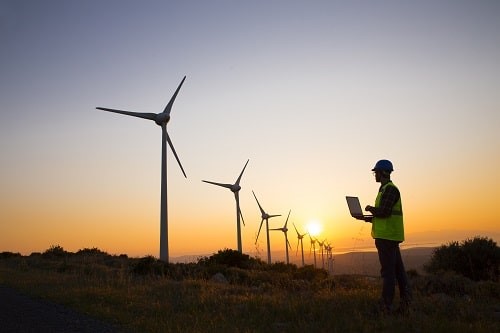 Removal of planning barriers in onshore wind was singled out as "positive progress in policy development" towards reaching net zero in the CCC's report. Photograph: iStock
While aviation emissions are up by 9 per cent year-on-year in the UK, driven by rising demand for international flights, there have been reductions in transport emissions in the UK, with electric cars on the road doubling roughly every two years.
Commenting on the findings from the Climate Change Committee’s (CCC)'s June report, Alex Sobel MP, Chair of the Net Zero APPG, said that the UK stands at a ‘critical crossroads.’
Writing for Politics Home, he said: “For years, there has been welcome cross-party recognition that net-zero is not just essential to tackling the climate crisis – it is also one of the most powerful tools we have to build a fairer, cleaner and more prosperous economy. That consensus must not be allowed to unravel.
“The reality is clear: net-zero is a catalyst, not a cost. According to recent CBI analysis, the UK’s net-zero economy supported nearly a million jobs last year and added more than £80bn to our national output.”
The government must respond to the CCC's recommendations, with the key one being to make electricity cheaper for consumers, arguing that lower bills are crucial for encouraging the adoption of clean technologies like electric vehicles and heat pumps.

NEWS

British Safety Council calls on UK Government to ban silica-containing materials
By British Safety Council on 20 August 2026
British Safety Council has called on the UK Government to ban the import and export of high silica-containing products within the next five years to protect workers from the risks associated with high-concentration silica-containing materials.

Mates in Mind launches free suicide prevention training for construction workers
By Thomas Tevlin on 13 August 2026
Mental health at work charity Mates in Mind has launched new digital training aimed at increasing awareness and reducing suicide amongst sole traders and self-employed construction workers to support World Suicide Prevention Day on 10 September.
Hidden Hazards. Recognise Risks. Protect Lives
By British Safety Council on 30 July 2026
British Safety Council launches new flagship campaign to shine a light on hidden hazards in the workplace.