

Most organisations recognise the importance of looking after their workers’ wellbeing but the lack of an agreed definition of what wellbeing is and how to measure it is holding back efforts to support employees in a rapidly changing world, a joint report by British Safety Council and the Institute of Occupational Medicine (IOM) has found.
News
Universal definition of wellbeing key to keeping workers safe and well in a changing world, new research finds
By
on 02 October 2024
The Being Well in a Changing World report, released on 2 October, calls for a shared approach to designing and measuring worker wellbeing, as part of a series of recommendations aimed at helping businesses ensure their employees are well-positioned to thrive in a world where rapid social, political and economic change has become the new normal.
 The report is based on research carried out by British Safety Council and the Institute of Occupational Medicine.
One of the most striking findings from the joint research project, which was conducted between June 2023 and September 2024 through a combination of surveys, academic reviews and in-depth interviews, was that there is no consistent definition of wellbeing, despite the fact that 70 per cent of employers said their organisational purpose is linked to the wellbeing of their workers.
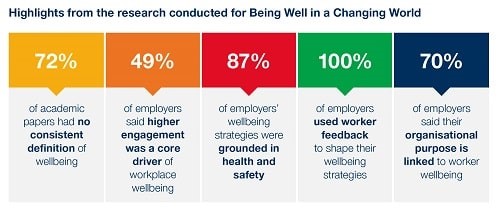 The research found that there is no consistent definition of wellbeing, despite most employers saying their organisational purpose is linked to worker wellbeing.
“Our Being Well in a Changing World research shows that, although employers want to do the right thing and support their workers’ wellbeing, there is still no agreed definition of what wellbeing is, how it should be measured, or indeed how organisations can measure their progress in improving it,” said British Safety Council chief executive Mike Robinson. “Without shared metrics, or ways that employers can learn from each other, workers risk being left behind, in a world where rapid change is the norm.”
The report also found that wellbeing priorities vary between different demographics, and that challenges related to rapid technological, environmental and social change will reshape the world of work, causing yet more uncertainty and anxiety going forward. More research is needed, therefore, to plug the gaps that exist between what is known about workplace wellbeing and how it can be better supported in practice, on a more universal basis.
“The research shows that effective wellbeing strategies require flexibility and responsiveness to the different challenges faced by workers,” said IOM chief executive Nathan Baker, adding that “employers who are able to adapt to external changes will be better positioned to support their employees’ wellbeing effectively, and will reap the benefits in increased productivity and profits”.
Taking these findings into account, the report makes five key recommendations. Alongside the call for a shared approach to defining and measuring wellbeing, it suggests that workplace wellbeing offerings are aligned with wider health and safety strategies, to reflect that happier and healthier workers are also safer workers. This already seems to have been recognised by businesses, with 87 per cent of those surveyed reporting that their wellbeing strategies are grounded in health and safety.
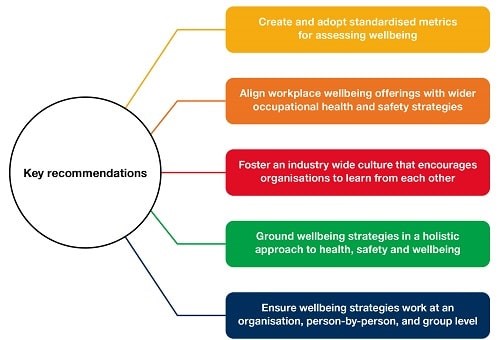 The report makes five key recommendations, aimed at helping businesses ensure their employees are well-positioned to thrive in a world where rapid social, political and economic change has become the new normal.
The report also calls for the development of an industry-wide culture, through which organisations can learn from one another, as well as a holistic approach to wellbeing that considers factors from both inside and outside the workplace.
Finally, the report recommends that workplace wellbeing strategies are designed to reflect the diverse nature of the workforce. They should combine organisation-level solutions with more targeted, individual solutions, as well as interventions for specific groups.
“By addressing the identified gaps and implementing the recommendations, employers can better support and enhance worker wellbeing to keep their employees well in a changing world,” the report concluded.
To read the report in full, go to:
NEWS
Scheme to recognise commitment to transport staff wellbeing launched by Road Haulage Association
By Orchie Bandyopadhyay on 01 October 2026
A new Wellbeing Recognition Scheme designed to allow organisations across the HGV, coach and van sectors to demonstrate their commitment to improving the health, wellbeing and resilience of the industry’s workforce has been launched by the Road Haulage Association (RHA).
Cost-of-living pressure is cutting into UK workers’ productivity, says report
By Orchie Bandyopadhyay on 04 October 2026
The cost of living is the single largest financial stressor for 62% of UK workers, far outweighing concerns about retirement savings (12%) and building emergency funds (8%), a new study has revealed. Sixty-two per cent of workers admit they do not fully understand the workplace retirement plan they pay into each month, according to TELUS Health’s Q2 2026 TELUS Mental Health Index.

Employers must meet staff to discuss flexible working requests, says first secretary of state
By Orchie Bandyopadhyay on 01 October 2026
Bosses must meet with employees who request flexible working and explain their reasons for any refusals, said Louise Haigh, first secretary of state, in a speech to the Trades Union Congress (TUC) in Brighton on 15 September.