

Although products made from recycled materials are often viewed as the most sustainable purchasing option, products made from virgin materials can often have a lower environmental impact if they are more durable and last longer.
Features
Why prioritising product longevity can boost an organisation’s sustainability performance
By
on 01 June 2023
The latest Love Sustainability insights report from Rubbermaid Commercial Products (RCP), Why Product Longevity is a Powerful First Step to Improving Commercial Sustainability, has found that low frequency sustainability, durability and reducing consumption are far more effective than an increase in so-called ‘green purchasing’ for both the planet and business’ budgets. So, what kind of challenges and blockers do businesses face when it comes to implementing practices to improve commercial sustainability?
 Photograph: Newell Brands
The power to make sustainable change
Working together, businesses have the power to make systemic, impactful change. However, a staggering 95 per cent of businesses¹ identify that there is much work still to be done, with the key areas for investment into sustainability² being waste management (81 per cent), recycling (60 per cent), sustainable materials (60 per cent) and energy efficiency (58 per cent).
So, how should businesses prioritise? How can they ensure that they are making the right sustainable choices by investing in genuinely sustainable practices without falling into the trap of ‘greenwashing’?
Low frequency sustainability
For a vast majority of businesses, when considering what makes a product sustainable, those made from recycled materials are often the first port of call. However, if your ultimate goal is to keep waste out of the chain rather than add to it, then opting for recycled products may not always be the most sustainable choice. When it comes to ‘sustainable products’, other considerations such as durability and the adage of ‘buy better, waste less’ should come into play.
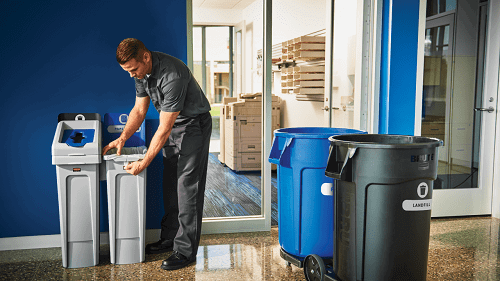
When looking at purchases, it’s important to understand if the majority of a product’s global warming potential is created during production. If we take the example of a recycling container, 96 per cent of the global warming potential is during production³. The longer the life of a product, the less global warming potential it has as long life eliminates production cycles where the majority of the warming potential is created.
Durability is better for the bottom line
Another challenge for many comes when factoring in the needs and aims of the business, its shareholders and its customers – ensuring both sustainability and commerciality are prioritised. Due to the current economic situation, as operational costs squeeze budgets, this focus on commerciality has only increased in recent times. In fact, 80 per cent of businesses agree that rising costs and inflation⁴ are the most significant challenges they face in the coming years.
For 60 per cent of businesses the perceived investment and increase in ongoing costs for more sustainable practices is cited as a barrier to implementation. However, in a positive shift in perception, 74 per cent disagreed that more sustainable products cost more⁵. This shift in mindset could see businesses reduce their environmental and business costs of remanufacture, operational downtime, and the transport of materials.
Reducing consumption beats ‘green’ buying
Further, businesses need to understand that reducing consumption over ‘green’ purchasing will result not only in significant sustainability gains but financial ones too. Extending the lifecycle of passive products (products that do not require energy usage, or supplementary materials during their life cycle – for example, the bins in a business facility), reduces environmental impact by up to 72 per cent and reduces commercial cost by up to a third⁶.
Let’s take an example. You’re going to replace the waste containers in your facility. Your choice is to opt for a brand new, freshly manufactured container or go for one made from recycled material. You might assume that a container made from recycled material is the more sustainable option. However, when we make our purchasing decisions we need to take into consideration where that recycled material has come from, the ecological cost of its remanufacturing and its durability.
Often, recycled materials suffer degradation over time⁷ and need remanufacturing sooner. Once you recycle plastic, it has to be recycled more often as the resulting products often don’t last as long. This starts an endless cycle of increasing resource use. So, considering the product longevity and material origins of each container, opting for a brand-new waste container that is built to last is actually the more sustainable choice here.
We know that 95 per cent of decision makers⁸ want to do more on sustainability but face various blockers to implementation. Supporting businesses in turning sustainability ideas into action, the new report helps to identify and overcome future challenges to implementation and provides data-driven recommendations to combat ‘green confusion’, reassess purchasing decisions and ultimately improve operational and systemic sustainability.
This latest report follows on from the Love Sustainability Journey, a roadmap to support businesses to make incremental sustainability gains against a backdrop of commercial considerations and challenges.
Emilio Capelli is VP sales and marketing international at Newell Brands.
For more information on the Love Sustainability Journey or to download the Why Product Longevity is a Powerful First Step to Improving Commercial Sustainability report, go to:
rubbermaid.eu/en/sustainability-journey/
References
- RCP Research – Question 8
- RCP Research – Question 10
- Global Warming Potential from Production (section 4.2.2)
- RCP Research – Question 6
- RCP Research – Question 25
- The Benefits of Extending Passive Products Lifespans
- Material Degradation in Recycling Processes (section 3.1)
- RCP Research – Question 8
FEATURES

Who is the wolf in your life? Listening to the people behind the hard hat
By Inna Cebotari, Kinth Square on 02 October 2026
A new play explores the lives of migrant construction workers in the UK, using humour, real-life experiences and physical theatre to capture the banter, friendships and absurd moments that make life on site bearable, alongside the pressures that often go unseen. Ahead of the play’s premiere in London on 12-14 November, playwright Inna Cebotari explains how Three Little Pigs aims to add to the public debate about how best to support the wellbeing of construction workers.

Eliminating barriers in reporting: how conversational AI can unlock safety engagement
By Julian Taylor, ecoPortal on 04 October 2026
Online reporting systems that require lengthy and cumbersome form filling and typing can discourage workers from reporting safety incidents and concerns. However, AI-powered mobile apps that allow reporting simply by speaking can simplify and speed up the process, boosting reporting rates and overall staff engagement with safety systems and culture.

Why UK employers need to rethink recruitment, retention and support for older workers
By Orchie Bandyopadhyay on 04 October 2026
With workers over the age of 50 now comprising almost one third of the entire UK workforce, recruiting and retaining older workers is now core to the success of the economy. However, not all employers are offering what’s needed to retain and recruit older workers, and ageist attitudes, limited flexible working opportunities, and employment support that doesn’t fit with health, caring, or other responsibilities are leaving too many people locked out of the labour market.