

Research shows that just one in four outdoor workers in the UK wear sun cream to protect themselves from UV radiation, so it’s vital employers do more to warn workers about the health risks from sun exposure.
Features
Here comes the sun
By
on 16 August 2021
Skin cancer is the most common type of cancer in the UK, according to the British Skin Foundation, and Britain sees 1,700 people diagnosed every year as a direct cause of occupational sun exposure, according to IOSH’s No Time to Lose occupational cancer campaign.
Despite growing awareness of the health risks from unprotected exposure to ultraviolet (UV) radiation from the sun, a study conducted by SC Johnson Professional found that 76 per cent of UK health and safety professionals were unaware of the danger, stating that they did not know that one death and five new cases of skin cancer per week in Britain could be attributed to occupational UV exposure.
Especially during the summer months, it is key that awareness is raised around the potential dangers of over-exposure to UV radiation, among both employees and health and safety professionals. Building on studies conducted in 2017 and 2019 with outdoor workers, in 2020 industrial skin care company SC Johnson Professional surveyed health and safety officials at UK companies, with 114 participating.
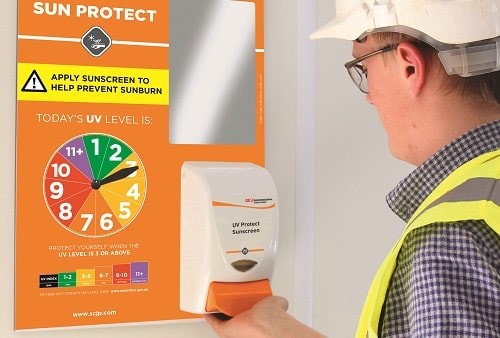 According to Health and Safety Executive (HSE) guidelines, UV radiation should be considered an occupational hazard for those who work outdoors. Photograph: SC Johnson Professional
The four-year research project is intended to understand the gaps in UV awareness among outdoor workers, discover what employers are doing on UV practice and protection, and identify the challenges they are facing in this area. It is also designed to provide recommendations on best practice for employers in providing protective skin creams to reduce UV exposure.
Among the key findings, one in three health and safety professionals stated that their organisation did not provide any UV protection to outdoor workers. Despite this leaving a third of the workforce vulnerable, outdoor workers themselves painted an even starker picture: two in three said their organisation did not provide UV protection to them in the 2019 survey.
This lack of provision may be due to the fact that 40 per cent of these safety professionals claimed that employees provided their own UV protection. This is despite the fact the Health and Safety at Work Act 1974 states that every employer has a legal duty to safeguard, as far as is reasonably practicable, the health of their employees. According to Health and Safety Executive (HSE) guidelines, UV radiation should be considered an occupational hazard for those who work outdoors.
Exploring this topic further, in their 2019 survey, SC Johnson Professional discovered that of those workers who did use sun cream at work, only 27 per cent were provided with product by their employer and 87 per cent stated that there was no UV protection product made available in their workplace. This suggests that employers need to provide more protection for their outdoor workforce when it comes to UV radiation.
Lack of awareness
When asked why they felt that a large proportion of employees did not use UV protection, 45 per cent of safety professionals said this could be due to a lack of awareness about the dangers of UV exposure. In 2019, 136 outdoor workers participated in SC Johnson Professional’s survey regarding their UV protection habits during that summer (one of the hottest on record).
The findings revealed that only one in four wore protective sun cream while at work, citing the effort involved as the main reason they did not use any. In contrast to this, 72 per cent of respondents claimed they would use protective sun cream while on holiday, but only 26 per cent would wear sun cream on cloudy days. The results highlight that, alongside the need to provide UV protection to staff, employers also need to raise awareness of the potential health risks from UV rays among employees who work outdoors.
Seeking to find out what was needed in terms of training, SC Johnson Professional found that safety professionals recognised the gap in knowledge among workers about UV risks, yet felt unequipped to address it. One in two organisations surveyed carried out no staff training on when and how to use UV protection – and just 37 per cent of safety professionals stated that they themselves have had the correct training to equip them to implement UV protection programmes at work.
Sixty-three per cent of respondents were either unsure or did not have enough information to enable them to carry out UV protection training programmes for their employees; in the utilities sector, for example, (with the highest proportion of employees who regularly worked outdoors), this number worryingly rose to 75 per cent.
Training emerged as a key finding from the 2020 survey. Of those safety professionals with a majority of employees working outdoors, one in three said they did not have enough information to brief workers on the dangers of UV exposure. Also, 41 per cent stated that they wanted clearer regulatory requirements to help them with this, and 43 per cent wanted better data and information on the risks posed by UV radiation in the UK.
Training resources
With the survey results in mind, how can outdoor workers be better protected against UV over-exposure? Easy-to-use training resources are crucial. Ideally, these should be specifically designed for employees who work outdoors and for safety professionals to implement as part of a full skincare training programme.
 One in two organisations surveyed carried out no staff training on when and how to use UV protection. Photograph: iStock
Training should include a range of resources. For instance, toolbox talks can help health and safety professionals to deliver quality, informative training, and real-life case studies can be used to bring home the reality of over-exposure to UV.
Training should also highlight the ‘5 S’ approach to sun safety, which can significantly contribute to the prevention of excessive UV exposure. This is to slip on clothing, slop on sunscreen with a Sun Protection Factor of 30 or above (SPF30), slap on a hat and neck protection, slide on some sunglasses that offer protection from solar UV radiation and shade from the sun when possible.
Alan Murray, chief executive officer at the British Safety Industry Federation, commented: “The research carried out by SC Johnson Professional clearly shows that more awareness and training is needed when it comes to UV protection at work here in the UK – both for health and safety professionals and people that work outside. Employers have a duty of care to provide UV protection to their workforce, and the best way to ensure this is implemented is via health and safety professionals.
“Along with skin care provision, other forms of protective clothing and methods of working, it is crucial that we provide good quality training and information to health and safety professionals, so they are fully equipped to train employees and to raise awareness more generally.”
At this time of year in particular, it is key that more awareness is raised around both the potential dangers of over-exposure to UV radiation, as well as the importance of educating workers. A painful sunburn just once every two years can triple the risk of the deadliest form of skin cancer, malignant melanoma, according to Cancer Research UK (bit.ly/3BaNQLA), so it is crucial that safety professionals are aware of these risks and are equipped to best protect their workforce from harm or injury in the workplace.
For free guidance and worker training materials on preventing harmful sun exposure at work, visit the SC Johnson Professional website: bit.ly/2TfyK6i
FEATURES

Who is the wolf in your life? Listening to the people behind the hard hat
By Inna Cebotari, Kinth Square on 02 October 2026
A new play explores the lives of migrant construction workers in the UK, using humour, real-life experiences and physical theatre to capture the banter, friendships and absurd moments that make life on site bearable, alongside the pressures that often go unseen. Ahead of the play’s premiere in London on 12-14 November, playwright Inna Cebotari explains how Three Little Pigs aims to add to the public debate about how best to support the wellbeing of construction workers.

Eliminating barriers in reporting: how conversational AI can unlock safety engagement
By Julian Taylor, ecoPortal on 04 October 2026
Online reporting systems that require lengthy and cumbersome form filling and typing can discourage workers from reporting safety incidents and concerns. However, AI-powered mobile apps that allow reporting simply by speaking can simplify and speed up the process, boosting reporting rates and overall staff engagement with safety systems and culture.

Why UK employers need to rethink recruitment, retention and support for older workers
By Orchie Bandyopadhyay on 04 October 2026
With workers over the age of 50 now comprising almost one third of the entire UK workforce, recruiting and retaining older workers is now core to the success of the economy. However, not all employers are offering what’s needed to retain and recruit older workers, and ageist attitudes, limited flexible working opportunities, and employment support that doesn’t fit with health, caring, or other responsibilities are leaving too many people locked out of the labour market.